
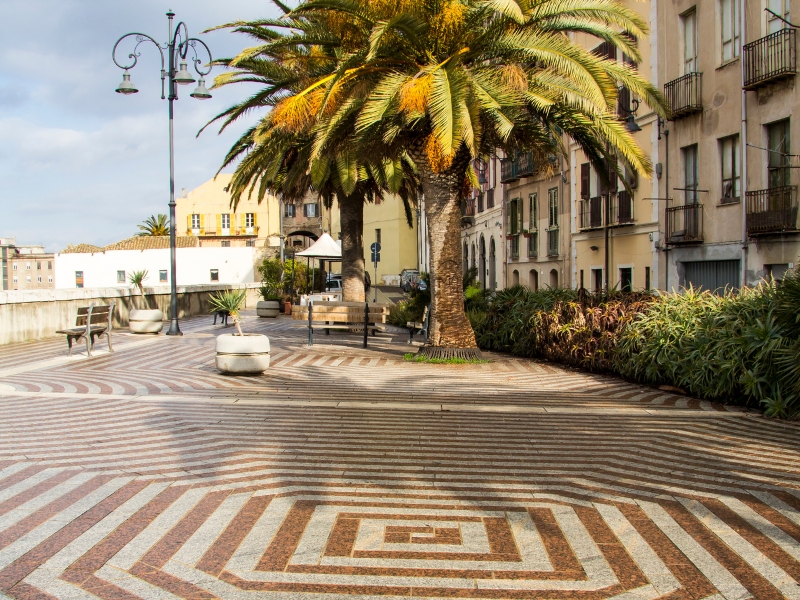
The Bastione di Santa Croce is a terrace on the western walls of the Castello, the fortified hilltop district of Cagliari. Built by the Spanish in the 16th century to defend this side of the citadel, it is now one of the city's favourite places to watch the sunset, with a view over the Stampace district to the Santa Gilla lagoon. It stands in what was once the Jewish quarter of Cagliari, next to a church that was the city's synagogue until 1492.
The Bastione di Santa Croce at a glance
- Where: on Via Santa Croce on the west side of the Castello district, a few minutes' walk from the cathedral.
- Built: begun in the early 16th century under the Spanish viceroy Joan Dusay, enlarged in 1530–1532 and modified again in the 1560s and 1570s.
- What it is today: a free public terrace with a bar, benches and a wide view, busy at sunset and on summer evenings.
- Time needed: 15 to 30 minutes, longer if you stay for the sunset.
From Spanish bastion to sunset terrace
Cagliari's Castello was the walled upper town, where for centuries the rulers, the nobility and the clergy lived. When the island belonged to the Crown of Aragon and then Spain, the walls were adapted to the age of cannon. In the early 1500s the viceroy Joan Dusay had this pentagonal bastion built to protect the western side. Between 1530 and 1532 it was raised to the level of the Santa Croce church and given rooms for barracks and stores, and in the 1560s and 1570s military engineers including Rocco Capellino and Giorgio Paleari reshaped it.
Under the House of Savoy, which ruled Sardinia from the 18th century, the buildings on the bastion became the barracks of the Dragoons, named after King Charles Emmanuel III, from 1738. In 1867 the city sold them to private owners, who turned them into modest homes. Today the bastion is an open terrace, and its name comes from the church of Santa Croce next door.
What to look for
- The view west over the roofs of Stampace and out to the Santa Gilla lagoon, best in the hour before sunset.
- The shape of the bastion itself, with its platforms on several levels following the old walls.
- The church of Santa Croce, a Baroque basilica that stands on the site of Cagliari's medieval synagogue.
- The narrow lanes of the former Jewish quarter around Via Santa Croce and the nearby exhibition centre known as Il Ghetto.
The Jewish quarter of the Castello
Before 1492 around seventy Jewish families lived in Cagliari, in a quarter of the Castello around Via Santa Croce granted to the community. Their synagogue stood where the church of Santa Croce is today. In 1492 the Spanish Crown, which ruled Sardinia, ordered the expulsion of Jews from all its territories, and the community disappeared from the island. The synagogue was turned into a church, and the name Ghetto degli Ebrei survives in the street names and in a building that now hosts exhibitions.
Tips for your visit
- Arrive about 45 minutes before sunset to find a spot on the wall; the terrace fills up quickly in summer.
- Bring a light jacket in spring and autumn: the bastion is exposed to the wind off the lagoon.
- The Castello is steep; take the public lifts from the lower town if you want to save your legs.
- Combine it with the Bastione di Saint Remy and the cathedral on the other side of the Castello.
Nearby
- Cagliari Cathedral: the cathedral of Santa Maria in the middle of the Castello, with its rich Baroque interior and crypt.
- Torre dell'Elefante: a 14th-century Pisan tower with a small stone elephant on its side, at the southern edge of the Castello.
- Bastione di Saint Remy: the grand 19th-century terrace and staircase on the eastern side, with views over the port.
- Stampace: the district below the bastion, with the church of Sant'Anna and lively streets.
See Cagliari with World City Trail
Our Cagliari scavenger hunt turns the city into a game you play on your phone. The route links 10 stops and takes around three hours, with about 45 minutes of walking. It includes places such as the Bastione di Saint Remy and Cagliari Cathedral.
If you prefer a different format, Cagliari also has a self-guided walking tour and an outdoor escape game.
Play the Cagliari scavenger hunt →
Take the self-guided walking tour of Cagliari →
Play the outdoor escape game in Cagliari →
Facts checked in October 2026.