
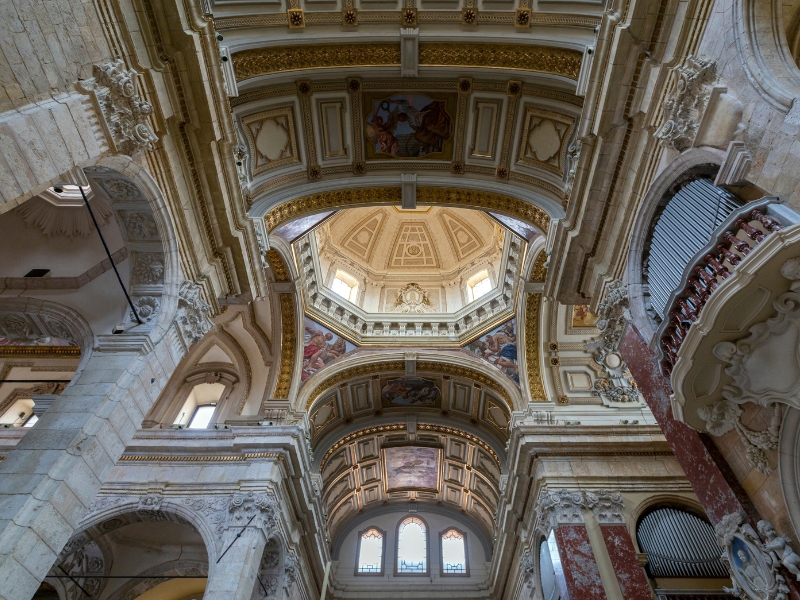
Cagliari Cathedral, the Cathedral of Santa Maria, stands on Piazza Palazzo at the top of Castello, the walled hilltop quarter of Cagliari. It was founded by the Pisans in the 13th century, and its most famous treasure came from Pisa too: a 12th-century marble pulpit carved for Pisa Cathedral and given to Cagliari in 1312. The Pisan-looking façade, however, is much younger than it seems: it was built in the 1930s.
Cagliari Cathedral at a glance
- Where: Piazza Palazzo in the Castello quarter, next to the Palazzo Regio, the former viceroys' palace.
- Built: 13th century by the Pisans; altered in Gothic and Baroque times; the current neo-Romanesque façade dates from the early 1930s.
- What it is today: the cathedral of the Archdiocese of Cagliari, dedicated to the Virgin Mary and St Cecilia, and a working church.
- Time needed: 30–45 minutes, plus the crypt; add time if you climb the bell tower.
From Pisan stronghold to Baroque cathedral
In the 13th century Pisa controlled Cagliari and built its fortified town, Castel di Castro, on the hill. The church is first mentioned in 1255, and it became the cathedral in 1258, after the Pisans destroyed the old capital of Santa Igia and its cathedral. In the 14th century, after the Aragonese conquest of Sardinia, a transept and side chapels turned the plan into a Latin cross. In 1618 Archbishop Francisco Desquivel had a crypt cut into the rock under the presbytery for the relics of martyrs found in the cemeteries around the Basilica of San Saturnino.
Between 1669 and the early 1700s the interior was remodelled in Baroque style, with a dome over the crossing, and the church received a Baroque marble façade. In the early 20th century that façade was taken down by restorers hoping to uncover a medieval Pisan front underneath. There was none. The church stood without a proper façade for years until the present neo-Romanesque one, inspired by Pisan models, was completed in the early 1930s.
What to look for
- The pulpit of Master Guglielmo: carved around 1160 for Pisa Cathedral and given to Cagliari in 1312. In 1669 it was split in two, and the halves now stand against the inside of the façade, either side of the main door. Its biblical scenes show figures in medieval clothes.
- The four marble lions: once the pulpit's supports, they now sit at the foot of the steps to the presbytery.
- The Sanctuary of the Martyrs: the crypt under the presbytery, with 179 niches holding relics and three Baroque chapels. Doors on either side of the presbytery lead down to it.
- The mausoleum of Martin I of Sicily: the Aragonese prince who died in Cagliari in 1409, remembered with a Baroque monument of 1676–1680 in coloured inlaid marble in the left transept.
- The two side portals: one Romanesque, one Gothic, a clear sign of the shift in styles during the 14th century.
- The bell tower: one of the few Pisan parts still standing, 13th century and about 36 metres high.
A façade that was never there
The story of the façade is a lesson in restoration. When the Baroque front came down, the hope was to reveal the original medieval face of the church. Instead the builders found almost nothing, and Cagliari was left for years with a bare wall at the end of its main square. The answer was to build a new medieval-style façade, modelled on Pisan churches. So what looks like the oldest part of the building is in fact one of the newest.
Tips for your visit
- It is a working church: dress respectfully, with shoulders and knees covered, and avoid visiting during Mass.
- Don't skip the crypt. It is easy to miss, but its carved niches and chapels are one of the highlights.
- The bell tower can sometimes be climbed (137 steps up a wooden staircase); check on the day, as access is not always possible and children under 10 are not allowed.
- Combine the cathedral with a walk around Castello: Piazza Palazzo, the Bastione di Saint Remy and the Pisan towers are all within a few minutes.
Nearby
- Palazzo Regio: the former residence of the Spanish and Savoy viceroys, right beside the cathedral on Piazza Palazzo.
- Bastione di Saint Remy: the monumental terrace on the old walls, with wide views over the lower town, the port and the sea, a short walk south.
- Torre dell'Elefante: the Pisan tower of 1307 guarding the southern gate of Castello, named after the small marble elephant on its side.
- Cittadella dei Musei: the museum complex at the northern end of Castello, home to the National Archaeological Museum and its nuraghic bronze figures.
See Cagliari with World City Trail
Our Cagliari scavenger hunt turns the old town into a game you play on your phone. The route links 10 stops and takes around 3 hours, with about 45 minutes of walking. The cathedral is one of the stops, along with the Bastione di Saint Remy.
If you prefer a different format, there is also a self-guided walking tour and an outdoor escape game in Cagliari.
Play the Cagliari scavenger hunt →
Take the self-guided walking tour of Cagliari →
Play the outdoor escape game in Cagliari →
Facts checked in October 2026.