
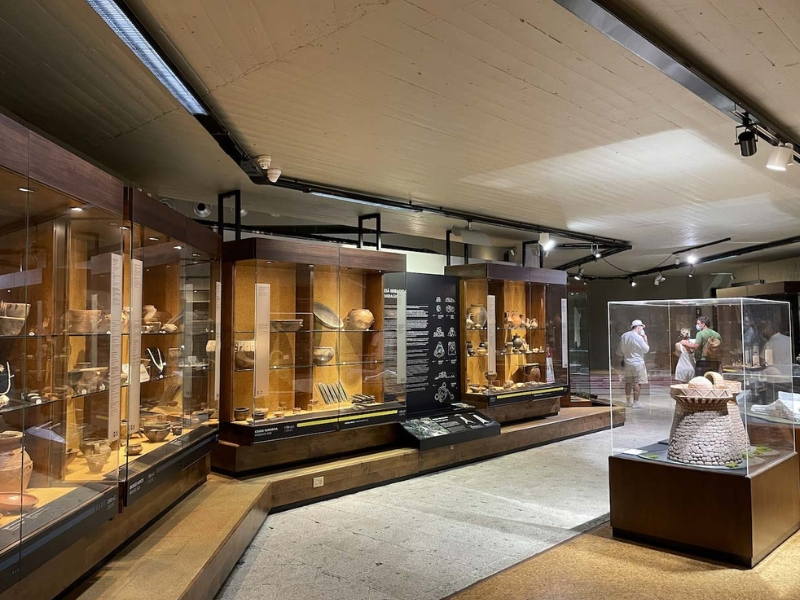
The National Archaeological Museum of Cagliari is the most important archaeological museum in Sardinia, housed in the Cittadella dei Musei at the top of the old Castello district. Its more than 4,000 objects cover about 7,000 years, from Neolithic mother goddess figures to Roman statues and Byzantine pieces. The highlight for most visitors is the Nuragic world: small bronze figures of warriors and chieftains, and the giant stone statues of Mont'e Prama.
The museum at a glance
- Where: Piazza Arsenale, in the Cittadella dei Musei, just inside the Torre di San Pancrazio at the top of Castello.
- Opened: the collection goes back to 1800; it opened as the Royal Archaeological Museum in 1904 and moved to its present building in 1993.
- What it is today: a state museum with a chronological route on the ground floor, site-by-site rooms upstairs and space for special exhibitions on the top floor.
- Time needed: 1.5 to 2 hours for a good visit.
From a viceroy's cabinet to the Museum Citadel
The museum began in 1800, when the viceroy Carlo Felice, later King of Sardinia, set aside a room in the Viceregal Palace for a small collection of antiquities and natural history, displayed in the manner of a cabinet of curiosities. The collection grew with finds from across the island, and in 1904 it opened as the Royal Archaeological Museum in the former mint on Piazza Indipendenza, in a building designed by Dionigi Scano.
In 1993 it moved to the Cittadella dei Musei, a museum complex created between 1956 and 1979 by restoring the old royal arsenal and the medieval walls on the northern tip of Castello. The citadel also houses other city and university collections, which makes Piazza Arsenale a natural starting point for a museum morning. In 2019 the museum became part of an autonomous state institute for the archaeology of Cagliari.
What to look for
- The Nuragic bronzes: small cast figures of warriors, archers, chieftains, mothers and animals, made by the people who built Sardinia's stone towers, the nuraghi.
- The statues of Mont'e Prama: large stone figures of warriors and archers found by chance by a farmer in 1974 and reassembled from thousands of fragments; part of the group has been shown here, while others are in Cabras, so check what is on display.
- The Neolithic mother goddess figures, some of the oldest objects in the museum.
- Phoenician and Punic jewellery from the cemeteries around Cagliari, a reminder that the city began as a Phoenician port.
- The rooms on Cagliari itself: finds from Tuvixeddu, Santa Gilla and Monte Claro, the places where the city's long history began.
Who were the Nuragic people?
From the Bronze Age, Sardinia was home to a culture named after its nuraghi, the stone towers that still dot the island in their thousands. They left no written records, so most of what we know comes from their buildings and from objects like the bronzes in this museum. The figures show warriors with horned helmets, shields and bows, as well as offerings and everyday life, and they are one of the best ways to picture the people who lived on the island long before the Phoenicians and Romans arrived.
Tips for your visit
- Start on the ground floor for the chronological overview, then go upstairs for the site-by-site rooms.
- Take your time with the bronzes: they are small, and the detail is easy to miss in a quick walk past the cases.
- The museum is fully accessible to visitors with reduced mobility, but there is no café inside, so plan a break in Castello.
- Come in the morning in summer, before the climb up to Castello gets too hot.
Nearby
- Torre di San Pancrazio: the Pisan tower of 1305 right next to Piazza Arsenale, one of the old gates of Castello.
- Cagliari Cathedral: the cathedral of Santa Maria on Piazza Palazzo, a few minutes' walk south through Castello.
- Bastione di Saint Remy: the grand terrace with views over the city and the sea, at the southern edge of Castello.
- Pinacoteca Nazionale: the city's picture gallery, in the same Cittadella dei Musei.
See Cagliari with World City Trail
Our Cagliari scavenger hunt turns the old town into a game you play on your phone. The route links 10 stops and takes around three hours, with about 45 minutes of walking. It includes places such as the Bastione di Saint Remy and Cagliari Cathedral.
If you prefer a different format, Cagliari also has a self-guided walking tour and an outdoor escape game.
Play the Cagliari scavenger hunt →
Take the self-guided walking tour of Cagliari →
Play the outdoor escape game in Cagliari →
Facts checked in October 2026.