
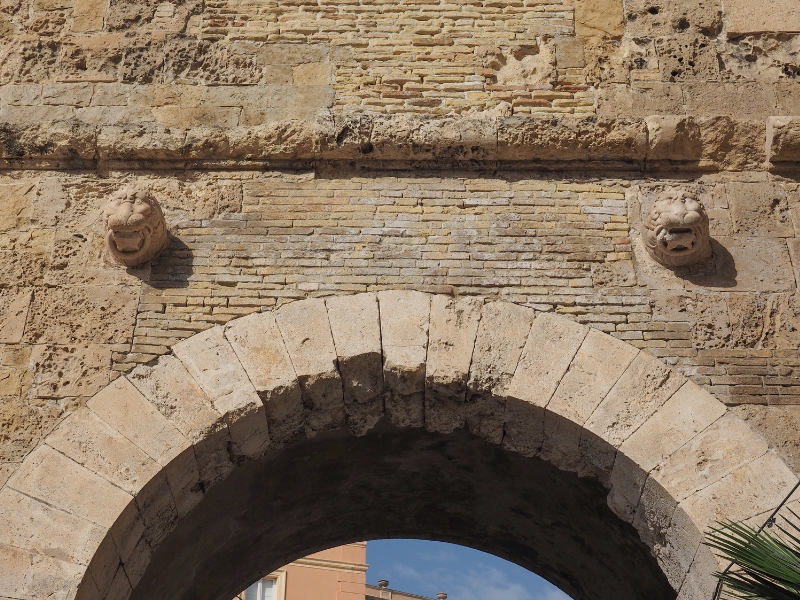
Porta Cristina is the classical stone gateway at the northern edge of Castello, the walled hilltop quarter of Cagliari. It was finished in 1825 and named after Maria Cristina of Bourbon, wife of King Charles Felix of Savoy, who ruled Sardinia at the time. It stands on Piazza Arsenale, between the medieval Torre di San Pancrazio and the former royal arsenal that now houses the Cittadella dei Musei.
Porta Cristina at a glance
- Where: on Piazza Arsenale at the northern end of the Castello quarter, next to the Torre di San Pancrazio.
- Built: approved by King Charles Felix in 1824 and completed in 1825, on the site of the 17th-century Porta del Soccolo.
- By: designed under Count Carlo Pilo Boyl; completed by the builder Efisio Fanari; the inscribed lunette is by Domenico Franco.
- What it is today: a pedestrian gateway linking Castello with the Cittadella dei Musei and Viale Buoncammino.
- Time needed: 10–15 minutes, or a couple of hours if you combine it with the museums next door.
A shortcut for the Savoy court
From 1720 Sardinia belonged to the House of Savoy, and the Kingdom of Sardinia was ruled from Turin. In the early 19th century King Charles Felix, who had spent long periods on the island, wanted an easier route between the old walled Castello and the royal arsenal to its north. He approved the project in 1824. The old Porta del Soccolo, built in the 17th century, was replaced by a new gate designed under Count Carlo Pilo Boyl and finished in 1825 by the builder Efisio Fanari.
The gate was named after the king's wife, Maria Cristina of Bourbon. Its design is classical, inspired by the Renaissance, and is said to draw on the Porta Angelica in Rome. A Latin inscription in the lunette, carved by Domenico Franco on the side facing the boulevard, dedicates the work to Charles Felix and Maria Cristina and celebrates the new, shorter road from Castello to the royal citadel. The arsenal behind it later became the Cittadella dei Musei, home to several of the city's museums.
What to look for
- The heavy rusticated arch with wedge-shaped stones, ribbed pilasters and Doric capitals.
- The Latin inscription of 1825 in the lunette on the side facing Viale Buoncammino.
- The way the gate opens in four directions: towards Castello, the old arsenal, the boulevard and the symmetrical S'Avanzada gate that leads down to Villanova.
- The Torre di San Pancrazio beside it, a tall medieval Pisan tower of white limestone.
- The contrast between the soft yellow limestone of the old walls and the neat 19th-century stonework of the gate.
Towers, walls and a royal arsenal
Porta Cristina is the newest piece in a long story of defences on this hill. The Pisans fortified Castello in the 13th and 14th centuries, building white limestone towers such as the Torre di San Pancrazio, completed in 1305. Later rulers, from the Aragonese to the Spanish and the Savoyards, added bastions and gates. Standing in Piazza Arsenale, you can see several layers at once: the medieval tower, the 19th-century gate and the former arsenal buildings, now turned into museums.
Tips for your visit
- Come in the late afternoon, when the light warms the stone and the views from nearby Viale Buoncammino are at their best.
- Walk through the gate from Castello towards the museums, then turn round to see the inscription on the outer side.
- Combine it with the National Archaeological Museum in the Cittadella dei Musei, home to the Nuragic statues of Mont'e Prama.
- Wear comfortable shoes: Castello is steep and paved with stone.
Nearby
- Torre di San Pancrazio: the Pisan tower right beside the gate, one of the symbols of Cagliari.
- Cittadella dei Musei: the former arsenal with the National Archaeological Museum and other collections, just through the gate.
- Cagliari Cathedral: the cathedral of Santa Maria in the middle of Castello, a few minutes' walk south.
- Bastione di Saint Remy: the grand terrace with wide views over the city and the sea, at the southern end of Castello.
See Cagliari with World City Trail
Our Cagliari scavenger hunt turns the old town into a game you play on your phone. The route links 10 stops and takes around 3 hours, with about 45 minutes of walking. It includes the Bastione di Saint Remy and Cagliari Cathedral.
If you prefer a different format, there is also a self-guided walking tour and an outdoor escape game in Cagliari.
Play the Cagliari scavenger hunt →
Take the self-guided walking tour of Cagliari →
Play the outdoor escape game in Cagliari →
Facts checked in October 2026.