
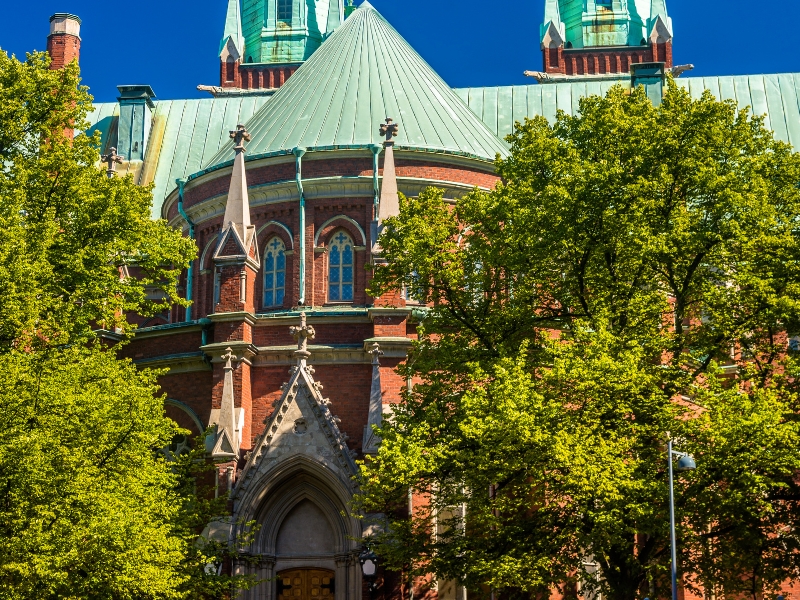
St John's Church (Johanneksenkirkko in Finnish, Johanneskyrkan in Swedish) is the red-brick Gothic Revival church whose two 74-metre spires rise over the southern districts of Helsinki. It stands on a small hill where people once lit Midsummer bonfires, and because Midsummer in Finland is St John's Day, the church was named after John the Baptist. With seats for 2,600 people and excellent acoustics, it is one of the largest churches in Finland and a favourite venue for concerts.
St John's Church at a glance
- Where: on Korkeavuorenkatu in Ullanlinna, in the southern part of central Helsinki, about 15 minutes' walk from the Esplanadi.
- Built: 1888–1891, consecrated on 13 December 1891.
- By: the Stockholm architect Adolf Emil Melander, who won the design competition of 1878.
- What it is today: the church of a Swedish-speaking Lutheran parish and one of the city's most popular venues for concerts and weddings.
- Time needed: 20 to 30 minutes inside, longer if you come for a concert.
From a bonfire hill to Helsinki's 'New Church'
In the 1880s Helsinki was growing fast and its existing churches had become too small. The new church, at first simply called the New Church, went up in what was then a poor district of small wooden houses. Its Gothic Revival style was a deliberate choice: it stressed the western, Lutheran roots of Finland, in contrast to the onion domes of the Orthodox Uspenski Cathedral across the city. Melander designed not only the building but also the pews, pulpit, altar and font.
The church was finished in 1891, but it took decades to complete the inside. Albert Edelfelt was meant to paint the altarpiece, but the plan fell through, and the painting finally came from Eero Järnefelt in 1932, the same year the church got its bells. In February 1944 Soviet air raids on Helsinki shattered several of its windows. More recently, in 2022, the concrete gargoyles damaged by the harsh sea air were repaired and renewed.
What to look for
- The twin spires: the two 74-metre towers are the tallest parts of the church and are visible from much of southern Helsinki.
- John the Baptist: on the front wall, a sculpture of the church's patron saint by Kari Juva, added in 2004.
- The gargoyles: look up at the roofline for the grotesque water spouts, renewed in 2022 after the salty air had worn the old ones down.
- The altarpiece: Eero Järnefelt's 'A Divine Revelation' (1932), showing the conversion of Paul. Järnefelt was the brother-in-law of the composer Jean Sibelius.
- The organ: built by Walcker of Ludwigsburg in 1891, when it was the largest in Finland. It was restored in 2005 and has 66 stops and over 4,000 pipes.
- The trefoils: the three-lobed shape, a Gothic symbol of the Holy Trinity, appears again and again in the windows and decoration.
Why a church for St John?
In Finland, Midsummer is called Juhannus, St John's Day, after John the Baptist, whose feast falls at the end of June. For generations, the rocky hill where the church now stands was a place where Helsinki people gathered to light Midsummer bonfires. When the city chose the site for its new church, naming it after St John was the natural choice. Even the bells, installed in 1932, have a musical touch: they ring out the first three notes of the Te Deum hymn.
Tips for your visit
- Try to hear the church in use: its acoustics are famous, and Christmas and Advent concerts here are a long Helsinki tradition. Check the concert calendar before you go.
- For the best photo of the spires, step back into the small park around the church, Johanneksenpuistikko, laid out in 1914.
- This is a working parish church: weddings and services take priority, so check before you go and keep your voice down inside.
- Combine your visit with the design shops and cafés of the surrounding Design District streets.
Nearby
- Design Museum: Finland's museum of design, on the same street, a few minutes' walk away.
- Kaivopuisto: the seaside park at the southern tip of the city, a good place for a walk along the water.
- Esplanadi Park: the green boulevard between the city centre and the harbour, with cafés and summer concerts.
- Market Square and the Old Market Hall: Helsinki's harbourside market and its 19th-century food hall, about 15 minutes' walk away.
See Helsinki with World City Trail
Our Helsinki scavenger hunt turns the city centre into a game you play on your phone. The route links 11 stops and takes around 3 hours, with about 53 minutes of walking, and includes places such as Helsinki Cathedral, the Market Square, the Ateneum and the Finnish National Theatre.
If you prefer a different format, there is also a self-guided walking tour and an outdoor escape game in Helsinki.
Play the Helsinki scavenger hunt →
Take the self-guided walking tour of Helsinki →
Play the outdoor escape game in Helsinki →
Facts checked in October 2026.