
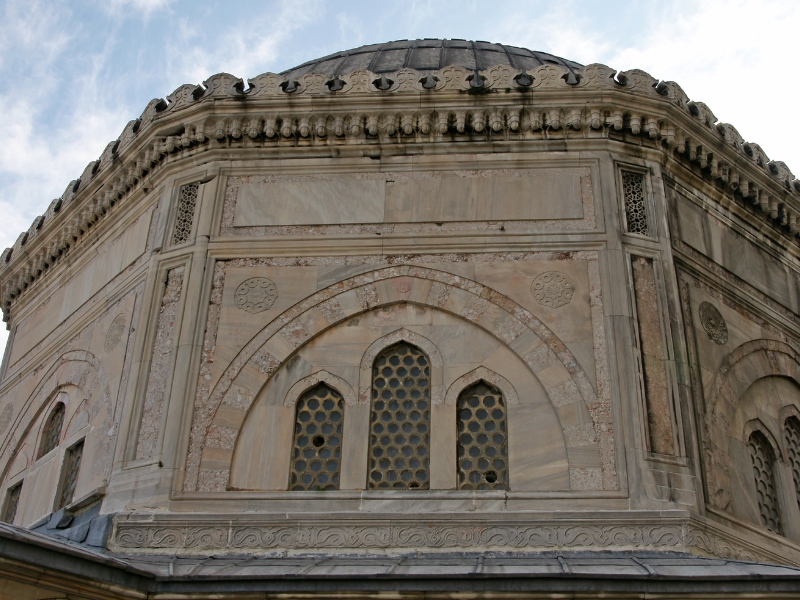
The Tomb of Abdul Hamid I is a domed marble mausoleum on Hamidiye Caddesi in Bahçekapı, the busy shopping streets between Sirkeci and Eminönü. Sultan Abdul Hamid I, who ruled from 1774 to 1789, lies here, and so does his son Mustafa IV, who reigned for little more than a year before he was killed in 1808. With its rounded corners and curving cornices, the tomb is one of the finest examples of Ottoman Baroque in the city.
The Tomb of Abdul Hamid I at a glance
- Where: at the corner of Hamidiye Caddesi and Hamidiye Türbesi Sokağı in Bahçekapı, Eminönü, in the Fatih district of Istanbul.
- Built: completed around 1789–1790, after the sultan's death; the complex it belonged to was begun in 1777.
- By: Mehmed Tahir Ağa, the chief court architect of the time.
- What it is today: a historic royal tomb, restored and reopened to visitors in 2009, with 20 sarcophagi inside.
- Time needed: 10–15 minutes.
The last sultan's complex in Istanbul
Abdul Hamid I came to the throne in 1774, just as the Ottoman Empire signed the Treaty of Küçük Kaynarca after a heavy defeat by Russia, and his reign saw the loss of Crimea. In 1777 he laid the foundations of a charitable complex in Bahçekapı, designed by Mehmed Tahir Ağa. It included a mosque, a madrasa, a library, a soup kitchen, a primary school, a public fountain and a row of shops, and it was the last imperial complex of its kind built in Istanbul. The madrasa and library were finished by 1780. When the sultan died in 1789, he was buried in a new tomb added to the complex.
Most of the complex has since disappeared or changed use. In the early 20th century the soup kitchen and school were pulled down to make way for the Fourth Vakıf Han, a large office building that is now a hotel, and the Baroque street fountain was taken apart and rebuilt beside the Zeynep Sultan Mosque. In 1926 the madrasa and mosque were given to the commodity exchange, which converted the library into a meeting hall. The tomb survived intact, and after restoration it reopened to visitors in August 2009.
What to look for
- The rounded corners: the tomb has a square plan, but its corners are curved, a typical touch of the Ottoman Baroque.
- Two rows of windows: 26 windows light the interior, set in two storeys divided by a deep, wide cornice.
- The entrance inscription: above the door, verses 27 to 30 of the Quranic Surah al-Fajr in elegant thuluth script.
- The Prophet's footprint: on the north wall inside, a marble panel shows the Qadam Rasul, a footprint attributed to the Prophet Muhammad.
- The sarcophagi: Abdul Hamid I and Mustafa IV lie among the tombs of princes and princesses of the dynasty; consorts and court officials are buried in the small graveyard beside it.
Which Abdul Hamid?
The name can be confusing. There were two sultans called Abdul Hamid, and the better known is his great-grandson Abdul Hamid II, who ruled from 1876 to 1909. He is not buried here: his tomb is in the mausoleum of Sultan Mahmud II on Divanyolu, near Sultanahmet. The tomb in Bahçekapı belongs to the first Abdul Hamid, the 18th-century sultan.
Tips for your visit
- This is a place of burial and prayer: dress modestly, keep your voice low, and expect to take off your shoes; women may be asked to cover their hair.
- Look at the outside from across Hamidiye Caddesi to see the whole dome and both rows of windows.
- Combine the visit with a walk down to Eminönü and the Galata Bridge, a few minutes away.
Nearby
- Fourth Vakıf Han: the grand office block by the architect Mimar Kemaleddin, built in 1916–1926 on the site of the sultan's soup kitchen and now a hotel.
- Sirkeci station: the 19th-century railway terminus once served by the Orient Express, a short walk east.
- New Mosque: the large 17th-century mosque on the waterfront at Eminönü, a few minutes' walk.
- Spice Bazaar: the covered market behind the New Mosque, with stalls of spices, dried fruit and sweets.
See Istanbul with World City Trail
Our Istanbul scavenger hunt turns the old town into a game you play on your phone. It takes around 3 hours, with about 60 minutes of walking.
If you prefer a different format, there is also a self-guided walking tour and an outdoor escape game in Istanbul.
Play the Istanbul scavenger hunt →
Take the self-guided walking tour of Istanbul →
Play the outdoor escape game in Istanbul →
Facts checked in October 2026.