
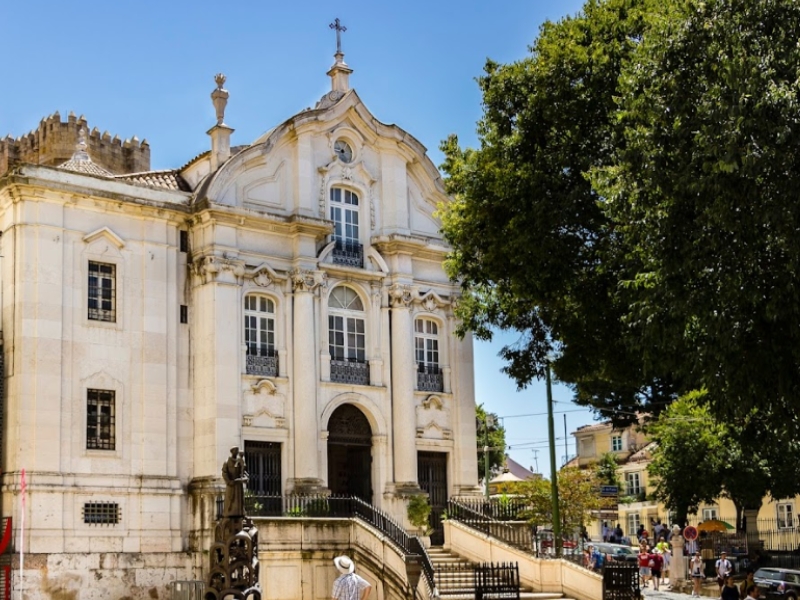
The Church of Saint Anthony (Igreja de Santo António) is a small Baroque church a few steps below Lisbon Cathedral, on the slope between the Baixa and Alfama. Tradition holds that it stands on the site of the house where Saint Anthony was born in 1195: the friar the world knows as Anthony of Padua, and Lisbon knows as its own. A crypt under the church marks the spot.
The Church of Saint Anthony at a glance
- Where: Largo de Santo António da Sé, across the street from Lisbon Cathedral (the Sé), between the Baixa and Alfama.
- Built: a chapel stood here from the 15th century; the present church was rebuilt after the 1755 earthquake and finished in the late 18th century, in a late Baroque and Rococo style.
- By: the architect Mateus Vicente de Oliveira, who also worked on the Queluz Palace.
- What it is today: a working Catholic church and a place of pilgrimage, with the Museum of Lisbon's Saint Anthony branch next door.
- Time needed: 15–20 minutes for the church and crypt; add half an hour for the museum.
From a family house to a pilgrims' church
Anthony was born Fernando de Bulhões into a well-off Lisbon family. He became an Augustinian canon, then joined the Franciscans and took the name Anthony, and spent his last years as a preacher and teacher in Padua, where he died in 1231. He was declared a saint less than a year later. His family's house is said to have stood here, very close to the cathedral, and in the 15th century a chapel was built on the site. It was rebuilt in the early 16th century under King Manuel I, when a brotherhood devoted to the saint was founded, and the city's senate met in a house next door. Under King John V, around 1730, the church was rebuilt and redecorated again.
The great earthquake of 1 November 1755 destroyed the church, leaving little more than the main chapel standing. Rebuilding began in the following years to designs by Mateus Vicente de Oliveira, and the result is the church you see today. Its most famous visitor came on 12 May 1982, when Pope John Paul II prayed in the crypt and unveiled the statue of the saint in the square outside.
What to look for
- The façade: a compact late Baroque front with curved lines, facing the square and the cathedral.
- The crypt: a stair leads down to a small room lined with blue-and-white azulejo tiles, marking the spot where Anthony is believed to have been born. This is where John Paul II prayed in 1982.
- The image of Saint Anthony: by tradition it survived the 1755 earthquake, when almost everything else in the church was lost.
- The statue in the square: the figure of the saint by the sculptor Soares Branco, unveiled by the pope in 1982.
- The view across the street: from the church steps, the fortress-like front of the cathedral is right in front of you.
Lisbon's matchmaker saint
Officially, Lisbon's patron saint is Saint Vincent, but in popular devotion Anthony has long shared the title, and he is the one the city celebrates. He is known as a matchmaker, and young people pray to him for help in love. His feast on 13 June is the high point of the Festas de Lisboa, with street parties, grilled sardines and pots of basil sold with little love poems. Since 1958 the city has sponsored the Santo António weddings on 12 June, when a group of couples marry together, with the religious ceremony in the cathedral across the street. On 13 June a procession in honour of the saint winds through Alfama.
Tips for your visit
- Come on a weekday morning for a quiet visit. Around 12 and 13 June the area is packed, but that is also when it is at its most festive.
- It is an active church: keep your voice down, dress modestly and avoid wandering around during Mass.
- Visit the museum next door after the church: it tells the saint's story and that of the June festivities.
Nearby
- Lisbon Cathedral (Sé): the city's oldest church, begun in the 12th century, right across the street.
- Museum of Lisbon – Saint Anthony: the small museum next to the church, devoted to the saint and his cult in the city.
- Miradouro de Santa Luzia: a short uphill walk, a tiled terrace with a view over the rooftops of Alfama to the Tagus.
- Praça do Comércio: the great riverside square of the post-earthquake city, downhill through the Baixa.
See Lisbon with World City Trail
Our Lisbon scavenger hunt turns the city centre into a game you play on your phone. The route links 10 stops and takes around 2 hours, with about 49 minutes of walking. It includes Rossio Square and the Foz Palace. You can play in English, German, French, Italian, Spanish, Dutch or Portuguese.
If you prefer a different format, there is also a self-guided walking tour and an outdoor escape game in Lisbon.
Play the Lisbon scavenger hunt →
Take the self-guided walking tour of Lisbon →
Play the outdoor escape game in Lisbon →
Facts checked in October 2026.