
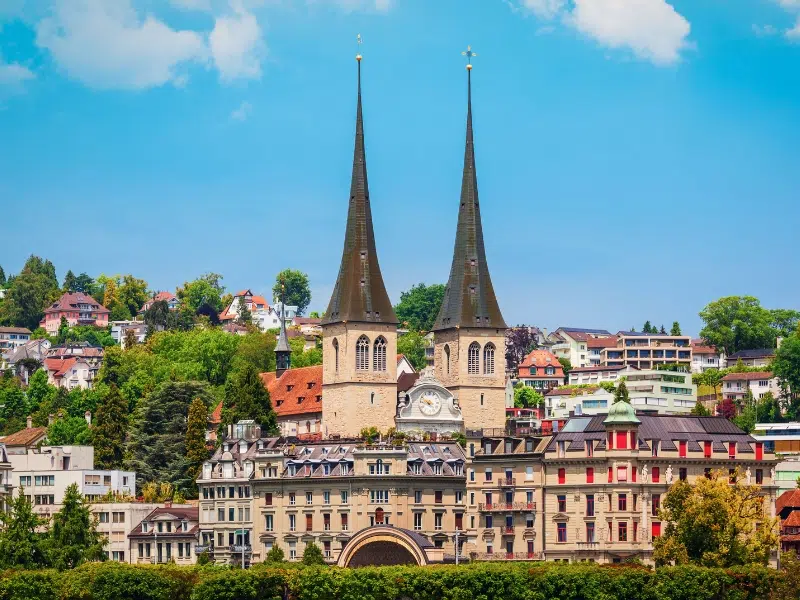
The Hofkirche St. Leodegar is Lucerne's main church, the twin-towered building on a terrace above the lakeside, a few minutes' walk from the Schwanenplatz. Almost all of it was rebuilt after a fire in 1633, which makes it one of the largest late Renaissance churches in the German-speaking world, but its two slender Gothic towers survived the flames. Inside is a huge 17th-century organ that can imitate a thunderstorm.
The Hofkirche at a glance
- Where: on a raised terrace above the Schweizerhofquai, at the top of a wide flight of steps, in the Hof quarter of Lucerne.
- Built: towers around 1504–1516; the rest rebuilt from 1633 into the 1640s after a fire.
- By: the rebuilding was directed by the Jesuit Jakob Kurrer, with much of the carving by the sculptor Niklaus Geisler.
- What it is today: a Catholic parish and collegiate church dedicated to Saints Leodegar and Maurice, with a church treasury that can be seen on guided tours.
- Time needed: 20–30 minutes, longer if you walk round the arcaded cemetery.
From abbey church to Renaissance rebuild
The church stands on one of the oldest religious sites in Lucerne. A small monastery was founded here around 735, and around 1135 it became a priory of the Alsatian abbey of Murbach. Murbach sold its rights to the Habsburgs in 1291, Lucerne gradually won them back, and in 1455–1456 the monastery became a chapter of secular canons. Its patron, Leodegar (Saint Leger), was a 7th-century bishop of Autun in Burgundy.
In 1633 a fire destroyed the medieval church, leaving only the two towers standing. Lucerne rebuilt at once: the Jesuit architect Jakob Kurrer designed a wide, bright church in late Renaissance style, and the sculptor Niklaus Geisler carved the portal, the pulpit and the choir stalls. The result is one of the largest and most richly furnished late Renaissance churches in the German-speaking world. Around it, a colonnade of Tuscan columns encloses the church and its old cemetery, like an Italian camposanto.
What to look for
- The towers: two thin, pointed late Gothic towers from the early 16th century, the only parts of the old church to survive 1633. Their spires were rebuilt after the fire.
- The main organ: built in the 1640s, enlarged in 1862 and rebuilt in 1972–1977, it now has 7,374 pipes and weighs about 30 tonnes. Its largest pipe, 10.7 metres long and 383 kilograms, was the biggest of its time.
- The high altar of black Unterwalden marble, with a painting of Christ on the Mount of Olives by the Italian Baroque painter Giovanni Lanfranco.
- The choir screen made by Johann Reiffel in 1641–1643, considered the earliest perspective grille: its ironwork is designed to create an illusion of depth.
- The cemetery arcades: walk round the colonnade that surrounds the church, lined with tombs and memorial plaques of old Lucerne families.
The rain organ
Since 1862 the organ has had a special effect known as the rain organ (Regenorgel) or organ thunderstorm. A wooden drum, turned by the organ's wind, rotates so that metal balls inside fall against a sheet of metal, producing the sound of rain and rolling thunder. It is used in concerts, and hearing it in the dark nave is something few visitors expect from a church organ.
Tips for your visit
- Look out for organ concerts and recitals: they are the best way to hear the main organ, and sometimes the rain effect.
- Before you go in, turn round at the top of the steps and look back towards the lake.
- It is a working church and the arcades are a cemetery: keep quiet and stay respectful near the graves.
Nearby
- Lion Monument: the dying lion carved into the rock in 1821 to a design by Bertel Thorvaldsen, honouring the Swiss Guards killed in Paris in 1792, a short walk uphill.
- Bourbaki Panorama: a giant circular painting showing the French Bourbaki army crossing into Switzerland in 1871, on the way to the Lion Monument.
- Schweizerhofquai: the lakeside promenade just below the church, with views of the lake and the mountains.
- Chapel Bridge: Lucerne's covered wooden bridge from the 14th century, rebuilt after a fire in 1993, about ten minutes' walk along the lake.
See Lucerne with World City Trail
Our Lucerne scavenger hunt turns the old town into a game you play on your phone. The route links 10 stops and takes around 3 hours, with about 59 minutes of walking. It includes the Jesuit Church, the Spreuer Bridge and the Nölliturm on the Musegg Wall. You can play in English, German, French, Italian, Spanish, Dutch and Chinese.
If you prefer a different format, there is also a self-guided walking tour and an outdoor escape game in Lucerne.
Play the Lucerne scavenger hunt →
Take the self-guided walking tour of Lucerne →
Play the outdoor escape game in Lucerne →
Facts checked in October 2026.