
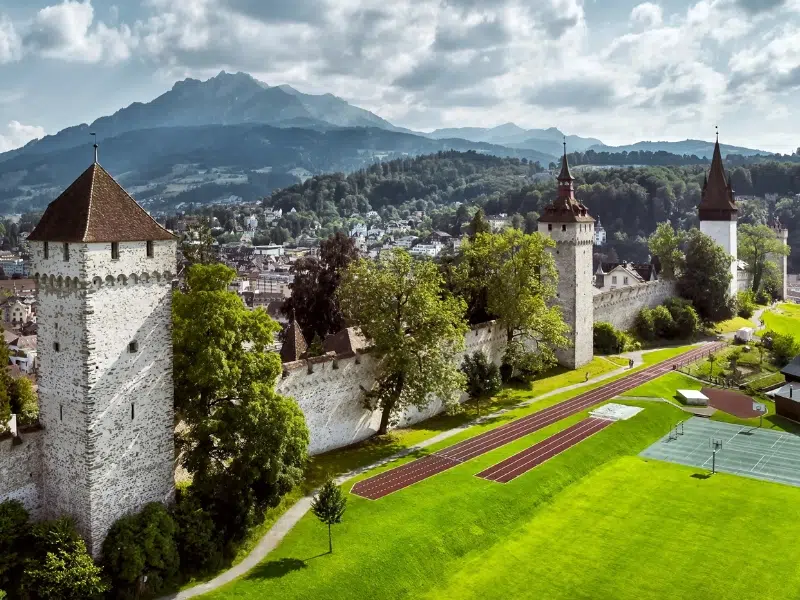
The Musegg Wall (Museggmauer) is the long stretch of medieval town wall that runs along the hill on the northern edge of Lucerne's old town, with nine towers still standing. Built around 1400, it is one of the best-preserved town fortifications in Switzerland. Its Zyt tower has a clock that, by an old privilege, strikes the hour one minute before every other public clock in the city.
The Musegg Wall at a glance
- Where: on the Musegg hill along the north side of the old town, from the river Reuss near the Spreuer Bridge to the Allenwinden tower in the east.
- Built: mainly around 1400, after the Battle of Sempach of 1386; the older town defences go back to the 13th century.
- What it is today: a protected monument about 800 metres long, with a walkway on part of the wall and several towers that can be climbed in the warmer months.
- Time needed: 45 minutes to 1.5 hours, depending on how many towers you climb.
Building the wall after Sempach
Lucerne joined the young Swiss Confederation in 1332, which put it on a collision course with the Habsburgs, its former overlords. In 1386 the Confederates defeated the Habsburg army at Sempach, but the threat had not gone away, and the city needed stronger defences on its exposed northern side. Around 1400 it built a new wall across the Musegg hill, with towers along its length, enclosing the town between the hill, the river Reuss and the lake.
As artillery improved and the city grew, the wall lost its military role. Elsewhere in Lucerne most of the old fortifications were torn down in the 19th century, but the Musegg Wall was spared, partly because the open meadow in front of it kept it from being built over. Today it is one of the city's emblems, lit up at night and seen from the lake, the bridges and the quays. It has been restored in several campaigns, and the walkway and some towers open to visitors from spring to autumn.
What to look for
- The nine towers, each with its own shape and name: Nölli, Männli, Luegisland, Wacht, Zyt, Schirmer, Pulver, Allenwinden and Dächli.
- The Zyt tower, the clock tower, with its large painted clock face facing the old town and, inside, the old clockwork behind glass.
- The Männli tower, named after the little armoured figure standing on its top.
- The Nölli tower down by the river Reuss, the westernmost tower, with a passage through it for the road.
- The view from the walkway and the towers over the old town roofs, the Reuss bridges, Lake Lucerne and the mountains beyond.
The clock that strikes first
The clock on the Zyt tower has a privilege that dates back to the late Middle Ages: it is allowed to strike one minute before all other public clocks in Lucerne. If you are in the old town on the hour, listen for its chime and then for the others following. Inside the tower you can see the clockwork and an exhibition of historic clocks, and for decades a city clockmaker climbed up every day to wind it by hand.
Tips for your visit
- Walk up from the old town by the Zyt tower, or start at the Nölli tower by the river and follow the wall east.
- The towers and walkway are open in the warmer months only; in winter you can still walk along the meadow side of the wall.
- The stairs inside the towers are steep and narrow: wear good shoes and take care with children.
- For the classic view of the whole wall, look up from the Reuss quays or the lakeshore, or come back after dark when it is lit.
Nearby
- Spreuer Bridge: the covered wooden bridge across the Reuss with its Dance of Death paintings, a few minutes from the Nölli tower.
- Weinmarkt and the old town squares: painted façades and fountains just below the wall.
- Lion Monument: the dying lion carved into a rock face in memory of the Swiss Guards killed in Paris in 1792, a short walk east.
- Chapel Bridge and the Water Tower: Lucerne's famous covered bridge, ten minutes' walk downstream.
See Lucerne with World City Trail
Our Lucerne scavenger hunt turns the city into a game you play on your phone. The route links 10 stops and takes around three hours, with about 59 minutes of walking. One of the stops is the Nölli tower on the Musegg Wall, and the route also includes the Jesuit Church and the Spreuer Bridge. You can play in English, German, French, Italian, Spanish, Dutch and Chinese.
If you prefer a different format, Lucerne also has a self-guided walking tour and an outdoor escape game.
Play the Lucerne scavenger hunt →
Take the self-guided walking tour of Lucerne →
Play the outdoor escape game in Lucerne →
Facts checked in October 2026.