
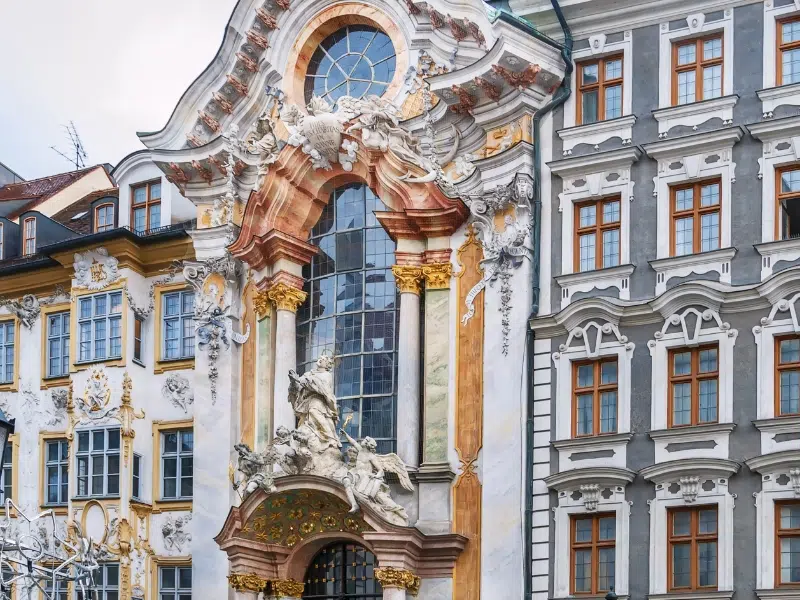
The Asamkirche, officially the Church of St John of Nepomuk, is a small Late Baroque church squeezed into the row of houses on Sendlinger Straße in Munich's old town. Two brothers, the sculptor Egid Quirin Asam and the painter Cosmas Damian Asam, built it at their own expense as their private church. Egid Quirin lived next door and could look at the high altar from a window of his house.
The Asamkirche at a glance
- Where: Sendlinger Straße 32, in the pedestrian zone between Sendlinger Tor and Marienplatz.
- Built: 1733–1746; consecrated on 1 May 1746.
- By: the brothers Egid Quirin Asam (sculpture, architecture) and Cosmas Damian Asam (painting).
- What it is today: a Catholic church, a daughter church of St Peter's, open to visitors outside services.
- Time needed: 15–20 minutes, plus a few minutes outside for the façade and the Asam House.
A church built for the builders
By the 1730s the Asam brothers were among the most sought-after church artists in southern Germany. Between 1729 and 1733 Egid Quirin bought several plots next to his house on Sendlinger Straße, and in 1733 the brothers began building a church there, dedicated to the Bohemian saint John of Nepomuk, who had been canonised a few years earlier. The foundation stone was laid in 1733 by the Bavarian Electoral Prince Max Joseph. Because nobody had commissioned it, the brothers could work entirely as they wished. They meant it as a private chapel, but public protests forced them to open it to the people of Munich.
The plot measures only about 22 by 8 metres, so the Asams built upwards. The interior is two storeys high and steeply proportioned, and it gets brighter as your eye rises: the lower zone with the pews is kept dark, the gallery level is lighter, and the ceiling, lit by hidden windows, is the brightest of all. The church was badly damaged by bombs in 1944. The façade was rebuilt in the 1970s and the interior restored between 1975 and 1983.
What to look for
- The façade, which curves gently outwards and seems to grow out of a rocky base, with St John of Nepomuk above the doorway.
- The high altar framed by four twisted columns, a nod to Bernini's columns over the tomb of St Peter in Rome.
- The Trinity group above the high altar, lit from behind by windows hidden behind the cornice.
- Cosmas Damian Asam's ceiling fresco of the life of St John of Nepomuk.
- The unusual orientation: the altar stands in the west rather than the east, so you walk towards the setting sun.
The Asam House
Look at the house to the left of the church as you face it: the Asam House, a 16th-century building that Egid Quirin acquired and covered around 1734 with exuberant stucco figures. A small angel with a staff serves as the pointer of a sundial. On the other side of the church stands the former priest's house, also with a decorated façade. Together the three buildings form one of the richest Baroque street fronts in Munich.
Tips for your visit
- Cross to the opposite side of Sendlinger Straße to see the façade, the Asam House and the priest's house together.
- The stucco looks most three-dimensional in the afternoon, when the light falls on the façade at an angle.
- Inside, sit in one of the back pews for a few minutes and let your eyes travel slowly up from the dark lower zone to the bright ceiling.
- This is a working church: keep quiet and avoid visiting during services.
Nearby
- Sendlinger Tor: one of the surviving medieval gates of Munich, a few minutes' walk south-west along the same street.
- Marienplatz: the main square with the New Town Hall and its Glockenspiel, about ten minutes north-east.
- Viktualienmarkt: the city's open-air food market, a short walk east.
- St Peter's Church: Munich's oldest parish church, whose tower gives a fine view over the old town.
See Munich with World City Trail
Our Munich scavenger hunt turns the old town into a game you play on your phone. The route links 10 stops and takes around 3 hours, with about 55 minutes of walking. It includes Marienplatz, the Frauenkirche and the Residenz. You can play in English, German, French, Italian, Spanish, Dutch or Polish.
If you prefer a different format, there is also a self-guided walking tour and an outdoor escape game in Munich.
Play the Munich scavenger hunt →
Take the self-guided walking tour of Munich →
Play the outdoor escape game in Munich →
Facts checked in October 2026.