
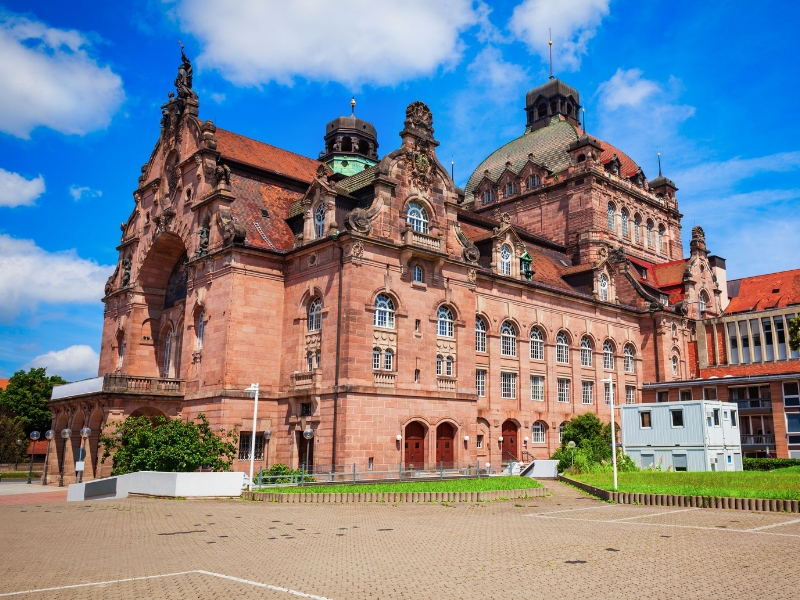
The Nuremberg Opera House (Opernhaus) stands on Richard-Wagner-Platz, just outside the medieval city wall near the Frauentor. Designed by Heinrich Seeling and opened in 1905, it is one of the largest theatres in Germany and the main stage of the Staatstheater Nürnberg. Its sandstone exterior has barely changed since then, but the auditorium inside was remodelled by the Nazis in 1935, so art and political history share the same building.
The Nuremberg Opera House at a glance
- Where: Richard-Wagner-Platz, on the south-western edge of the old town, a few minutes' walk from the Frauentor.
- Opened: September 1905, after construction began in the early 1900s.
- By: Heinrich Seeling, a Berlin architect who specialised in theatres.
- What it is today: the home of opera, ballet and concerts of the Staatstheater Nürnberg.
- Time needed: 10–15 minutes to study the facade from outside; an evening if you see a performance.
From Jugendstil showpiece to Nazi stage
Seeling built the opera house on the site of a former hospital, combining heavy neo-Baroque forms with Art Nouveau (Jugendstil) decoration. Only the sandstone came from Nuremberg itself; the design was a modern, big-city theatre for a fast-growing industrial town. Inside, the original auditorium was a lavish Jugendstil interior. For most of its life it was the city's municipal stage, and it only became the Staatstheater Nürnberg in 2005.
In 1935 the Nazi regime had the interior redesigned by Paul Schultze-Naumburg, who stripped the Art Nouveau stucco and put in flat ceilings. He was dismissed shortly before the work was finished, and Gerdy Troost and Leonhard Gall completed it. Hitler made Wagner's Die Meistersinger von Nürnberg a fixed part of the Nazi party rallies, and he watched performances here from his own box. The building came through the Second World War with only minor damage, was used by the US Army and returned to the city in 1951. The 1930s redesign still largely defines the look of the hall today.
What to look for
- The gable of the main facade: a niche holds a mosaic of the three Norns, the goddesses of fate from Norse myth, after a design by Hermann Schwabe the Younger.
- The sculpture group of Noris, the female figure who personifies Nuremberg, flanked by Orpheus and a figure representing the theatre, with bronze work by Hermann Feuerhahn.
- The domed lantern on the roof: it was rebuilt in a modern style in the 1950s and restored to its original form in 1991.
- The north side: relief heads by Philipp Kittler between the pilasters, and a mosaic of the city's coat of arms from the 1950s, when the facade in front of the stage house was rebuilt.
- The overall mix: massive neo-Baroque volumes with Jugendstil details, a style you will not find in the medieval streets inside the wall.
Hitler's box and a tunnel that probably never existed
During the Nazi years a special box was created on the east side of the auditorium, modelled on the royal boxes of Baroque theatres and fitted with its own salon and private toilet. Hitler, the mayor Willy Liebel and the Gauleiter Julius Streicher watched performances from it. A story that has circulated for decades says a secret tunnel led from the nearby Hotel Deutscher Hof, Hitler's usual hotel in Nuremberg, to the opera house. Researchers behind the 2018 exhibition "Hitler.Macht.Oper" at the Documentation Centre treated it as most likely an urban legend.
Tips for your visit
- View the facade from the far side of Richard-Wagner-Platz, where the dome, the gable mosaic and the sculptures fit into one picture.
- The only way to see the 1930s auditorium is to book a performance; the Staatstheater's programme covers opera, ballet and concerts.
- A long renovation is planned: the city expects it to take about ten years, with the company moving to an interim stage at the Kongresshalle on the former Nazi party rally grounds. No start date had been fixed in 2026, so check before you go.
- Combine it with the Frauentor and the city wall, then walk into the old town towards St Lorenz Church.
Nearby
- Frauentor: one of the old town's gates, guarded by a massive round tower, a few minutes' walk away.
- Germanisches Nationalmuseum: one of the largest museums of German art and culture, with Dani Karavan's Way of Human Rights beside it.
- St Lorenz Church: the great Gothic church of the southern old town, with Veit Stoss's carved Angelic Salutation hanging in the choir.
- Schauspielhaus: the Staatstheater's drama house stands right next to the opera house.
See Nuremberg with World City Trail
Our Nuremberg scavenger hunt turns the old town into a game you play on your phone. The route links 10 stops and takes around 2 hours, with about 41 minutes of walking. Among its stops are the Frauentor, St Lorenz Church and the Schöner Brunnen on the Main Market.
If you prefer a different format, there is also a self-guided walking tour and an outdoor escape game in Nuremberg.
Play the Nuremberg scavenger hunt →
Take the self-guided walking tour of Nuremberg →
Play the outdoor escape game in Nuremberg →
Facts checked in October 2026.