
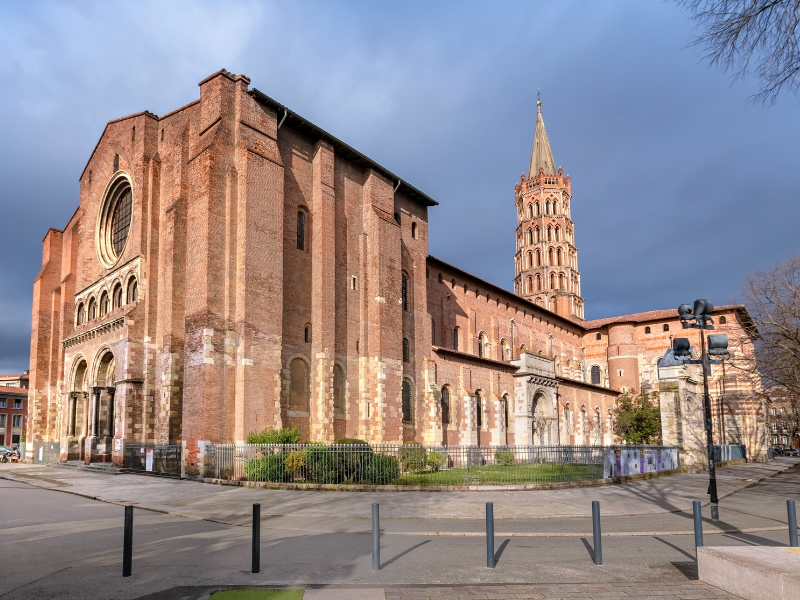
The Basilica of Saint-Sernin is the great brick pilgrimage church in the north of Toulouse's old centre, built over the tomb of the city's first bishop. It is the largest Romanesque church in France, and its eight-sided bell tower, rising in five tiers of arches, is the landmark of the 'pink city'.
Saint-Sernin at a glance
- Where: Place Saint-Sernin, at the northern end of Rue du Taur, about ten minutes' walk from the Capitole.
- Built: begun around 1070–1080; the altar was consecrated by Pope Urban II on 24 May 1096, while much of the church was still unfinished. Work went on into the 12th century, and the upper tower is later.
- What it is today: a parish church and basilica, listed by UNESCO since 1998 as part of the Routes of Santiago de Compostela in France. Inside it is about 115 metres long and 64 metres across the transept, with a vault 21 metres high.
- Time needed: 45 minutes to an hour, including a walk round the outside and the ambulatory.
A bishop's tomb on the road to Santiago
Saint Saturnin, called Sarnin in Occitan and later Sernin, was the first bishop of Toulouse and was put to death around 250. A church stood over his grave from the late 4th century. In the late 11th century the canons began the huge church you see today, laid out as a 'pilgrimage church': a long nave with double aisles, a wide transept and an ambulatory with radiating chapels, so crowds of pilgrims could walk past the relics without disturbing services. The cathedral of Santiago de Compostela, begun in 1082, follows a very similar plan.
Urban II consecrated the altar in 1096 during the journey on which he preached the First Crusade, and building continued in phases from east to west. Around 1270 two Gothic tiers were added to the bell tower, and the spire followed in the 15th century. From 1860 the architect Eugène Viollet-le-Duc restored the church heavily; in the late 20th century much of his work, especially on the roofs, was undone to bring back the medieval look.
What to look for
- The bell tower: count the five tiers. The lower three, with round Romanesque arches, date from the 12th century; the upper two, with pointed mitre-shaped arches, from about 1270. The tower leans slightly, which you can see from some angles.
- The Porte Miègeville: the south doorway, with a tympanum of Christ's Ascension surrounded by angels, carved in the early 12th century and one of the earliest great Romanesque portals.
- The Porte des Comtes: the doorway into the south transept, named after the tombs of the counts of Toulouse in an alcove beside it. Its capitals show the story of Lazarus and the rich man.
- Bernard Gilduin's reliefs: in the ambulatory, marble reliefs from around 1096 show Christ in majesty with the symbols of the evangelists. Gilduin also carved the altar consecrated by Urban II.
- The ambulatory and crypts: the 'circuit of the relics' round the choir, with 17th-century reliquaries, the baroque canopy over Saint Saturnin's tomb and crypts that held many relics.
- The Cavaillé-Coll organ: built in 1888 and inaugurated in 1889, it is one of the most important organs in France.
The bull of Saint Saturnin
According to tradition, Saturnin refused to sacrifice to the pagan gods and was tied to a bull, which dragged him through the streets until the rope broke. The name Rue du Taur, the street linking the Capitole to the basilica, comes from the bull (taur in Occitan). The church of Notre-Dame du Taur halfway along is said to stand where the saint's body was left.
Tips for your visit
- Walk round the outside first: the chevet at the east end, with its stacked chapels and roofs climbing up to the tower, is the best view of the building.
- Late afternoon sun warms the brick to its deepest colour.
- This is a working church: keep quiet during Mass, and check whether an organ concert is on during your stay.
Nearby
- Musée Saint-Raymond: Toulouse's archaeology museum right beside the basilica, with Roman sculpture from the region.
- Notre-Dame du Taur: the church on Rue du Taur linked to the legend of Saint Saturnin, on your way to the Capitole.
- Capitole: the city hall and its huge square, at the other end of Rue du Taur.
- Couvent des Jacobins: the Dominican church with the 'palm tree' column, a short walk south-west across the old centre.
See Toulouse with World City Trail
Our Toulouse scavenger hunt turns the old town into a game you play on your phone. The route links 10 stops and takes around 3 hours, with about 45 minutes of walking. The Basilica of Saint-Sernin is one of the stops, along with the Musée Saint-Raymond.
If you prefer a different format, there is also a self-guided walking tour and an outdoor escape game in Toulouse.
Play the Toulouse scavenger hunt →
Take the self-guided walking tour of Toulouse →
Play the outdoor escape game in Toulouse →
Facts checked in October 2026.