
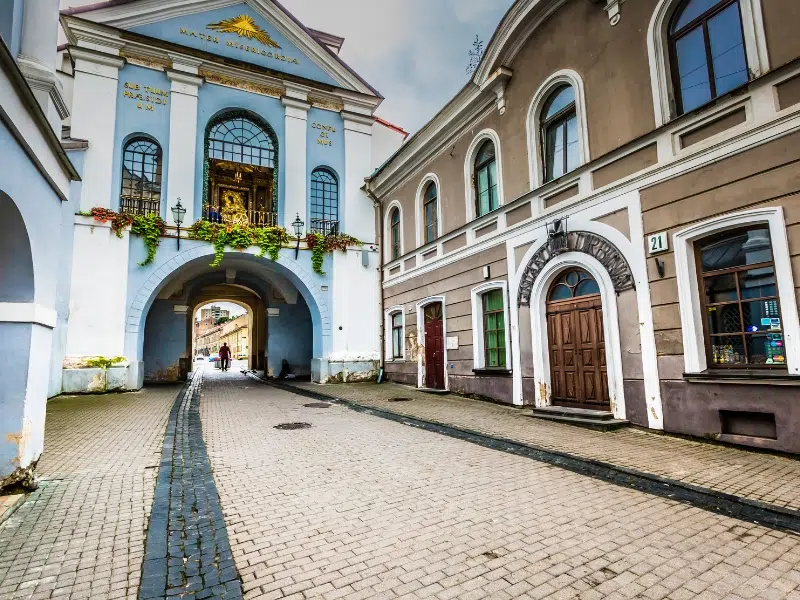
The Gate of Dawn (Aušros vartai) is the only surviving gate of the old city walls of Vilnius, at the southern entrance to the Old Town. Inside the gate, above the archway, is a small chapel with a painting of the Virgin Mary that Catholics in Lithuania and Poland revere as miraculous. You do not even need to go inside to see her: the chapel's big windows face the street, and the painting looks down on everyone who walks through.
The Gate of Dawn at a glance
- Where: at the southern end of Aušros Vartų Street, where the Old Town of Vilnius begins, next to St Teresa's Church.
- Built: the gate between 1503 and 1514, as part of the city walls; the chapel in its present form in 1828–1830.
- What it is today: a working chapel and one of the most important Marian shrines in Eastern Europe, with daily Masses in Lithuanian and Polish.
- Time needed: 15–30 minutes for the gate and the chapel, longer if you sit through part of a Mass.
From city gate to shrine
Vilnius built its walls in the early 16th century to protect the city from Tatar raids, and the Gate of Dawn was one of nine gates. It was also known as the Medininkai Gate, after the road that left the city here. When the walls were pulled down by the Russian authorities in 1799–1805, this was the only gate left standing, probably because of the painting it held. The Discalced Carmelites, who settled beside the gate in 1626 and built St Teresa's Church, looked after the image and spread devotion to it. A wooden chapel was built for it in 1671–1672, replaced by a brick one after a fire in 1711, and rebuilt in neoclassical style in 1828–1830.
The painting itself, Our Lady of the Gate of Dawn, Mother of Mercy, was most likely made around 1630, in tempera on oak planks. It survived the Russian dissolution of the Carmelite monastery in 1844 and bans on preaching in the 19th century. In 1927 it was solemnly crowned, and in 1993 Pope John Paul II prayed in the chapel, followed by Pope Francis in 2018. The Old Town around it has been a UNESCO World Heritage Site since 1994.
What to look for
- The outer side of the gate, facing away from the Old Town: a Renaissance attic decorated with two griffins holding the Vytis, the mounted knight of Lithuania's coat of arms, and gun ports from the gate's defensive past.
- The chapel windows on the inner side: three large arched windows with iron railings, the middle one bearing Mary's monogram, and the Eye of Providence above.
- The painting: Mary with her head bowed and hands crossed on her chest, covered by a gilded silver casing that leaves only her face and hands visible, with two crowns above her head.
- The crescent moon at the bottom of the painting, a votive offering dated 1849.
- The thousands of small silver votive offerings covering the chapel walls: hearts, hands, legs and praying figures left in thanks for answered prayers.
- The covered staircase gallery that links the chapel to St Teresa's Church, built in the late 18th century.
A line from Pan Tadeusz
The Gate of Dawn is one of the best-known places in Polish literature. Adam Mickiewicz, who studied in Vilnius, opens his epic poem Pan Tadeusz (1834) with a prayer to the Holy Virgin who defends Częstochowa and shines in the Ostra Brama, the Polish name of the gate. That is why so many Polish visitors come here, and why the city's two Catholic traditions, Lithuanian and Polish, share the chapel with services in both languages.
Tips for your visit
- Look at the gate from both sides: the defensive outer façade with the griffins, and the inner side where the chapel windows face Aušros Vartų Street.
- Behave as you would in a church even on the street below: many people stop, pray or kneel when they pass under the painting, and by tradition men take off their hats.
- To visit the chapel, go up the narrow staircase from the street on the St Teresa's Church side. Dress modestly, keep quiet and do not take photos during Mass.
- Come early in the morning or in the evening for fewer people; around the feast of Our Lady of Mercy in mid-November the street fills with pilgrims.
Nearby
- St Teresa's Church: the Carmelites' early Baroque church right next to the gate, with a richly painted interior.
- Orthodox Church of the Holy Spirit: the main Orthodox church of Vilnius, across Aušros Vartų Street, behind a gateway a few steps from the gate.
- Basilian Gate: the elaborate late Baroque gateway to the Holy Trinity monastery, a short walk down Aušros Vartų Street.
- Town Hall Square: the old market square with the neoclassical Town Hall, a few minutes' walk downhill along Aušros Vartų Street.
See Vilnius with World City Trail
Our Vilnius scavenger hunt turns the old town into a game you play on your phone. The route links 10 stops and takes around 3 hours, with about 58 minutes of walking. The Gate of Dawn is one of the stops, along with Town Hall Square and Literatų Street. You can play in English, German, French, Italian, Spanish and Dutch.
If you prefer a different format, there is also a self-guided walking tour and an outdoor escape game in Vilnius.
Play the Vilnius scavenger hunt →
Take the self-guided walking tour of Vilnius →
Play the outdoor escape game in Vilnius →
Facts checked in October 2026.