
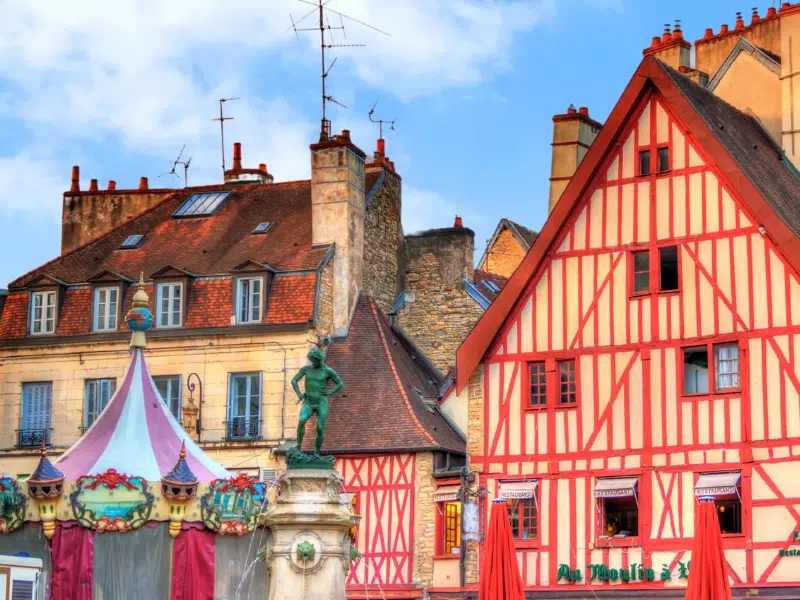
Place François Rude is the small, busy square on Rue de la Liberté in the centre of Dijon, with café terraces, half-timbered houses and an old-style carousel. In the middle stands a fountain topped by a bronze statue of a naked grape-treader, whom the people of Dijon call the Bareuzai. Locals often call the whole square Place du Bareuzai.
Place François Rude at a glance
- Where: on Rue de la Liberté, the main pedestrian street between the Porte Guillaume and the Palace of the Dukes, at the start of Rue des Forges.
- Created: 1904, when the square was laid out and named after the sculptor François Rude.
- What it is today: a pedestrian square and meeting point, with cafés, shops, the Bareuzai fountain and a children's carousel.
- Time needed: 10–15 minutes, longer if you stop for a coffee on a terrace.
A square for a sculptor
François Rude was born in Dijon in 1784 and trained at the city's drawing school before leaving for Paris. His most famous work is the huge relief on the Arc de Triomphe in Paris known as La Marseillaise, or The Departure of the Volunteers of 1792. When Dijon laid out this square in 1904, it named it after him, the best-known artist the city has produced.
The square sits at a meeting of old and new Dijon: Rue de la Liberté, the long shopping street that links the Porte Guillaume with the Palace of the Dukes, and Rue des Forges, one of the oldest streets in town, lined with merchants' houses. The fountain in the middle celebrates the wine of Burgundy, and since 1978 a carousel has turned beside it. Its paintings tell the life of Gustave Eiffel, who was born in Dijon in 1832. In October 2023 a fire destroyed the carousel; a new one, still dedicated to Eiffel, was installed on the same spot in February 2024.
What to look for
- The Bareuzai: the bronze grape-treader on top of the fountain, standing as if in a vat of grapes.
- The half-timbered houses on the north side of the square, with timber frames and upper floors that lean out over the street.
- The carousel and its painted panels on the life and work of Gustave Eiffel.
- The view east along Rue des Forges, where the 15th-century Hôtel Chambellan hides a Gothic courtyard with a spiral staircase.
Why 'Bareuzai'?
Bareuzai is a word from the local dialect. It refers to the winegrowers who trod the grapes at harvest time and came out of the vats with their legs stained red by the juice, as if they were wearing pink stockings. The statue shows exactly that: a young vineyard worker at work. There is also a popular story that on great feast days the fountain once ran with wine instead of water, which may explain why the Bareuzai looks so pleased with himself.
Tips for your visit
- Come in the morning for photos of the fountain and the half-timbered houses before the café terraces fill up.
- In the evening the carousel lights make the square one of the liveliest spots in the centre.
- Combine it with a walk along Rue des Forges and Rue de la Chouette: the owl of Notre-Dame is only a few minutes away.
Nearby
- Owl of Notre-Dame: the small stone owl on the side of the church of Notre-Dame on Rue de la Chouette. By tradition, you touch it with your left hand and make a wish.
- Palace of the Dukes and Place de la Libération: the former ducal palace, now the town hall and the Museum of Fine Arts, facing a semicircular square designed by Jules Hardouin-Mansart.
- Les Halles: Dijon's 19th-century covered market of iron and glass, a few minutes' walk north, where locals buy cheese, mustard and wine.
- Musée Rude: a small museum in the former church of Saint-Étienne with casts of Rude's sculptures, including a full-size cast of La Marseillaise.
See Dijon with World City Trail
Our Dijon scavenger hunt turns the old town into a game you play on your phone. The route links 10 stops and takes around 2 hours, with about 25 minutes of walking. Place François Rude is one of the stops, along with the Porte Guillaume, the Jardin des Cloches and the Cathedral of Saint-Bénigne. You can play in English, German, French, Italian, Spanish or Dutch.
If you prefer a different format, there is also a self-guided walking tour and an outdoor escape game in Dijon.
Play the Dijon scavenger hunt →
Take the self-guided walking tour of Dijon →
Play the outdoor escape game in Dijon →
Facts checked in October 2026.