
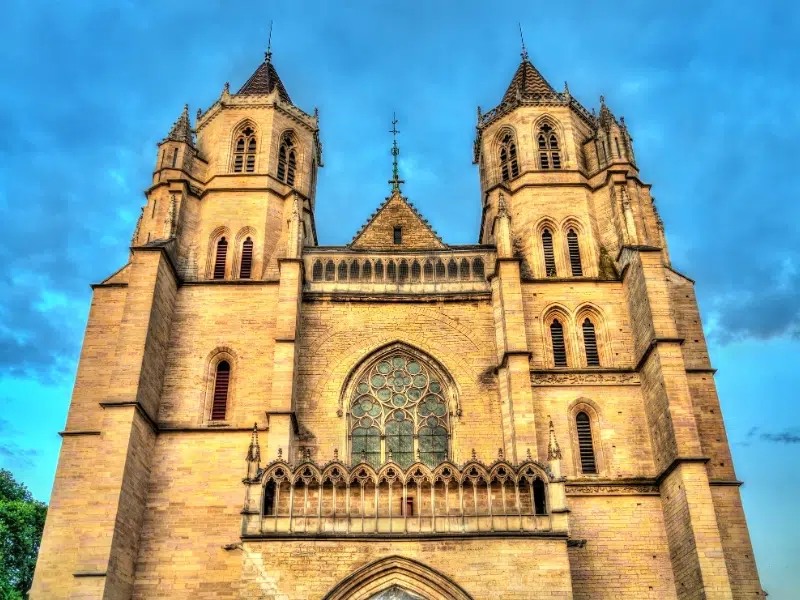
Saint-Bénigne is Dijon's cathedral, a Gothic church at the western edge of the old town with a 93-metre spire. Its most remarkable part is underground: the crypt is the surviving lower storey of a round church built around the year 1000 over the tomb of Saint Benignus, the martyr venerated as the apostle of Burgundy. After four years of restoration it reopened to visitors in 2024.
Saint-Bénigne Cathedral at a glance
- Where: Place Saint-Bénigne, at the western end of the old town, a few minutes' walk from Place Darcy.
- Built: the rotunda whose crypt survives was consecrated in 1018; the present Gothic church was begun around 1280 and completed in the first half of the 14th century; the spire dates from 1896.
- What it is today: the cathedral of the Archdiocese of Dijon and a working church, with the restored crypt open for visits.
- Time needed: 20–30 minutes for the church, plus about 50 minutes if you visit the crypt.
From a martyr's tomb to a cathedral
According to Gregory of Tours, a bishop of Langres found the tomb of Benignus in the 6th century and built a first basilica over it, and an abbey grew up around the site. Around 1001 the reforming abbot William of Volpiano began a new abbey church with a three-storey rotunda inspired by the Pantheon in Rome, complete with a central opening in the roof. It was consecrated on 13 May 1018, and the chronicler Raoul Glaber praised it as one of the wonders of its time.
After part of the Romanesque church collapsed in 1271, the monks began the present Gothic church around 1280 and moved the saint's relics into it in 1288. During the Revolution the abbey was dissolved and in 1792 the church became the cathedral of Dijon, replacing Saint-Étienne. The same year the rotunda was judged unsafe and demolished, and its lower level was filled with rubble. It was rediscovered in 1843 and restored in the 19th century, and a restoration with archaeological excavations from 2020 to 2024 gave the crypt its present look.
What to look for
- The crypt: rings of columns from the lower storey of the rotunda, some with carved capitals from around the year 1000, lit through a round opening that recalls the original oculus.
- The tomb of Saint Benignus at the centre of the crypt, surrounded by Romanesque mosaics and coloured marble paving.
- The two restored spiral staircase towers, which once led up to the rotunda's vanished upper floors.
- The spire: 93 metres high and added in 1896, with eight statues of famous Burgundians at its base.
- The organ above the west door, built between 1740 and 1745 by the Riepp brothers from Ottobeuren in Swabia. It was then the largest organ in provincial France and came through the Revolution intact.
- The Gothic interior: a tall, plain nave with ribbed vaults, left fairly bare because the church was emptied of almost all its furnishings during the Revolution.
Tips for your visit
- The crypt is entered through a former sacristy, with a lift for visitors with reduced mobility. Visits take about 50 minutes and guided tours are available.
- The cathedral is a working church: avoid walking around during Mass and keep your voice down in the crypt.
- Combine the cathedral with the Archaeological Museum next door; together they take about two hours.
Nearby
- Archaeological Museum: housed in the surviving monastic buildings of the old abbey, right next to the cathedral, with Gallo-Roman finds and a Romanesque vaulted hall.
- Church of Saint-Philibert: the Romanesque church just south of the cathedral; even from outside, its simple stone walls contrast with Saint-Bénigne's Gothic height.
- Place Darcy and the Porte Guillaume: a few minutes' walk away, an 18th-century triumphal arch and the Jardin Darcy, with a copy of François Pompon's polar bear.
- Rue de la Liberté: the main street from Porte Guillaume to the Palace of the Dukes of Burgundy, about ten minutes on foot.
See Dijon with World City Trail
Our Dijon scavenger hunt turns the old town into a game you play on your phone. The route links 10 stops and takes around 2 hours, with about 25 minutes of walking. Saint-Bénigne Cathedral is one of the stops, along with the Porte Guillaume and Place François Rude. You can play in English, German, French, Italian, Spanish and Dutch.
If you prefer a different format, there is also a self-guided walking tour and an outdoor escape game in Dijon.
Play the Dijon scavenger hunt →
Take the self-guided walking tour of Dijon →
Play the outdoor escape game in Dijon →
Facts checked in October 2026.