
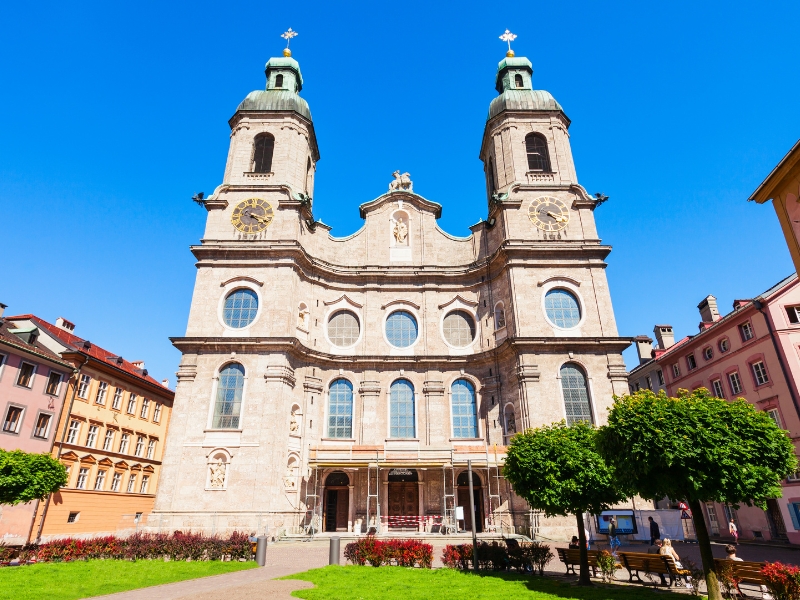
The Dom zu St. Jakob is Innsbruck's cathedral, a Baroque church with two towers and a green copper dome rising above the roofs of the old town. It was built between 1717 and 1724, and inside it holds one of the most venerated images of the Virgin Mary in the Alps: the Mariahilf painting by Lucas Cranach the Elder, hanging above the high altar.
St James Cathedral at a glance
- Where: on the Domplatz in Innsbruck's old town, a few steps behind the Hofburg and the Golden Roof.
- Built: 1717–1724, on the site of a church first mentioned in 1180; it became a cathedral in 1964.
- By: designed by Johann Jakob Herkomer and completed by his nephew Johann Georg Fischer; ceiling frescoes by Cosmas Damian Asam and stucco by his brother Egid Quirin Asam.
- What it is today: the cathedral of the Catholic Diocese of Innsbruck and a working parish church dedicated to St James the Greater.
- Time needed: 20 to 30 minutes for the interior; a little longer if you sit and look at the ceiling.
From market church to cathedral
A church stood here in the market of the new town as early as 1180, when Innsbruck was founded on the right bank of the Inn. Fires and earthquakes damaged it again and again, and Albrecht Dürer painted it in a watercolour in the 1490s, with a single spire behind the town walls. In 1650 Archduke Ferdinand Charles gave the church Cranach's Mariahilf, and St James became a place of pilgrimage. After further earthquake damage, the citizens pushed for a new, safer building. The foundation stone was laid on 12 May 1717; Herkomer died that October, and Fischer finished the church to his uncle's plans.
The Asam brothers from Munich decorated the interior, and the church was consecrated on 9 September 1724; the furnishings were finished in 1732. On 16 December 1944 an air raid brought down the vaults and destroyed altars and paintings, and the church was restored between 1946 and 1950. When the Diocese of Innsbruck was created in 1964, the old parish church became its cathedral. It celebrated its 300th anniversary in 2024.
What to look for
- The façade on the Domplatz: two towers, a curved front of local stone, statues of Tyrolean saints in the niches and St James on horseback at the top.
- Asam's ceiling frescoes on the life of St James. Look at the vault above the nave from the middle of the church: painted architecture seems to open the ceiling into the sky.
- The Mariahilf above the high altar, a small, tender painting of Mary holding the Christ Child.
- The dome over the choir rather than over the crossing, an unusual layout that pulls the light and your eye towards the altar.
- The canopied tomb of Archduke Maximilian III, Grand Master of the Teutonic Order, dating from 1620, in the north (left) aisle.
Why Mariahilf matters
Lucas Cranach the Elder painted the Mariahilf around 1530 in Saxony, where he was court painter. It came to Innsbruck in the 17th century and was copied countless times: versions of it hang in churches and on house façades all over Tyrol, Bavaria and beyond, and the invocation "Maria, hilf" (Mary, help) gave the image its name. The original you see in the cathedral is the one all those copies go back to.
Tips for your visit
- This is a working cathedral: dress respectfully and keep visits out of the way during services.
- Bright days are best for the frescoes, as the clear windows light the ceiling well.
- Step back across the Domplatz for the full view of the façade and towers; the square is small, so the far corner works best for photos.
- Combine it with the Golden Roof and the Hofburg, both a couple of minutes away.
Nearby
- Golden Roof (Goldenes Dachl): the gilded late-Gothic balcony of Emperor Maximilian I, the symbol of the old town, around the corner.
- Hofburg: the imperial palace of the Habsburgs in Tyrol, with state rooms remodelled under Maria Theresa, next to the cathedral.
- Court Church (Hofkirche): home of Maximilian I's monumental tomb with its larger-than-life bronze figures, a few minutes' walk away.
- City Tower (Stadtturm): climb the old town's medieval tower for views over the roofs and the mountains.
See Innsbruck with World City Trail
Our Innsbruck scavenger hunt turns the old town into a game you play on your phone. The route links 10 stops and takes around two hours, with about 24 minutes of walking. It includes places such as the Triumphpforte and Eduard-Wallnöfer-Platz. You can play in English, German, French, Italian, Spanish or Dutch.
If you prefer a different format, Innsbruck also has a self-guided walking tour and an outdoor escape game.
Play the Innsbruck scavenger hunt →
Take the self-guided walking tour of Innsbruck →
Play the outdoor escape game in Innsbruck →
Facts checked in October 2026.