What is the Innsbruck outdoor escape game?
The Innsbruck outdoor escape game is a puzzle walk through the old town that runs on your phone: at each of the 10 stops a puzzle is waiting, and you crack it by studying what surrounds you and working through the logic. Plan on about 2 hours, including 24 minutes of walking over 1.8 km, and start on whatever day suits you.
The puzzles are hidden in the landmarks themselves, from the Triumphal Arch and the Golden Roof to the Hofburg, the Court Church with the cenotaph of Maximilian I and the City Tower. Each puzzle stands alone, so there is no storyline to follow, and up to three levels of hints are available when you get stuck. Innsbruck suits this format because the sights sit close together in the Inn valley, with the Alps close by.
- Durationabout 2 hours
- Walkingabout 24 min · 1.8 km
- Stops10
- LanguagesEnglish, German, French, Italian, Spanish, Dutch
How the game works
Think it through
Solve the puzzle at every stop by combining what you observe with logic. You do not need to know the city beforehand.
Look around
The clues are in the details around each landmark, on façades, squares and monuments.
Walk
Google Maps guides you from stop to stop: about 24 minutes on foot over roughly 1.8 km.
Go at your pace
No countdown runs. Ask for a hint when you need one, pause for a coffee and carry on later or another day.
See the route and attractions →
How it works
- Book online Choose the number of players. Your booking reference arrives by email straight away.
- Get the app Download the World City Trail app from the App Store or Google Play and enter your booking reference.
- Play when you like Start whenever you are ready, walk at your own pace and pause any time. No guide, no fixed schedule.
Who it suits
Friends
Each puzzle gives the group something to debate before the next stop, and nobody has to know the city in advance.
Couples
A challenge to share as you move from one landmark to the next, without a clock hurrying you along.
Team building
Colleagues can split into teams of up to 5, each playing on its own phone.
Good to know
- Bring a charged smartphone with mobile data; a power bank helps.
- Best started in daylight, so you can see the details the puzzles ask about.
- No entry tickets needed: everything happens outside the buildings. Going inside is optional and paid separately.
- Family friendly; children must be accompanied by an adult.
- Not suitable for wheelchair users and difficult with strollers.
- Teams of up to 5 work best; bigger groups split into several teams, one ticket per player.
- Every purchase helps support stray cats and dogs in Greece.
Puzzle route: from the Triumphal Arch to the cathedral
10 stops · about 24 min walking · start: Triumphal Arch (Triumphpforte) · finish: Cathedral of Saint James (Dom St. Jakob)
The route begins at the Triumphal Arch, which closes the southern end of Maria-Theresien-Straße, and ends at the Cathedral of Saint James. In between come Eduard-Wallnöfer-Platz, Saint Anne's Column, the Ferdinandeum, the City Tower, the Golden Roof, the Hofburg, the Court Church and the Leopold Fountain. Daylight is the best time to set off, since the puzzles are solved outdoors and rain or wind slow everything down. Google Maps leads you between stops, the app lets you change the start and the order, and no entry tickets are needed.
Open the route map ↗
1Triumphal Arch (Triumphpforte)Start
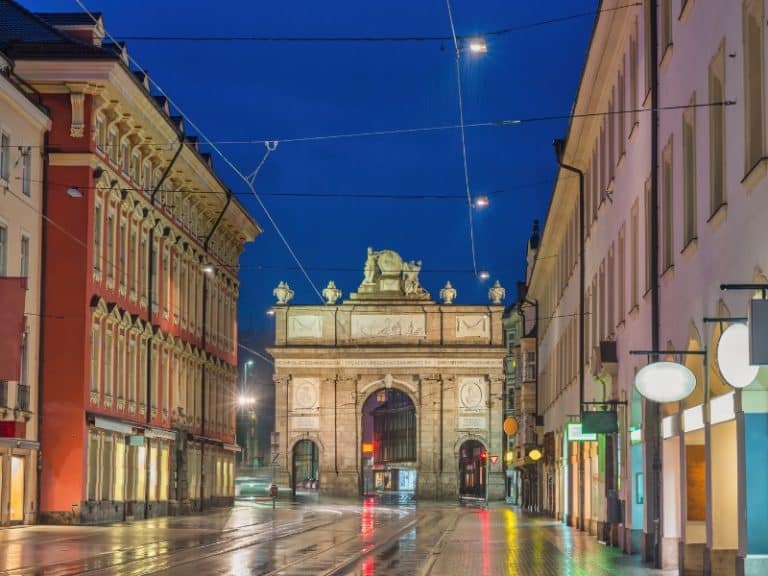
The Triumphpforte closes the southern end of Maria-Theresien-Straße and was built in 1765 for the wedding of Archduke Leopold. Modelled on the Arch of Constantine in Rome, its north side commemorates the death of Emperor Francis Stephen that same year.
Read the full story →
2Eduard-Wallnöfer-Platz
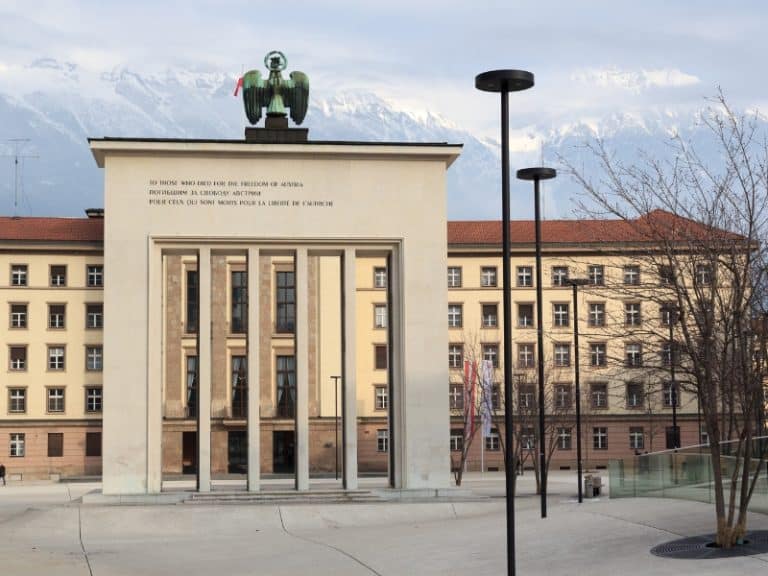
This square, home to the Tyrolean state government buildings, was built in the late 1930s and is named after former governor Eduard Wallnöfer. Its many ramps and obstacles have made it a favourite with skateboarders and BMX riders.
3Annasäule (Saint Anne's Column)
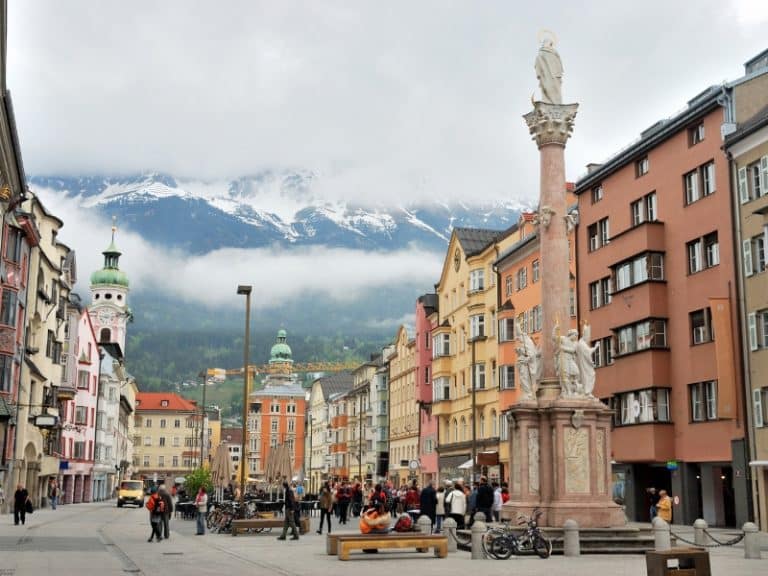
The Annasäule was erected after the last Bavarian troops were expelled from Tyrol during the War of the Spanish Succession, and it was consecrated in 1706. Cristoforo Benedetti of Trento designed it in red Kramsach marble, and a statue of the Virgin stands on top about 13 metres above the street.
4Tyrolean State Museum Ferdinandeum
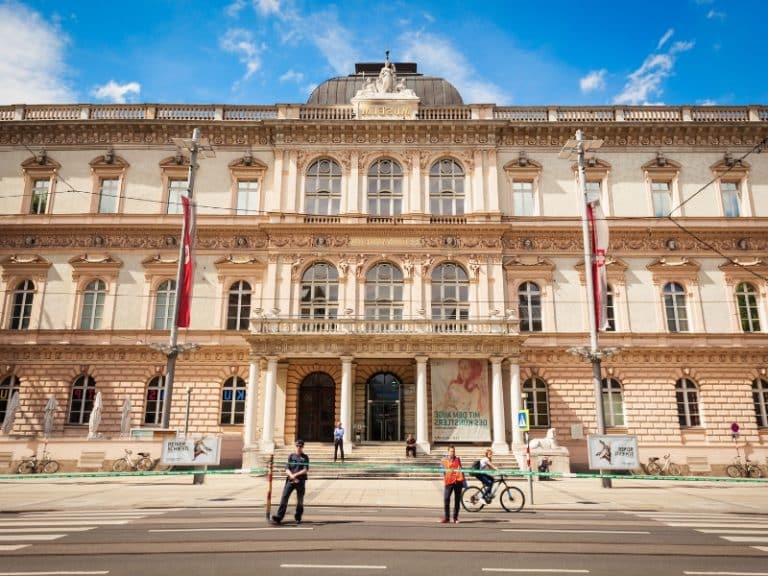
The Ferdinandeum was founded in 1823 by a Tyrolean museum society and is named after Archduke Ferdinand. Its collections range from prehistoric and Roman finds to Gothic and modern art, including works by Michael Pacher and a music room with instruments by Jakob Stainer.
5City Tower (Stadtturm)
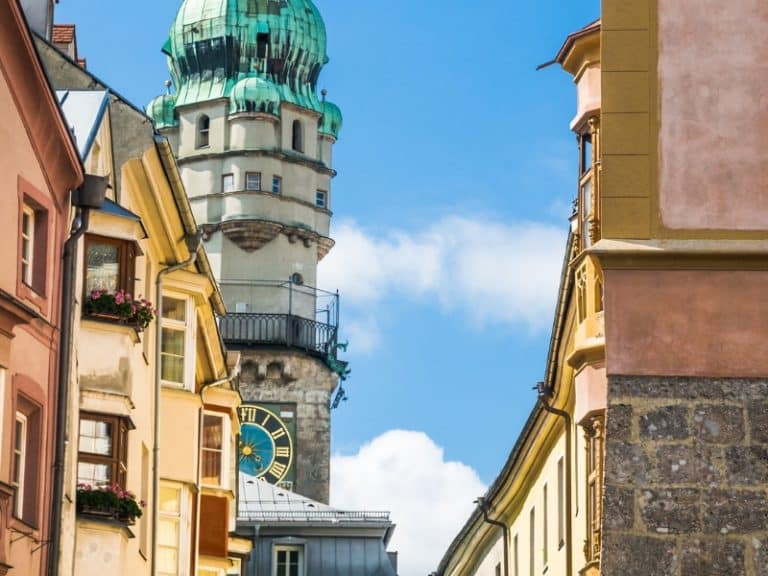
The Stadtturm was built between 1442 and 1450 in the late Gothic style as part of Innsbruck's old town hall. At 51 metres it still dominates the skyline, and its viewing platform at 31 metres is reached by 133 steps, with no lift.
Read the full story →
6Golden Roof (Goldenes Dachl)
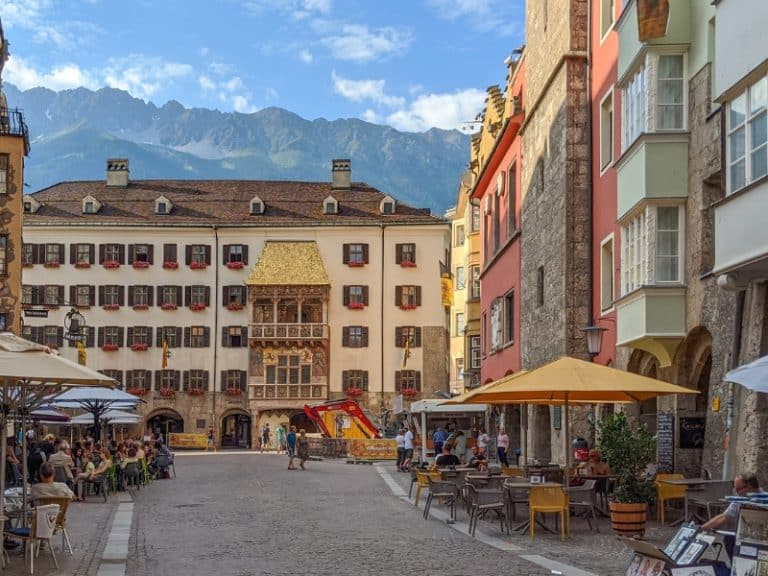
The Golden Roof is an oriel, or bay window, added between 1497 and 1500 to a residence built in 1420, for Maximilian I. Its roof is covered with 2,657 fire-gilded copper shingles, and its reliefs show Maximilian with his two consorts, a chancellor and a court jester.
Read the full story →
7Hofburg
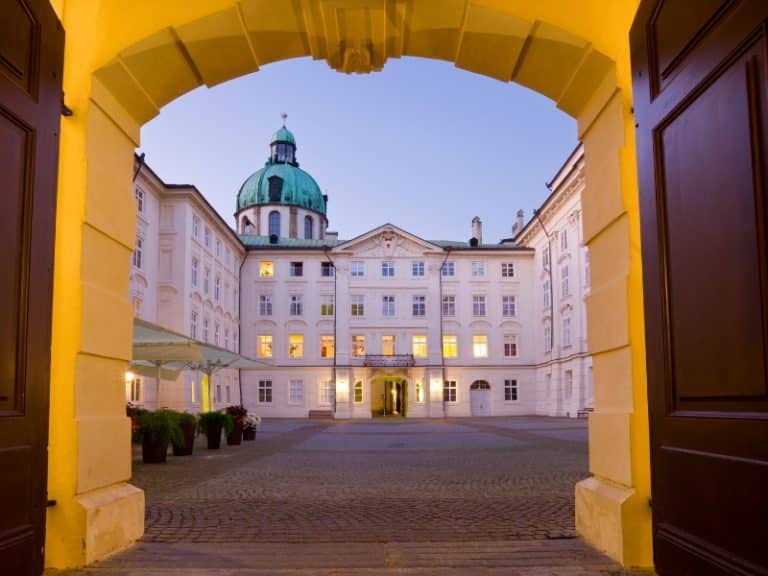
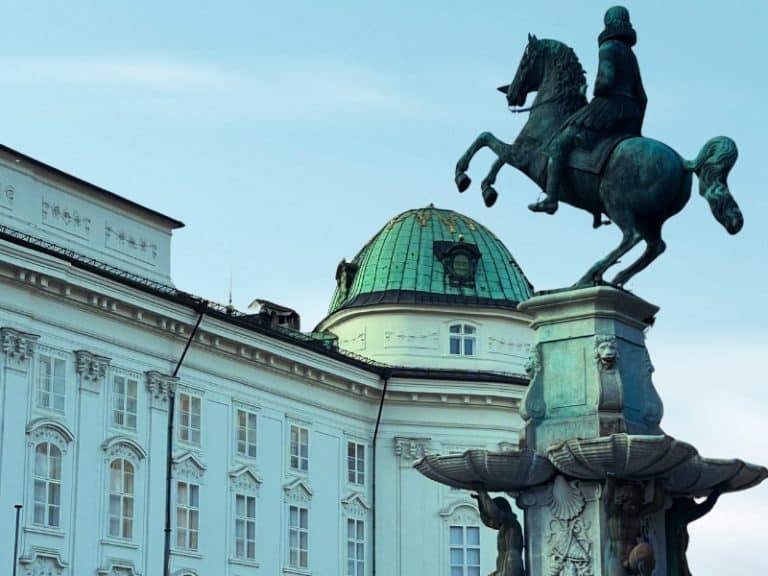
Work on the Hofburg began in 1446 under Archduke Sigismund, and the palace was rebuilt in the Baroque style for Empress Maria Theresa between 1754 and 1776. Its main façade on Rennweg was designed by Nikolaus Pacassi, and Franz Anton Maulbertsch painted the ceiling fresco of the Giants' Hall in 1775 and 1776.
8Court Church (Hofkirche)
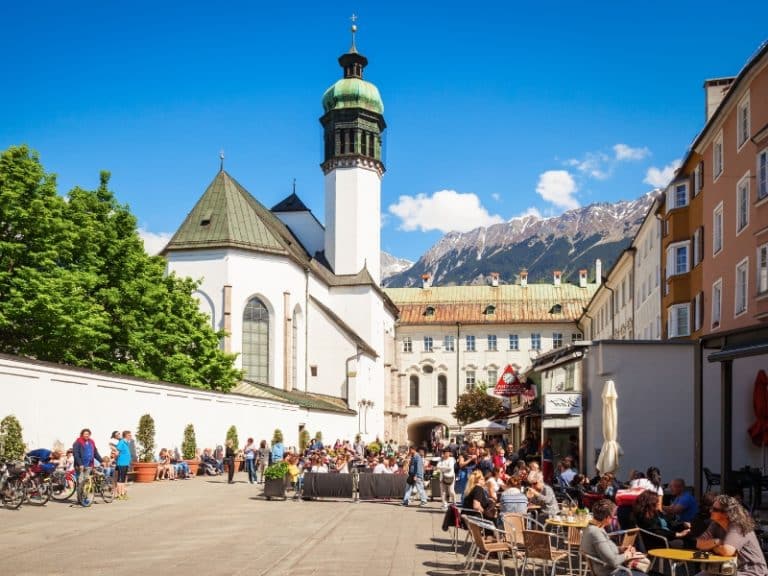
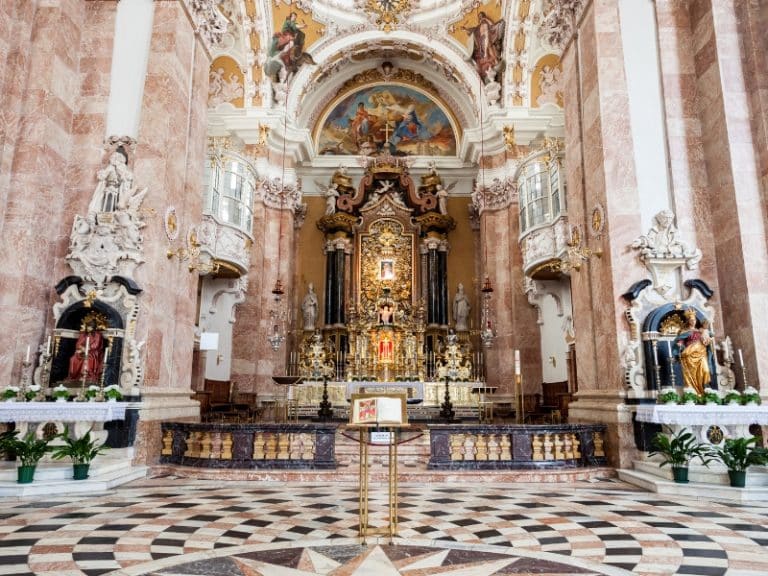
Work on the Court Church began in 1502 on a tomb planned by Maximilian I for himself. Its cenotaph shows him kneeling life-size on the lid, surrounded by 24 reliefs from his life and by bronze figures of his ancestors, known as the Black Men, of which 28 of the planned 40 were completed.
9Leopold Fountain (Leopoldsbrunnen)
The Leopold Fountain on Rennweg was built between 1622 and 1630 for Archduke Leopold V, whose equestrian statue was meant as a symbol of his claim to power. The fountain took its present appearance only in 1893, and it is named after the archduke who commissioned it.
10Cathedral of Saint James (Dom St. Jakob)Finish
The cathedral of Saint James took its present Baroque form between 1717 and 1724, to a design by Johann Jakob Herkomer, who died in 1717 and was succeeded by Johann Georg Fischer. Cosmas Damian Asam painted its frescoes, and the church became a cathedral only in 1964.
Read the full story →
Only logged in customers who have purchased this product may leave a review.




Reviews
There are no reviews yet.