
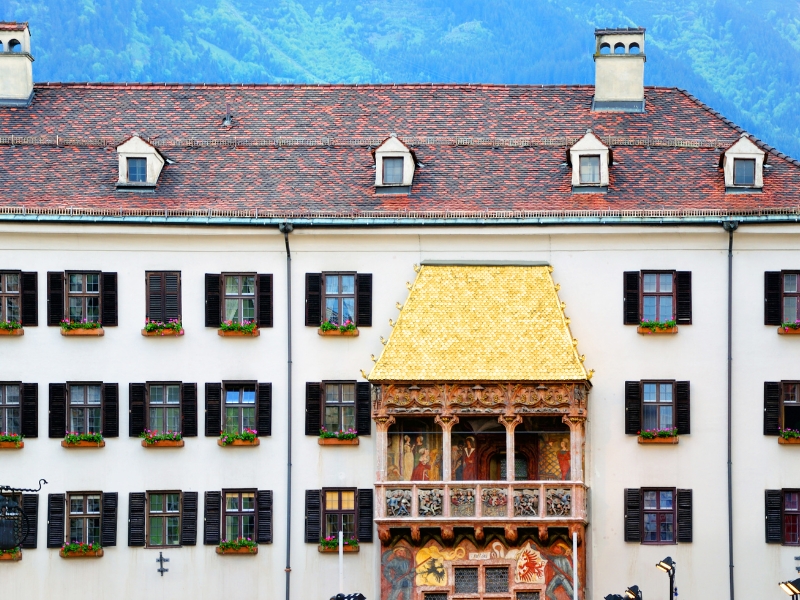
The Golden Roof, or Goldenes Dachl, is a late Gothic balcony at the end of Herzog-Friedrich-Straße in Innsbruck's old town, covered with 2,657 fire-gilded copper tiles. Emperor Maximilian I had it added to the old ducal residence around 1500 as a royal box, from which he and his court could watch tournaments and festivals in the square below. It has been the symbol of Innsbruck ever since the late 19th century.
The Golden Roof at a glance
- Where: Herzog-Friedrich-Straße 15, at the end of the main street of the old town, facing the square where the street widens.
- Built: the oriel was added in roughly 1497–1500 to a residence built around 1420.
- By: Niklas Türing the Elder, Maximilian's court builder in Innsbruck; the wall paintings are traditionally attributed to the court painter Jörg Kölderer.
- What it is today: the building houses the Golden Roof Museum, the city archive and, since 2003, the permanent secretariat of the Alpine Convention.
- Time needed: 10 minutes outside, around an hour if you visit the museum inside.
An emperor's box seat on the old town
The building behind the balcony, known as the Neuhof, was built around 1420 as a residence for the Tyrolean princes when Innsbruck became their seat. Maximilian I, who loved Tyrol and spent much time here, commissioned the showpiece oriel at the end of the 15th century. It is often linked to his marriage to Bianca Maria Sforza of Milan in 1494 and to the turn of the century in 1500. The gilded roof was meant to catch the eye from far down the street, while the two open floors of the loggia gave the emperor a stage from which to see and be seen.
The square below was used for tournaments, festivals and public events, not all of them happy ones: in 1536 the Anabaptist preacher Jakob Hutter was burned alive in front of the building. Today the oriel's reliefs are careful copies, as the originals were moved to the Tyrolean State Museum Ferdinandeum to protect them. A museum about Maximilian opened inside in 1996 and was renewed and reopened as the Golden Roof Museum in 2007.
What to look for
- The roof: 2,657 copper tiles gilded by the fire-gilding method, which is why they still glow after more than five centuries.
- The coats of arms: the lower balustrade carries eight carved shields representing Maximilian's lands, with painted standard-bearers above them.
- Maximilian with two wives: on the upper balustrade, one central relief shows the emperor with Bianca Maria Sforza, who holds an apple, and with his first wife, Mary of Burgundy.
- The jester and the chancellor: the other central relief shows Maximilian with his court jester and his chancellor.
- The Morisco dancers: the outer reliefs show acrobatic dancers, a popular entertainment of the time.
A mystery inscription
Behind the figures on the reliefs runs a ribbon of strange characters that puzzled scholars for centuries: a mix of Latin, Greek and Hebrew letters and possibly invented signs. Parts were deciphered in 2006, including a word read as 'Christ' and another as 'nihil' (nothing). In 2020 a local amateur historian claimed to have read the whole thing as 'Ego sum lux mundi', 'I am the light of the world', but this has not been confirmed. Take a close look and see what you make of it.
Tips for your visit
- Come early in the morning, before the tour groups arrive, to photograph the roof with an empty street in front of it.
- Walk up Herzog-Friedrich-Straße from the river end for the classic view, with the Golden Roof closing off the street ahead.
- On sunny afternoons the gilding is at its brightest; on grey days, look for the details of the reliefs instead.
Nearby
- Helblinghaus: the house opposite with an extravagant late Baroque stucco facade, among the most photographed in the city.
- Stadtturm: the old city tower a few steps away, with a viewing gallery over the rooftops to the mountains.
- Hofburg: the imperial palace of Innsbruck, remodelled under Maria Theresa, a couple of minutes' walk away.
- Hofkirche: the court church with Maximilian's monumental tomb, surrounded by 28 larger-than-life bronze figures.
See Innsbruck with World City Trail
Our Innsbruck scavenger hunt turns the old town into a game you play on your phone. The route links 10 stops and takes around 2 hours, with about 24 minutes of walking, and it includes places such as the Triumphpforte and Eduard-Wallnöfer-Platz. You can play in English, German, French, Italian, Spanish and Dutch.
If you prefer a different format, Innsbruck also has a self-guided walking tour and an outdoor escape game.
Play the Innsbruck scavenger hunt →
Take the self-guided walking tour of Innsbruck →
Play the outdoor escape game in Innsbruck →
Facts checked in October 2026.