
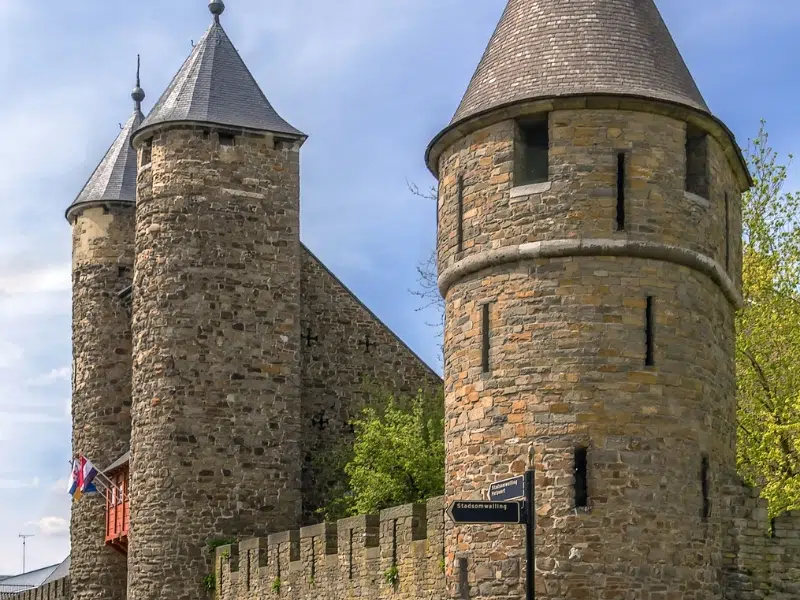
The Helpoort is a stone gate with two round towers at the southern edge of Maastricht's old town, in the Jeker Quarter. Built around 1229 as part of the city's first wall, it is the oldest surviving city gate in the Netherlands. Despite its name, it has nothing to do with hell: for centuries it was called the Hoogbruggepoort, and the name Helpoort came much later.
Helpoort at a glance
- Where: at the end of Sint Bernardusstraat in the Jeker Quarter, on the southern edge of the old town near the Stadspark.
- Built: around 1229, as a gate in Maastricht's first city wall.
- What it is today: a protected monument housing the Maastricht Fortress Museum, which tells how the city's defences were built and attacked, and runs guided walks along the ramparts.
- Time needed: 10 minutes to see the gate, about an hour with the museum, longer with a rampart walk.
From city gate to gunpowder store
In the early 13th century Maastricht received the right to build a wall, and work on the first ring of defences began around 1229. The Helpoort guarded the road into the city from the south. When the city grew and a second, wider wall was built from the 14th and 15th centuries onwards, the old gate ended up inside the town and lost its military role.
It survived because it remained useful. Over the centuries the building served as a meeting place for cloth merchants, a storehouse, a gunpowder magazine and a home. Most of the first wall disappeared, but this gate and a stretch of wall beside it were kept, and today they are among the best-preserved monuments in Maastricht.
What to look for
- The two round towers: they flank the gateway passage, guarding what was once the road into the city from the south.
- The wooden bay window: above the passage, a small timber oriel projects from the thick stone walls.
- The walls: feel the thickness of the natural stone as you walk through the passage, which is still open to pedestrians.
- The old city wall: next to the gate, a stretch of the 13th-century wall survives, with the Jeker flowing at its foot.
- The Pesthuys: the long building just outside the gate, beside the river, with cast-iron wall anchors on its façade.
Why 'Hell Gate'?
The name sounds dramatic, but the Helpoort was not named after hell or a gate of the dead. For centuries it was known as the Hoogbruggepoort, the gate of the high bridge. The name Helpoort appeared much later and probably refers to a house in the neighbourhood called 'In de Helle'. The plague house next door has a similar story: the Pesthuys was originally a paper mill called Het Ancker, and despite its name it never served as a plague hospital; the nickname comes from the time when plague patients were isolated in the houses around it.
Tips for your visit
- Walk through the gate from the old town side first, then turn around outside to see the towers and the gateway from the south.
- The Fortress Museum is not open every day, so check before you go if you want to see inside or join a rampart walk.
- Come in the late afternoon, when the Jeker Quarter's cafés fill up and the low sun lights the stone.
- Combine the gate with a walk along the Jeker and the walls of the Stadspark towards the river Maas.
Nearby
- De Vijf Koppen: a late-medieval bastion on the second city wall, named after five heads put on display after executions during the Eighty Years' War; the museum's guided walks go there.
- Bisschopsmolen: a working watermill on the Jeker with a bakery, a few minutes' walk into the old town.
- Natural History Museum Maastricht: in a 17th-century former convent, home to a fossil of the Mosasaurus, the giant marine reptile named after the Maas.
- Stadspark: the green park along the old ramparts, with views of the walls and the Jeker.
See Maastricht with World City Trail
Our Maastricht scavenger hunt turns the old town into a game you play on your phone. The route links 10 stops and takes around 2 hours, with about 36 minutes of walking, and includes places such as the Sint Servaasbrug, the Town Hall on the Markt and the Dominicanen bookshop. You can play in English, German, French, Italian, Spanish or Dutch.
If you prefer a different format, there is also a self-guided walking tour and an outdoor escape game in Maastricht.
Play the Maastricht scavenger hunt →
Take the self-guided walking tour of Maastricht →
Play the outdoor escape game in Maastricht →
Facts checked in October 2026.