
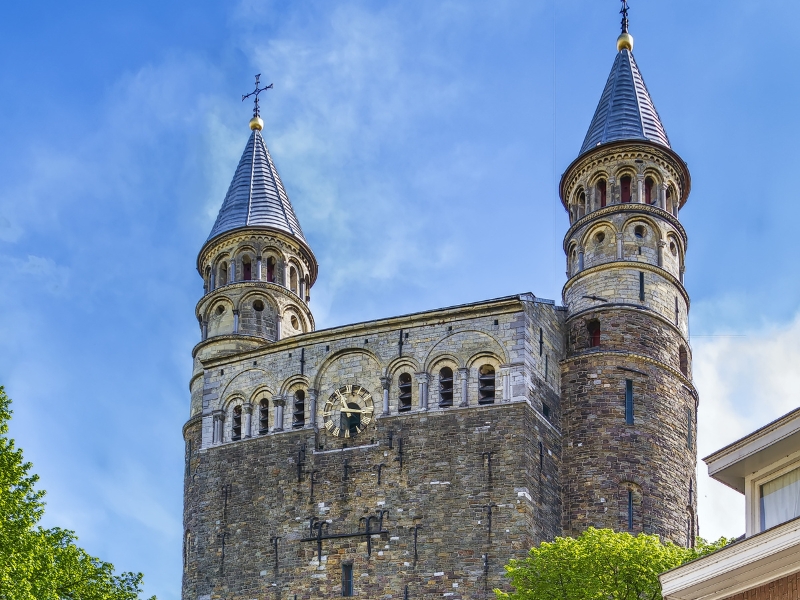
The Basilica of Our Lady (Onze-Lieve-Vrouwebasiliek) is a Romanesque church on a small, tree-lined square in Maastricht's old town, built mostly in the 11th and 12th centuries inside the walls of the old Roman fort. Its massive, almost windowless west front looks more like a castle than a church. Just inside, a candlelit chapel holds the Star of the Sea, the 15th-century statue of Mary that is Maastricht's best-loved image.
The Basilica of Our Lady at a glance
- Where: Onze Lieve Vrouweplein, in the southern part of the old town, a few minutes from the Maas and the Helpoort.
- Built: mainly in the 11th and 12th centuries; work on the westwork began shortly after the year 1000, and the cloister was rebuilt in 1558–59.
- What it is today: a Catholic parish church of the Diocese of Roermond and a minor basilica since 1933, with the Star of the Sea chapel, a cloister and a treasury.
- Time needed: 30–45 minutes, longer if you visit the treasury.
From Roman fort to minor basilica
The church stands inside the Roman castrum that guarded the Maas crossing, and an earlier church may have served as the cathedral of the diocese of Tongeren-Maastricht in the 4th or 5th century, although no excavation inside has confirmed it. Before 1100 it became a collegiate church with about 20 canons appointed by the prince-bishop of Liège, and its ties to Liège lasted until 1798. The present building is one of the main works of the Mosan Romanesque style: the westwork came first, the nave followed in the second half of the 11th century, and the east choir, modelled on the choir of St Lambert's Cathedral in Liège, was added in the 12th century. The nave got its Gothic vaults in the 13th century.
After the French annexed Maastricht in 1794, religious institutions were dissolved, and the garrison used the church and cloister as a blacksmith's shop and stables. Worship returned only in 1837, when the parish of the nearby St Nicholas Church moved here; St Nicholas was demolished the following year. Between 1887 and 1917 the architect Pierre Cuypers restored the church, stripping away Baroque plaster and replacing large Gothic windows with small Romanesque ones. Pope Pius XI made it a minor basilica on 20 February 1933.
What to look for
- The westwork: the tall, closed west front flanked by two slender towers. Some of the stones in its lower part are reused Roman blocks.
- The Star of the Sea chapel: entered through a Gothic portal from the square, it holds the wooden statue of Mary, surrounded by candles and votive offerings.
- The capitals in the choir ambulatory: 20 carved capitals show scenes from the Hebrew Bible, animals and monsters. One is signed Heimo, and its carving may show the sculptor handing a capital to the Virgin.
- The cloister: late Gothic, built of local marl in 1558–59, with old gravestones in the floor, some brought from the demolished St Nicholas Church.
- The east end: from outside, look for the rounded choir between two towers topped with stone Rhenish helm roofs.
The Star of the Sea
The statue of Mary known as the Star of the Sea (Sterre der Zee) was carved in the 15th century for a Franciscan monastery nearby. It moved to St Nicholas Church in 1801 and to Our Lady's in 1837, and since 1903 it has stood in its own Gothic chapel near the main entrance. Pope Pius X had the image crowned on 15 August 1912. The statue is carried through the city in processions twice a year, and on an ordinary day a steady stream of people comes in to light a candle.
Tips for your visit
- Be quiet in the Star of the Sea chapel: it is a place of prayer at all hours. Skip the flash and keep photos discreet.
- Walk all the way round the outside to compare the fortress-like westwork with the rounded east choir.
- Afterwards, take a seat on one of the café terraces under the trees on Onze Lieve Vrouweplein.
Nearby
- Helpoort: the oldest surviving city gate in the Netherlands, from 1229, a few minutes' walk south.
- Sint Servaasbrug: the 13th-century stone bridge over the Maas, one of the oldest bridges in the Netherlands.
- Vrijthof and St Servatius Basilica: the city's large square and the church built over the grave of Saint Servatius, Maastricht's first bishop.
- Dominicanen bookshop: a bookshop set inside a 13th-century Gothic Dominican church.
See Maastricht with World City Trail
Our Maastricht scavenger hunt turns the old town into a game you play on your phone. The route links 10 stops and takes around 2 hours, with about 36 minutes of walking. It includes the Sint Servaasbrug, the Town Hall on the Markt and the Dominicanen bookshop. You can play in English, German, French, Italian, Spanish or Dutch.
If you prefer a different format, there is also a self-guided walking tour and an outdoor escape game in Maastricht.
Play the Maastricht scavenger hunt →
Take the self-guided walking tour of Maastricht →
Play the outdoor escape game in Maastricht →
Facts checked in October 2026.