
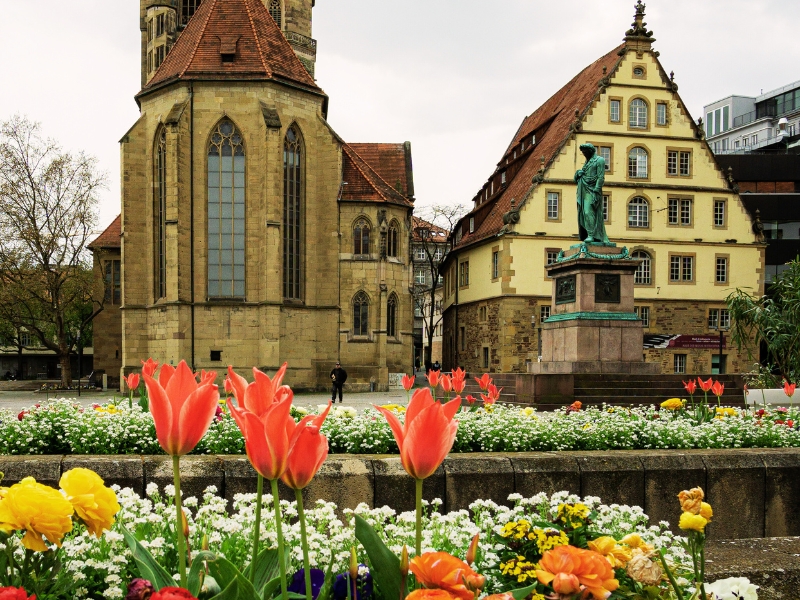
Schillerplatz is the cobbled square at the historic core of Stuttgart, ringed by the Old Castle, the Collegiate Church, the Old Chancellery and the Prinzenbau. In its centre stands the statue of the poet Friedrich Schiller by the Danish sculptor Bertel Thorvaldsen, unveiled in 1839 as the first monument to Schiller in Germany. The square itself has kept the dimensions it was given in the 1590s.
Schillerplatz at a glance
- Where: in the city centre, just south-west of Schlossplatz and a couple of minutes from the Marktplatz.
- Created: laid out as a Renaissance square from 1594 by the ducal architect Heinrich Schickhardt; officially named Schillerplatz in 1934.
- By: Heinrich Schickhardt (square); Bertel Thorvaldsen (Schiller monument, 1839).
- What it is today: a public square with a street market twice a week, used for the Christmas market and the Stuttgart wine festival, with an underground car park beneath.
- Time needed: 15–20 minutes for the square, more if you visit the church or the museums around it.
From stud farm to Renaissance square
Stuttgart takes its name from a stud farm, the Stutengarten, and the town's first known stone building, the Stuthaus, stood next to the present Collegiate Church; the area of the square may have been part of that stud around the year 1000. Houses spread over it from the 12th century, and the Old Castle and the Old Chancellery, finished in 1542, grew up along its edges. In 1594 Duke Frederick I had Heinrich Schickhardt turn the cramped space into a representative square: houses were bought and demolished, the ground was paved, and the result was called the Castle and Chancellery Square.
The Prinzenbau, begun in the early 17th century as a house for envoys, was completed in 1677, and the castle moat was filled in in 1775–77, giving the square its final form. When the New Castle was built from 1746, the old square became known as the Alter Schlossplatz; the Schiller statue of 1839 gave it the popular name it officially received in 1934. All the buildings around it burned in 1944–45 and were rebuilt with their old exteriors, except for the King of England inn, replaced by a plain new building in the 1950s. The underground car park was dug in 1972–73, destroying much of the archaeology beneath.
What to look for
- Thorvaldsen's bronze Schiller in the centre, based on a drawing made of the poet in 1787 that has since been lost.
- The Mercury Column at the north entrance by the Old Chancellery: a slender former water tower of 1598, crowned since 1862 by a gilded figure of Mercury.
- The late Gothic Fruchtkasten, the old granary in the south-west corner beside the Collegiate Church, now the Württemberg State Museum's House of Music.
- The Kanzleibogen, the archway through the Prinzenbau in the northern corner, which leads towards Königstraße and the Kunstmuseum.
- The Old Castle on the east side, with its round corner towers; parts of the castle date back to the 14th century.
A fairy tale about the statue
Hans Christian Andersen, a fellow Dane of Thorvaldsen, wrote a tale called The Old Church Bell about the making of the monument. In it, the cracked old bell of Schiller's home town of Marbach is melted down and recast as the bronze of the statue. It is a fairy tale, not history, but it shows how much the monument meant to people at the time: a Danish sculptor and a Danish writer helped turn a Swabian poet into a national figure.
Tips for your visit
- Come on a market morning for the liveliest atmosphere; the stalls fill the square around the statue.
- In late November and December the square becomes part of the Christmas market, so expect crowds.
- For a good photo, stand by the Prinzenbau and frame Schiller with the Collegiate Church's towers behind him.
- Combine the square with the Stiftskirche and the Old Castle's arcaded courtyard, both right on its edge.
Nearby
- Stiftskirche: Stuttgart's main Protestant church, on the south side of the square, with a row of Renaissance statues of the counts of Württemberg inside.
- Old Castle: the former ducal residence, now the Württemberg State Museum, with an arcaded Renaissance courtyard.
- Schlossplatz and New Castle: the city's largest square with the Baroque palace, just through the Planie.
- Marktplatz: the market square with the town hall, a couple of minutes' walk along Kirchstraße.
See Stuttgart with World City Trail
Our Stuttgart scavenger hunt turns the city centre into a game you play on your phone. The route takes around 3 hours, with about 43 minutes of walking, and leads you through the historic centre. You can play in English, German, French, Italian, Spanish and Dutch.
If you prefer a different format, Stuttgart also has a self-guided walking tour and an outdoor escape game.
Play the Stuttgart scavenger hunt →
Take the self-guided walking tour of Stuttgart →
Play the outdoor escape game in Stuttgart →
Facts checked in October 2026.