
In the heart of Turin, amidst the elegant arcades of Piazza Castello, stands the Duke of Aosta monument that tells a compelling story of national pride, military heroism, and World War I sacrifice. The Monumento a Emanuele Filiberto Duca d’Aosta is more than just a statue; it is a powerful symbol of Italy’s history, a tribute to one of its most revered military leaders, and a must-see for anyone exploring the city’s rich past. Its imposing bronze figures and central location make it a commanding landmark that captures the essence of a nation coming to terms with its role in a global conflict.
The “Undefeated Duke”
The monument honors Emanuele Filiberto, Duke of Aosta (1869–1931), a prominent member of the House of Savoy, Italy’s royal family. A general and a cousin of King Victor Emmanuel III, he earned his place in history as the commander of the Italian Third Army during World War I. In the brutal trench warfare on the Isonzo Front, his army earned the nickname Armata Invitta, or the “Undefeated Army,” and he became known as Il Duca Invitto (“The Undefeated Duke”). His leadership, marked by loyalty and courage, made him a beloved figure both during and after the war.
Tragically, the Duke died in 1931, a loss that prompted a nationwide effort to create a monument in his honor. The people of Italy, particularly those in Turin, the historical capital of the House of Savoy, wanted to commemorate his legacy. The monument was inaugurated on July 4, 1937, with a grand ceremony attended by the King, becoming a major national event that solidified the Duke’s place as a hero.

A Masterpiece of Bronze and Symbolism
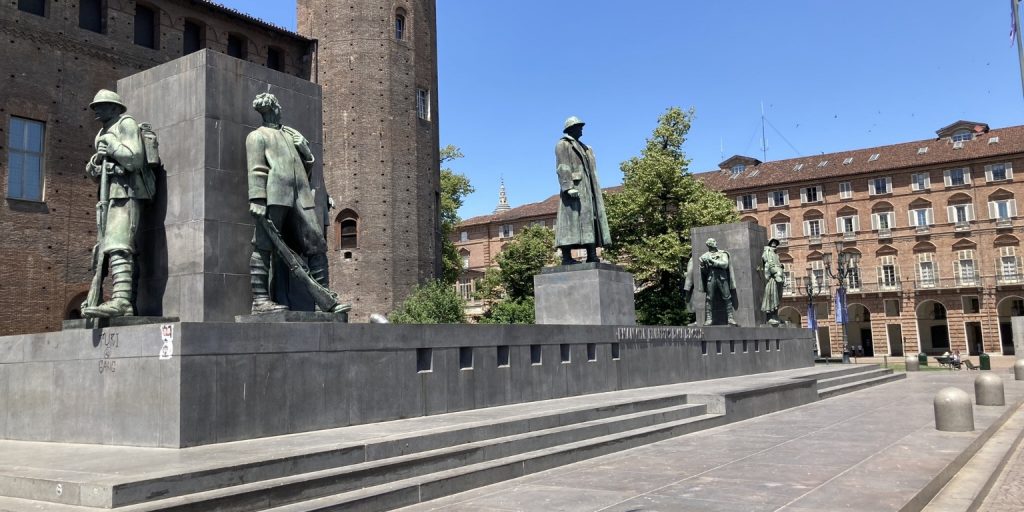
The Duke of Aosta monument is an extraordinary example of monumental sculpture. Designed by sculptors Eugenio Baroni and Publio Morbiducci, it is a massive bronze complex cast from four captured enemy artillery pieces—a symbolic act of turning the instruments of war into a tribute to peace and remembrance. The central figure is a towering statue of the Duke himself, standing resolutely with clenched fists and looking east, toward the battlefields where he fought. His posture and expression convey a sense of unyielding determination and sorrow for the men he commanded.
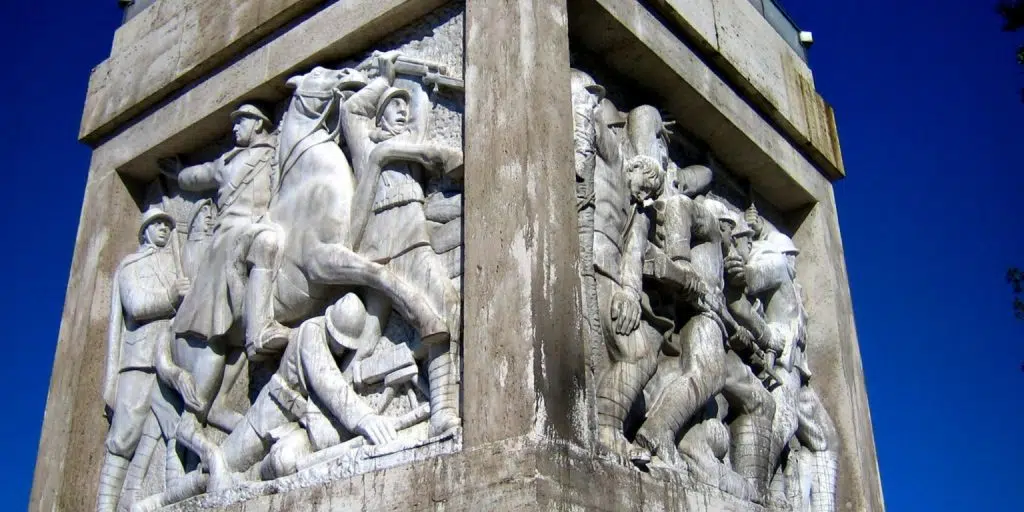
Flanking the Duke’s statue are two powerful groups of soldiers, eight in total, representing the infantry, artillery, engineers, and other branches of the Italian army that fought in the war. These figures are depicted in a somber and realistic manner, their weary expressions and battle-worn gear conveying the hardship of the conflict. The entire composition stands on a base that symbolically represents a captured trench, a poignant reminder of the brutal and costly nature of the war.
A Place of National Pride
The Duke of Aosta monument is a key feature of Turin’s urban landscape and a source of deep civic pride. Its location in Piazza Castello places it at the very heart of the city’s royal and political heritage, surrounded by magnificent buildings like the Palazzo Madama and the Royal Palace. The monument is not merely an artistic installation; it is a point of reference for historical reflection and a gathering place for ceremonies commemorating the fallen of World War I.
For any visitor to Turin, the monument is an absolute must-see. It provides a deeper understanding of Italy’s national identity and its enduring connection to the House of Savoy. The power of its artistry and its historical significance make it a compelling destination. It stands as a timeless reminder of the sacrifices of a generation and the unwavering spirit of a nation, all beautifully captured in a single, powerful monument in the heart of Turin.