
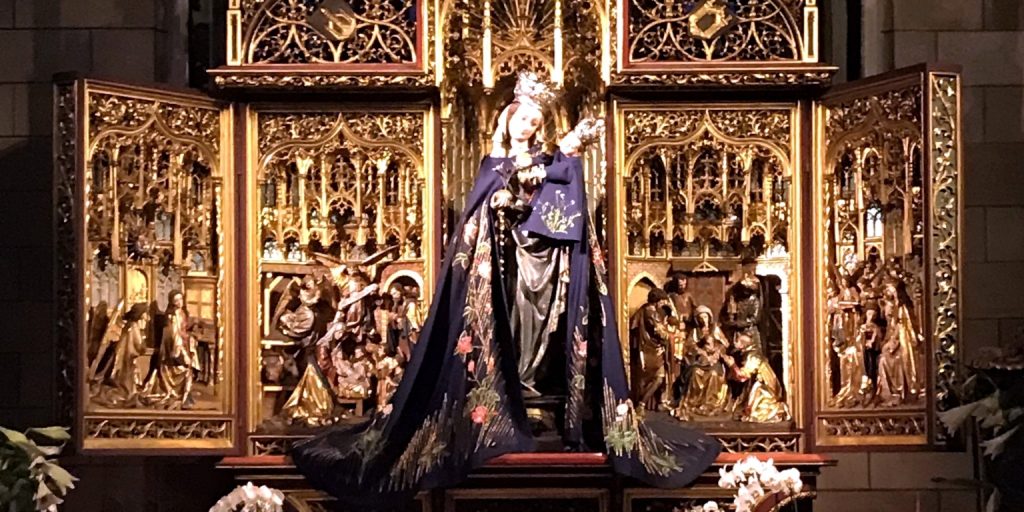
The Star of the Sea (Sterre der Zee) is a small 15th-century wooden statue of the Virgin Mary in a candle-lit chapel of the Basilica of Our Lady in Maastricht. It is the city's best-loved religious image: people of Maastricht drop in all day to light a candle and say a prayer, and the statue still leaves the church in procession through the old town.
The Star of the Sea at a glance
- Where: in the Mérode chapel of the Basilica of Our Lady (Onze-Lieve-Vrouwebasiliek), entered from Onze Lieve Vrouweplein in the old town south of the Markt.
- Created: probably around 1470; the statue's carver is not known.
- In the basilica since: 1837, and in its own chapel by the main entrance since 1903.
- What it is today: a place of pilgrimage and everyday prayer, crowned on behalf of Pope Pius X in 1912, and carried through the streets in procession.
- Time needed: 10–15 minutes for the chapel; about an hour if you also visit the basilica and its treasury.
From a Franciscan altar to the Mérode chapel
The statue first belonged to the Franciscans, whose monastery stood on Sint-Pieterstraat in the south of the old town. The friars carried it through the streets in a grand procession on Easter Monday, a custom that goes back about five centuries. According to tradition, in 1684 a nobleman caught in a storm at sea promised to build an altar for the statue if he survived; he came home safely, had the altar built in the Franciscan church, and from then on the Madonna was known as the Star of the Sea.
After the French took Maastricht in the 1790s and the monasteries were closed, the statue moved in 1801 to the former parish church of St Nicholas next to the basilica. When that church closed in 1837, it was brought into the basilica itself, and in 1903 it was given the Gothic side chapel by the main entrance where it stands today. On 15 August 1912 it was solemnly crowned, a ceremony carried out by the bishop of Roermond on behalf of Pope Pius X, and in 1933 the church was made a minor basilica.
What to look for
- The statue: a wooden Madonna of around 1470, usually dressed in a fabric cloak and wearing a crown, so that little of the carved wood is visible.
- The candles: banks of votive candles that burn in front of the statue from morning to evening. Lighting one is the main ritual here, for believers and visitors alike.
- The portal: the chapel is entered through a 13th-century Gothic doorway, rebuilt in the 15th century, that opens straight onto Onze Lieve Vrouweplein.
- The cloak: one of the statue's cloaks was made by people in Maastricht with the help of local firms, with a lining printed with the names of hundreds of sponsors.
- The basilica's westwork: step back onto the square to see the massive, fortress-like west front, begun shortly after the year 1000 and one of the oldest parts of the church.
Why 'Star of the Sea'?
Stella Maris, Star of the Sea, is an old Latin title for Mary, long used by sailors who prayed to her for a safe voyage. In Maastricht, a river city far from the coast, the name is tied to the 1684 story of the storm-tossed nobleman; it is a pious tradition rather than a documented event. The procession has also had a recent revival. In 2017 the Brotherhood of Our Lady restored the Grand Walk of Prayer (Bidweg), in which the Bearers' Guild carries the flower-decked statue on their shoulders through the old town. It now takes place every year on 10 October, the diocesan feast of the Star of the Sea, and it is listed in the Netherlands' inventory of intangible heritage.
Tips for your visit
- The chapel is a place of prayer, and many visitors are locals stopping on their way through town. Keep your voice down, do not use flash and leave the front benches to people praying.
- Because the chapel has its own door on the square, you can step in even when you are not visiting the rest of the basilica.
- If you are in Maastricht on 10 October, watch for the procession leaving the basilica; at other times of year the Little Walk of Prayer takes place on Saturday mornings without the statue.
Nearby
- Onze Lieve Vrouweplein: the tree-shaded square in front of the basilica, lined with café terraces.
- Helpoort: the oldest surviving city gate in the Netherlands, from 1229, a few minutes' walk south.
- Sint Servaasbrug: the old stone bridge over the Maas, built in the late 13th century, a short walk north-east.
- Vrijthof: Maastricht's great square with the Basilica of St Servatius and St John's Church, about ten minutes away on foot.
See Maastricht with World City Trail
Our Maastricht scavenger hunt turns the old town into a game you play on your phone. The route links 10 stops and takes around 2 hours, with about 36 minutes of walking. It includes the Sint Servaasbrug, the Town Hall on the Markt and the Dominicanen bookshop. You can play in English, German, French, Italian, Spanish and Dutch.
If you prefer a different format, there is also a self-guided walking tour and an outdoor escape game in Maastricht.
Play the Maastricht scavenger hunt →
Take the self-guided walking tour of Maastricht →
Play the outdoor escape game in Maastricht →
Facts checked in October 2026.