
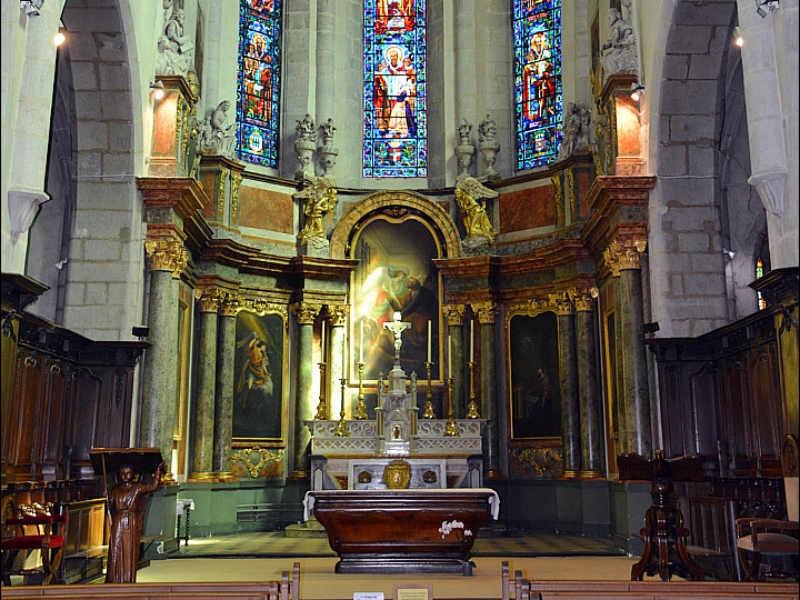
The Cathédrale Saint-Pierre is Annecy's cathedral, a modest Gothic church with an Italian Renaissance facade on rue Jean-Jacques Rousseau in the old town. It was built in the 1530s for a Franciscan convent, and within a few years it became the church of the bishops of Geneva, who had fled to Annecy when Geneva turned Protestant.
Cathédrale Saint-Pierre at a glance
- Where: on rue Jean-Jacques Rousseau in the old town, a short walk from the Palais de l'Île.
- Built: 1535–1538, with the facade the last part to be finished.
- By: built for the Cordeliers (Franciscans) after a vow by the churchman Pierre Lambert; Jacques Rossel, a master builder of Geneva's cathedral, worked on it.
- What it is today: the cathedral of the Diocese of Annecy since 1822, and a regular venue for concerts.
- Time needed: 15–20 minutes.
From convent chapel to cathedral
The church was built between 1535 and 1538 as the chapel of the Cordeliers' convent, paid for by the Lambert family, whose house stood opposite. At almost the same moment Geneva adopted the Protestant Reformation, and the Catholic bishop of Geneva and many of his clergy moved to Annecy. From 1538 the new Franciscan church served as their cathedral in exile. Francis de Sales, bishop of Geneva from 1602 and later a saint, preached here.
The French Revolution brought a sharp break: the church was stripped of its religious use and turned into a 'Temple of Reason'. Catholic worship returned afterwards, and in 1822 the church officially became the cathedral of the newly created Diocese of Annecy. Around 1775 the Turin architect Giovanni Piacenza had already redesigned the choir, and later centuries added an organ and new stained glass.
What to look for
- The facade: the lower level is divided into three by flat pilasters and the upper level ends in a triangular pediment, the Italian Renaissance face of a Gothic church.
- The rose window: a Gothic rose set in the Renaissance facade, inspired by one Jacques Rossel made for Geneva's cathedral.
- The Lambert coat of arms: above the main door, the arms of the family that paid for the building.
- The organ: installed in 1842 and listed as a historic monument.
- The interior: a plain Gothic nave with a choir redesigned in the late 18th century, 18th-century stucco and stained glass from the 1930s.
Hard to see in one piece
Houses crowd so closely around the cathedral that it is difficult to see the whole building from the street. Walk around to the side for a clearer view of its volume, and from rue Royale you can see one of the old town's canals running underneath the building. Its small bell tower holds two bells; the larger, weighing about 3 tonnes, was cast by the Paccard foundry, which still works in the area.
Tips for your visit
- Look out for posters at the door: concerts, often of Baroque music, are held here regularly.
- Keep quiet if a service is under way; this is a working cathedral.
- Step back across the narrow street to photograph the facade, ideally in the morning before the lanes get busy.
Nearby
- Palais de l'Île: the triangular former prison in the middle of the Thiou, a few minutes' walk away.
- Château d'Annecy: the castle of the Counts of Geneva above the old town, now a museum.
- Église Notre-Dame-de-Liesse: the neoclassical church founded by the Counts of Geneva, with a bell tower from around 1530, in the old town nearby.
See Annecy with World City Trail
Our Annecy scavenger hunt turns the old town into a game you play on your phone. The route links 10 stops and takes around 2 hours, with about 18 minutes of walking. Annecy Cathedral is one of the stops, along with the Palais de l'Île, Pont Morens and the Pont des Amours. You can play in English, German, French, Italian, Spanish and Dutch.
If you prefer a different format, there is also a self-guided walking tour and an outdoor escape game in Annecy.
Play the Annecy scavenger hunt →
Take the self-guided walking tour of Annecy →
Play the outdoor escape game in Annecy →
Facts checked in October 2026.