
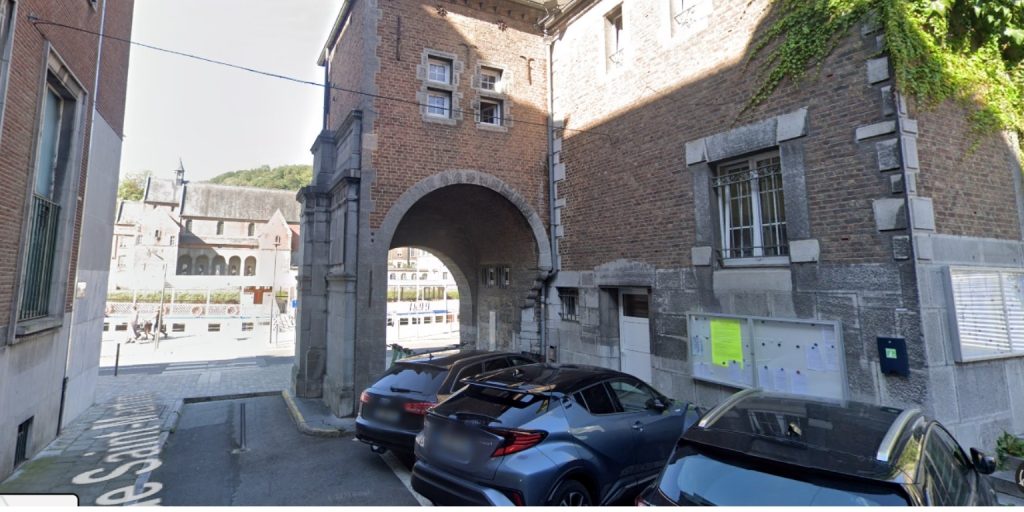
Dinant is a small town squeezed between the River Meuse and a wall of limestone cliffs, and almost everything worth seeing sits along one short stretch of riverbank. This guide covers five places that belong together: the collegiate church under the citadel, the bridge lined with saxophones, the house of Adolphe Sax, the memorial to the civilians killed in August 1914 and the town's regional cultural centre. All of them can be seen in one unhurried walk.
Collegiate Church of Notre-Dame
The Collegiate Church of Notre-Dame is the building on every postcard of Dinant: a Gothic church pressed right against the cliff, with a bulb-shaped bell tower that looks oversized for the narrow quay. An earlier Romanesque church stood here until the 13th century, when a fall of rock from the cliff destroyed it; the present church was built in its place in the Gothic style, and parts of the older building survive on the north side.
Inside, the church is tall and light for its size. Look for the tall stained-glass windows high in the walls. Directly above the church, on top of the rock, sits the citadel, reached either by a long flight of steps that starts beside the church or by cable car. The church is one of the stops on our Dinant scavenger hunt.
- The onion-shaped tower, best seen from the far side of the Meuse, where church, cliff and citadel line up in one view.
- The way the east end of the church is built right up to the rock face.
- The stained-glass windows, which glow most on a sunny morning.
Pont Charles de Gaulle and its saxophones
The road bridge that crosses the Meuse in front of the church is named after Charles de Gaulle. As a young French lieutenant, he was wounded here on 15 August 1914, in one of the first battles of the First World War. A statue of the wounded officer stands at the end of the bridge on the left bank; both the bridge and the statue are stops on the scavenger hunt.
Today most people know the bridge for its saxophones. Large sculpted saxophones line both sides, each painted in its own style by an artist to represent a country of the European Union, a playful tribute to Adolphe Sax, the inventor of the instrument, who was born in Dinant. They make the crossing slow: everyone stops to find their own country. It is also a good spot to watch the river boats pass below.
- The saxophone of your own country and the small plaque that names it.
- The statue of Lieutenant de Gaulle at the left-bank end.
- The view upriver from the middle of the bridge, with the church and citadel framed above the water.
Maison de Monsieur Sax
Adolphe Sax was born in Dinant in 1814, the son of an instrument maker. He moved to Paris and patented the saxophone there in 1846. Besides the saxophone, he also developed the saxhorns, a family of valved brass instruments. The house at his birthplace, on the street now named after him, is a small free visitor centre called the Maison de Monsieur Sax. It tells his story with panels and sound, including the many lawsuits he fought with rival makers. The house and the saxophone monument are both on the scavenger hunt route.
Outside, a bronze Adolphe Sax sits on a bench with his saxophone, and there is space beside him to sit down for a photo. Saxophones turn up all over town, from shop windows to street art, so keep your eyes open as you walk.
Memorial to the victims of 23 August 1914
Dinant's darkest day came in the first weeks of the First World War. On 23 August 1914, German troops entering the town shot 674 civilians, men, women and children, and set much of the town on fire. It was one of the worst of the massacres of Belgian civilians in 1914, and the town still remembers it every year.
Several memorials in the centre recall that day, and the scavenger hunt begins at the memorial to the victims. Take a moment to read the names: whole families are listed together. It helps explain why so much of Dinant's riverside looks rebuilt in the 1920s.
Regional Cultural Centre of Dinant
The Centre culturel régional de Dinant has worked since 1972 to bring theatre, concerts, film, exhibitions and workshops to the town and the surrounding villages, including communes that have no cultural centre of their own. It is the last stop on the scavenger hunt, and a good place to check what is on in the evening if you stay overnight.
How to see them in one walk
Start at the memorial to the victims of 1914, then follow the riverside to the Pont Charles de Gaulle and cross over to the statue of the wounded lieutenant. Walk back over the bridge to the Collegiate Church of Notre-Dame, continue along the main street to the Maison de Monsieur Sax and finish at the cultural centre. If you have energy left, climb the steps beside the church to the citadel for the view over the river. Everything except the de Gaulle statue lies on the same bank of the Meuse, so you never have to retrace your steps for long.
See Dinant with World City Trail
Our Dinant scavenger hunt turns the town into a game you play on your phone. The route links 10 stops, from the memorial to the victims of 1914 to the Regional Cultural Centre. Four of the places in this guide are stops: the collegiate church, the Pont Charles de Gaulle with its statue, the Maison de Monsieur Sax and the cultural centre, along with the saxophone monument.
If you prefer a different format, there is also a self-guided walking tour and an outdoor escape game in Dinant.
Play the Dinant scavenger hunt →
Take the self-guided walking tour of Dinant →
Play the outdoor escape game in Dinant →
Facts checked in October 2026.