
Lausanne is built on steep slopes above Lake Geneva, and its centre climbs in layers from the old river valley to the cathedral hill. This guide covers four places that show those layers: the Esplanade de Montbenon with its lake view, the Flon district in the filled-in valley, the Église Saint-Laurent and the Vaud Parliament on the Cité hill. All four are stops on our Lausanne scavenger hunt.
Esplanade de Montbenon
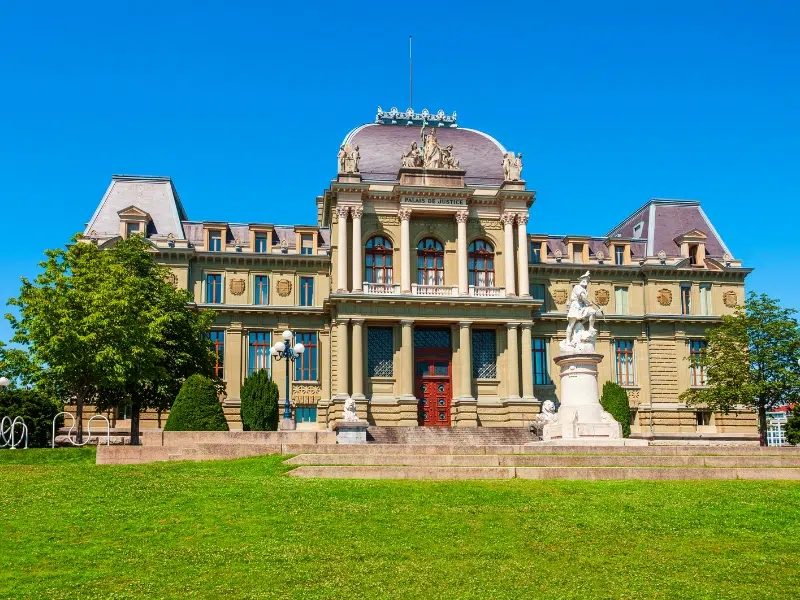
Montbenon is a long, flat terrace west of the centre, one of the few level spaces in this hilly city. At one end stands the Palais de Justice de Montbenon, built in the 1880s by the architect Benjamin Recordon, which housed the Swiss Federal Supreme Court until the court moved to Mon-Repos in 1927. At the other end, the Casino de Montbenon is home to the Cinémathèque suisse, the national film archive.
Between them lies a park with lawns and benches facing south, and on a clear day the view reaches across Lake Geneva to the mountains of the French shore. Look for the statue of William Tell by the French sculptor Antonin Mercié, a gift to the city at the start of the 20th century. The esplanade is one of the scavenger hunt stops.
- The view south over the rooftops to the lake and the Alps of Haute-Savoie.
- The Palais de Justice, with its columns and grand staircase.
- The William Tell statue, with the crossbow on his shoulder.
The Flon district
Below Montbenon lies the Flon, named after the small river that once ran through a deep valley here. In the 19th century the river was put underground, and in the 1870s the valley floor was raised with earth dug out during the construction of the Lausanne-Ouchy railway. The flat new ground was covered with warehouses, and for a century the Flon was a working district of depots and workshops below the bridges.
Since the 1990s the old warehouses have been turned into shops, bars, restaurants, galleries and a cinema, with new buildings in between, and the Flon has become one of the liveliest parts of town, especially at night, when the terraces and clubs fill up and the old loading docks become places to sit. It is also Lausanne's transport hub, where the M1 and M2 metro lines meet. The Flon is the last stop of the scavenger hunt.
- The Grand-Pont, the stone bridge that crosses high above the district, which shows how deep the valley once was.
- The lift towers and stairways that connect the low Flon with the streets above.
Église Saint-Laurent
The church of Saint-Laurent stands on a small square between Rue Saint-Laurent and Rue de l'Ale, on the site of a medieval church that fell into ruin after the Reformation came to Lausanne in 1536. The present Protestant church was built between 1716 and 1719 by the architect Guillaume Delagrange, joining the cathedral and Saint-François as the city's places of worship.
Its façade was redesigned in 1762 by Rodolphe de Crousaz in a neoclassical style, with fluted pilasters and a rounded pediment; the bell tower is built into the front. During the revolutionary years at the end of the 18th century, the church served as a meeting place for political clubs. It is a scavenger hunt stop.
A detour: Place de la Palud
A few minutes from Saint-Laurent, the sloping Place de la Palud is the old market square and the seat of the city government, in the 17th-century town hall with its arcades. In the middle stands the Fountain of Justice, whose figure of Justice with her scales is a copy of a 16th-century statue. Opposite the town hall, a clock on the façade comes to life on the hour with small moving figures from the history of Vaud, and from the corner of the square the covered wooden Escaliers du Marché climb towards the cathedral. The square is a scavenger hunt stop.
Parlement vaudois
On the Cité hill, next to the Château Saint-Maire, the Vaud Parliament combines old and new. The first parliament, designed by Alexandre Perregaux, was completed in 1804, soon after the canton of Vaud was created. On the night of 13 to 14 May 2002, during renovation work, a fire destroyed most of the building, and the ruins stood empty for about twelve years.
The new parliament, designed by the Lausanne firm Atelier Cube with the Catalan architects Bonell and Gil, opened in April 2017. Its most striking feature is the large roof, which stands out above the old town; after a referendum in 2012 its volume was reduced. Perregaux's neoclassical façade survived the fire, and inside, the medieval façade of one of the oldest houses in the Cité has been kept in the main hall. The parliament is a scavenger hunt stop.
How to see them in one walk
Start at Montbenon for the view, then go down into the Flon and look up at the Grand-Pont. Climb the streets to the Église Saint-Laurent, continue to the Place de la Palud, and take the covered wooden stairs up to the cathedral. From there, walk along the Cité to the Vaud Parliament and the Château Saint-Maire. Expect plenty of steps: Lausanne is a city of slopes, and the metro is a good way to save your legs on the way back down.
See Lausanne with World City Trail
Our Lausanne scavenger hunt turns the city into a game you play on your phone. The route links 10 stops, from the railway station to the Flon. All the places in this guide are stops: the Esplanade de Montbenon, the Église Saint-Laurent, the Place de la Palud, the Vaud Parliament and the Flon, along with the cathedral, the Château Saint-Maire, the Palais de Rumine and the Basilica of Notre-Dame du Valentin.
If you prefer a different format, there is also a self-guided walking tour and an outdoor escape game in Lausanne.
Play the Lausanne scavenger hunt →
Take the self-guided walking tour of Lausanne →
Play the outdoor escape game in Lausanne →
Facts checked in October 2026.