
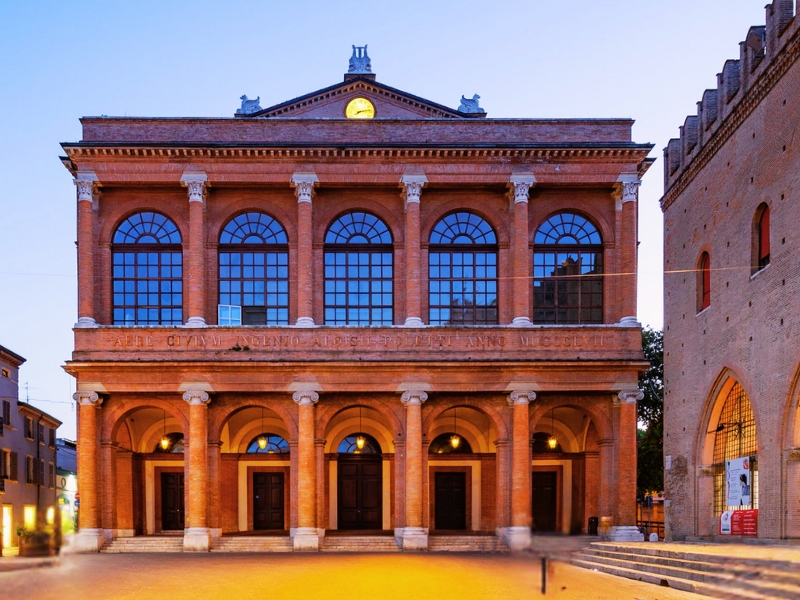
Rimini is more than its beach. This guide covers three places in and around the old town that show the city's cultural side and how it came back after the Second World War: the Teatro Amintore Galli, the opera house that reopened 75 years after it was bombed; the Cinema Fulgor, where Federico Fellini, born in Rimini in 1920, saw his first films; and Parco XXV Aprile, the long green park laid out along the old course of the river Marecchia. They lie on one line from Piazza Cavour down Corso d'Augusto to the river.
Teatro Amintore Galli
Rimini's theatre stands on Piazza Cavour, the old main square. It was designed by the Modena architect Luigi Poletti, and the first stone was laid on 8 August 1843; work stopped from 1846 to 1854 because of rising costs, and the hall finally opened on 11 July 1857 with Verdi's Il Trovatore. A few weeks later, on 16 August 1857, Verdi's opera Aroldo, a reworking of his earlier Stiffelio, had its world premiere here. The theatre was first named after King Vittorio Emanuele II, and in 1947 it was renamed after Amintore Galli, a composer and music writer who set the Workers' Hymn of Filippo Turati to music and spent his last years in Rimini.
On 28 December 1943 Allied bombs aimed at the railway station hit the theatre and destroyed about 90 percent of the auditorium and stage. For decades it stood unrepaired. Restoration began in 2013, the atrium opened in 2015 and the whole theatre reopened on 28 October 2018, with three tiers of boxes and a gallery for 800 people. The theatre is one of the stops on our scavenger hunt.
- The facade on Piazza Cavour, the face of the theatre that Rimini lived with during the long years before the rebuilding.
- The rebuilt auditorium with its tiers of boxes, which you can see at a performance or on a guided visit.
- The archaeological area under the stalls, where excavations found a Roman house, Byzantine remains and part of the medieval town walls of the Malatesta.
Cinema Fulgor
On Corso d'Augusto, the old Roman main street, stands the Cinema Fulgor, in an 18th-century three-storey building. Fellini saw his first films here as a boy, and the cinema of his film Amarcord, his memory of growing up in Rimini, carries the Fulgor name. After a renovation from 2013 to 2018, the cinema reopened with sets by Dante Ferretti, the production designer who had worked with Fellini. It still shows films, with its own programme.
The building also became part of the Fellini Museum. Since December 2021 the Palazzo del Fulgor has held exhibition rooms on the director's life and work, together with a tiny cinema, the Cinemino, where Fellini's films are screened. The other parts of the museum are at Castel Sismondo and in Piazza Malatesta nearby, and between them they show his drawings, Nino Rota's scores, photographs, film clips and costumes. The Fulgor is not one of our scavenger hunt stops, but the route passes along Corso d'Augusto.
- The exhibition rooms upstairs in the Palazzo del Fulgor, on Fellini's life and work.
- The Cinemino, a 25-seat hall inside the Palazzo del Fulgor.
Parco XXV Aprile
Until the 1920s the Marecchia ran through the edge of Rimini, under the Roman Ponte di Tiberio, and out to sea through what is now the harbour canal. Because the river flooded, an artificial channel was dug between 1924 and 1930 to take it to the sea north of the city, and its old bed was left behind. Since then the river no longer flows under its own Roman bridge, which now stands over the old riverbed that still forms the city's harbour. Part of that land was turned into Parco XXV Aprile, also called Parco Marecchia, one of the city's main parks.
Its name refers to 25 April, the day Italy celebrates its liberation from Fascism and German occupation in 1945. Rimini itself was liberated on 21 September 1944, after the hard fighting of the Gothic Line, by which time about 82 percent of its buildings had been destroyed, the highest share of any Italian city with more than 50,000 people. The park is a place for walks, runs and picnics, and it is where the city's cycle network joins the path that follows the Marecchia inland. It is not on our scavenger hunt route, but it begins next to the Ponte di Tiberio, one of the stops.
- The Ponte di Tiberio seen from the park side, over what was once the river itself.
- The cycle and walking paths that follow the old riverbed inland.
How to see them in one walk
Start at the Teatro Galli on Piazza Cavour. From the square walk to Corso d'Augusto and follow it towards the river, stopping at the Cinema Fulgor and the Palazzo del Fulgor. At the end of the street cross the Ponte di Tiberio or walk down beside it into Parco XXV Aprile, and finish with a stroll through the park, or in the Borgo San Giuliano on the far side of the bridge. If you prefer to arrive from the south, start at the Arco di Augusto instead: Corso d'Augusto takes you through Piazza Tre Martiri, the site of the Roman forum, and Piazza Cavour is a few steps off the street on the way to the river.
See Rimini with World City Trail
Our Rimini scavenger hunt turns the old town into a game you play on your phone. The route links 10 stops, from the Arco di Augusto to the church of the Madonna della Scala, and the Teatro Galli is one of them, along with the Tempio Malatestiano, Piazza Tre Martiri, Castel Sismondo, the Domus del Chirurgo, the City Museum, the Ponte di Tiberio and the murals of the Borgo San Giuliano.
There is also a self-guided walking tour and an outdoor escape game in Rimini, for people who prefer a different format.
Play the Rimini scavenger hunt →
Take the self-guided walking tour of Rimini →
Play the outdoor escape game in Rimini →
Facts checked in October 2026.