
This guide covers six places in the northern and western parts of Melbourne's central grid, all of them stops or near stops on our scavenger hunt: St Francis' Church, the City Baths, the Queen Victoria Market, the Flagstaff Gardens, the Hellenic Museum in the old Royal Mint and SEA LIFE Melbourne on the Yarra. Several of them go back to the city's first decades, when Melbourne was a small colonial town that needed a church, clean water to bathe in, a market and a lookout over the bay.
St Francis' Church
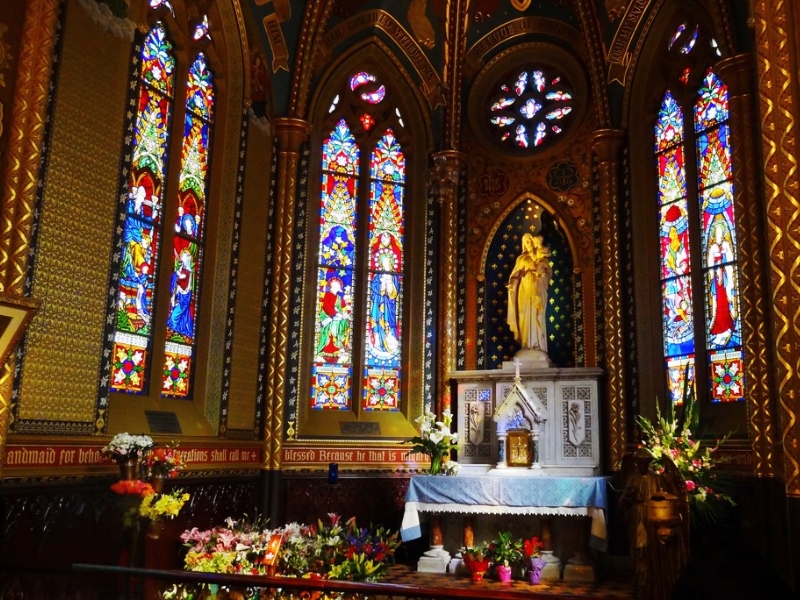
On the corner of Lonsdale and Elizabeth streets stands St Francis', generally described as the oldest Catholic church in Victoria. Its foundation stone was laid on 4 October 1841, the first Mass was said in the finished nave on 22 May 1842, and the church was blessed in 1845. It was designed by Samuel Jackson and still looks much as he planned it. From 1848 to 1868 it served as the cathedral, until the bishop's seat moved to the still-unfinished St Patrick's Cathedral. Since 1929 it has been in the care of the Congregation of the Blessed Sacrament, and it is often called one of the busiest churches in Australia.
- The richly decorated Ladye Chapel on the west side, built in 1856 to 1858.
- The plain Gothic Revival exterior, a rare survivor from the 1840s town among the office towers. Please keep quiet inside: it is a working church with many Masses.
Melbourne City Baths
In the 1850s many people washed and swam in the Yarra, which was badly polluted and linked to typhoid. Public baths opened on this site in 1860 to give them an alternative. The first baths were poorly kept and closed in 1899, and the present building, designed by the father-and-son architects J. J. and E. J. Clark, opened on 23 March 1904. Men and women had separate pools and separate street entrances; mixed bathing only arrived in 1947. The baths are still in use today, with pools, a spa, sauna, squash courts and a gym.
- The Edwardian Baroque facade on Swanston Street, in red brick with cream painted bands.
- The original separate entrances, a reminder that men and women swam apart for more than four decades.
Queen Victoria Market
The Queen Victoria Market officially opened in March 1878 and now covers more than seven hectares, which makes it the largest open-air market in the Southern Hemisphere. Its oldest original building is the Meat Hall from 1869, and the long rows of open sheds were added as the market grew. It is listed on both the Victorian Heritage Register and the National Heritage List; in the 1970s a plan to redevelop it was stopped by a green ban.
The market has a darker side: it was built over the Old Melbourne Cemetery, the town's first burial ground. In 1920 the cemetery was estimated to hold around 10,000 graves, but between 1920 and 1922 only 914 bodies were exhumed and reburied elsewhere, so most of the dead still lie beneath the market. One of our scavenger hunt stops is right here, at the Victoria Market Pharmacy.
- The facade of the Meat and Fish Hall, dated 1884, a reminder of the market's Victorian grandeur.
- Sheds K, L and M, built on the cleared cemetery land.
Flagstaff Gardens
The Flagstaff Gardens are the oldest public park in Melbourne, set aside in 1862. Before that the hill had two other uses. It was first known as Burial Hill, because the settlers who died after the town was founded in 1835 were buried here. In 1840 a flagstaff was put up to signal to ships in the Port of Melbourne, and a taller one replaced it the next year; when the electric telegraph arrived in the 1860s, flag signalling was no longer needed. On 11 November 1850 the hill was where news of Victoria's separation from New South Wales was celebrated, with a bonfire watched by around 5,000 people. The gardens are one of the stops on our scavenger hunt.
- The huge Moreton Bay fig trees, avenues of elms and old eucalypts that shade the lawns.
- The monument of 1950 on the site of the old flagstaff, marking a hundred years of self-government in Victoria.
Hellenic Museum
Melbourne has a large Greek community, and the Hellenic Museum, founded in 2007 by the businessman Spiros Stamoulis, tells its story along with that of Greek culture as a whole. It occupies the former Royal Mint on the corner of William and La Trobe streets, which opened in 1872 as a branch of the British Royal Mint, minting coins from Victoria's gold; it was designed by J. J. Clark, the same architect behind the City Baths. In 2013 the museum partnered with the Benaki Museum in Athens, which from 2014 lent it a collection of Greek antiquities. It is one of the stops on our scavenger hunt.
- The Mint building itself, one of the city's grand public buildings of the gold-rush era.
- Collections that run from Cypriot antiquities and casts of ancient Greek statues to Byzantine icons and Bill Henson's photographic installation Oneiroi.
SEA LIFE Melbourne
SEA LIFE Melbourne sits on the north bank of the Yarra, beside and partly under the King Street Bridge and the Flinders Street Viaduct. It opened on 17 January 2000 as the Melbourne Aquarium, in a building by Peddle Thorp designed to look like a ship moored to the river, and was relaunched under the SEA LIFE name in 2013. Its main tank, the oceanarium, holds 2.2 million litres of water and is home to grey nurse sharks, and an Antarctic area added in 2008 keeps king and gentoo penguins. It is the final stop of our scavenger hunt.
- The building's ship-like shape, best seen from the opposite bank of the Yarra.
- The king and gentoo penguins in the Antarctic zone, and the rays and sharks of the oceanarium.
How to see them in one walk
Start at St Francis' Church on Lonsdale Street and walk north up Swanston Street to the City Baths. Head west along Franklin and Victoria streets to the Queen Victoria Market, then go south to the Flagstaff Gardens. The Hellenic Museum is on the corner of the gardens at William and La Trobe streets. Finish by walking down William Street or King Street to the river and SEA LIFE Melbourne.
See Melbourne with World City Trail
Our Melbourne scavenger hunt turns the city centre into a game you play on your phone. The route links 10 stops, from St Paul's Cathedral to SEA LIFE Melbourne, and St Francis' Church, the City Baths, the Victoria Market Pharmacy, the Flagstaff Gardens, the Hellenic Museum and SEA LIFE Melbourne are all stops, along with Melbourne Town Hall, the State Library Victoria and the Old Melbourne Gaol. At each stop you solve a puzzle and learn something about the place, at your own pace.
There is also a self-guided walking tour and an outdoor escape game in Melbourne, for people who prefer a different format.
Play the Melbourne scavenger hunt →
Take the self-guided walking tour of Melbourne →
Play the outdoor escape game in Melbourne →
Facts checked in October 2026.