
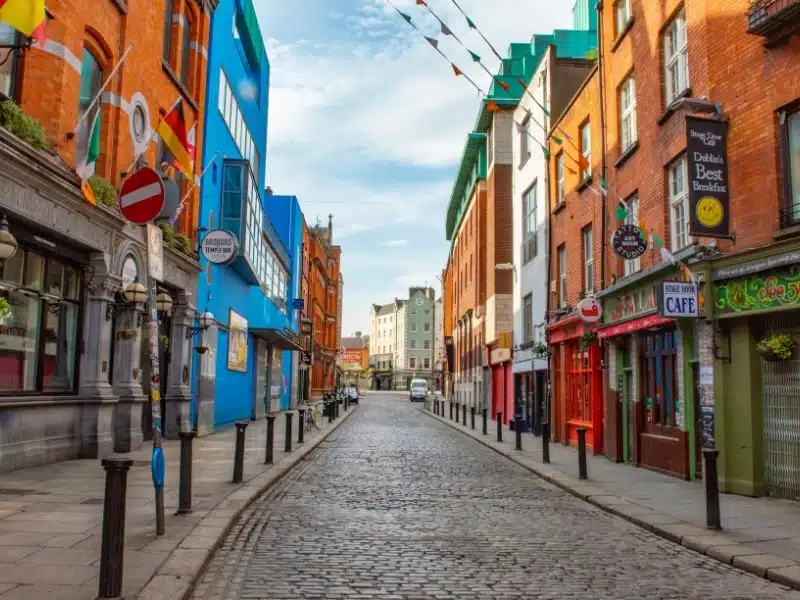
This guide follows one straight line through Dublin, from the top of O'Connell Street to St Stephen's Green, and five places along it: the Gate Theatre, the Parnell Monument, the Spire, the Irish Whiskey Museum and the Little Museum of Dublin. Two are monuments, three are places where Dubliners tell their own story, on stage, in a glass or through the objects they gave to a museum, and you can link them all on foot in a day.
Gate Theatre
The Gate Theatre was founded in 1928 by the actors Hilton Edwards and Micheál MacLiammóir, together with Daisy Bannard Cogley and Gearóid Ó Lochlainn. They wanted a theatre for international and modern drama, and their first season included Ibsen's Peer Gynt, Eugene O'Neill's The Hairy Ape and Oscar Wilde's Salomé. After two seasons in the small Peacock Theatre, the company moved in 1930 to its present home on Cavendish Row, a hall built between 1784 and 1786 as part of the New Assembly Rooms of the Rotunda.
Several famous careers began on its stage: Orson Welles, James Mason, Geraldine Fitzgerald and Michael Gambon all started out here. In 1991 the Gate staged the first Beckett Festival, presenting all 19 of Samuel Beckett's stage plays over three weeks.
- The 18th-century building on Cavendish Row, once part of the assembly rooms of the Rotunda; its restoration was overseen by the architect Ronnie Tallon of Scott Tallon Walker.
Parnell Monument
The Parnell Monument stands at the northern end of O'Connell Street and honours Charles Stewart Parnell (1846–1891), the leader of the campaign for Irish Home Rule, often called the uncrowned king of Ireland. The foundation stone was laid on 8 October 1899, and the monument was unveiled by John Redmond on 1 October 1911, in front of a large crowd. The bronze statue is by the Irish-born American sculptor Augustus Saint-Gaudens, who died in 1907 before it was finished, and the granite obelisk behind it, 19 metres high, was designed by Henry Bacon. It is one of the stops on our scavenger hunt.
- The gilt inscription and harp on the south side, with Parnell's words: no man has a right to fix the boundary to the march of a nation.
The Spire
The Spire of Dublin, also called the Monument of Light, is a stainless-steel needle 120 metres high in the middle of O'Connell Street. It was designed by Ian Ritchie Architects and completed on 21 January 2003. It stands on the site of Nelson's Pillar, a column with a statue of Admiral Nelson that was bombed in 1966 and then demolished. The Spire is 3 metres wide at the base and narrows to just 15 centimetres at the tip. It is one of the scavenger hunt stops.
- The top 10 metres, which light up at dusk: LEDs shine through 11,884 small holes in the steel.
- The pattern on the lower part, blasted into the surface and based on a core sample of local rock and the double helix of DNA.
Irish Whiskey Museum
The Irish Whiskey Museum opened in 2014 on Grafton Street, beside Trinity College. It is independent of all whiskey brands, so instead of promoting one distillery it tells the story of Irish whiskey as a whole and its place in the country's turbulent history. Visits are by guided tour through four rooms, each set in a different period, and they end with a tasting of several Irish whiskeys. It is also one of the stops on our scavenger hunt.
- Besides the tour, the museum offers a whiskey blending session and an Irish coffee masterclass.
- The whiskey bar and tasting room, where you compare styles side by side at the end of the tour.
Little Museum of Dublin
The Little Museum of Dublin opened in 2011 in an 18th-century Georgian townhouse at 15 St Stephen's Green. It was the idea of Trevor White, and its collection was built almost entirely from objects donated or lent by Dubliners: letters, photographs, posters and everyday things that tell the story of the city in the 20th century. It now holds more than 6,000 items. The museum closed in 2024 for a major renovation and reopened on St Stephen's Green in 2025.
Visits are by guided tour only, and the tours focus on the city's history, humour and hospitality. Tours start and finish on the first floor, where the permanent collection of donated objects is shown. The museum is a registered charity.
- The Editor's Room, a recreation of the office of The Irish Times under its editor Bertie Smyllie, who ran the paper from 1934 to 1954.
- U2: Made in Dublin, a fan-curated exhibition on the band, with objects such as a Trabant car and a life-size figure of MacPhisto, one of Bono's stage characters.
How to see them in one walk
Start at the Gate Theatre on Cavendish Row, at the top of O'Connell Street. The Parnell Monument stands just in front of it. Walk south along O'Connell Street to the Spire, then continue to the river and cross O'Connell Bridge. Follow Westmoreland Street to College Green and the front of Trinity College; the Irish Whiskey Museum is at the start of Grafton Street. Walk the length of Grafton Street, Dublin's main shopping street, to St Stephen's Green, where the Little Museum faces the park on its north side.
See Dublin with World City Trail
Our Dublin scavenger hunt turns the city centre into a game you play on your phone. The route links 10 stops, from the Parnell Monument to the Irish Whiskey Museum, and the Parnell Monument, the Spire and the Irish Whiskey Museum are all stops, along with O'Connell Bridge, City Hall, Christ Church Cathedral, St Patrick's Cathedral, Fusiliers' Arch, the National Museum of Ireland – Archaeology and St Andrew's Church. At each stop you solve a puzzle and hear a story, at your own pace.
There is also a self-guided walking tour and an outdoor escape game in Dublin, for people who prefer a different format.
Play the Dublin scavenger hunt →
Take the self-guided walking tour of Dublin →
Play the outdoor escape game in Dublin →
Facts checked in October 2026.