
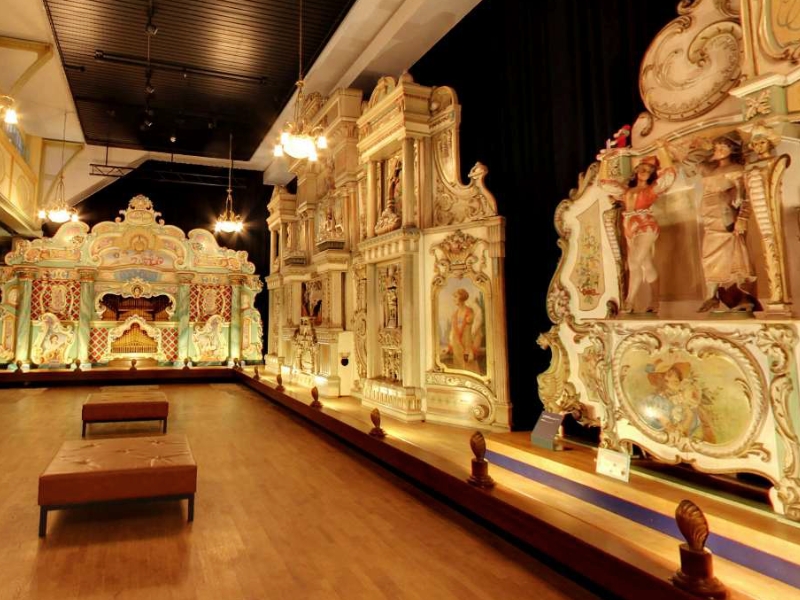
This guide covers six places in the old centre of Utrecht: the Dom Tower, St Martin's Cathedral, the Oudegracht canal, Museum Speelklok, the Expo of Het Utrechts Archief and De Letters van Utrecht, a poem that grows one letter a week. All six are stops on our scavenger hunt, and they sit within a short stroll of each other around the Domplein, so together they tell the city's story from its Roman fort to the poets of today.
The Dom Tower
The Dom Tower is the tallest church tower in the Netherlands, at about 112 metres. It was built between 1321 and 1382 to a design by John of Hainaut, as the bell tower of St Martin's Cathedral. Since a storm brought down the nave of the cathedral in 1674, the tower has stood on its own, with an open square between it and the rest of the church. A restoration of the outside ran from 2019 to 2024, and the tower is free of scaffolding again. You can climb its 465 steps on a guided tour, passing the bishop's private chapel on the first floor and the bell chamber on the way.
- The 14 swinging bells, together weighing about 32 tonnes, which are still rung by hand; each has its own name, such as Salvator, Maria and Martinus.
- The carillon, first installed in 1664 by the brothers Pieter and François Hemony and enlarged to 50 bells in 1972, which you can hear across the old town.
St Martin's Cathedral
St Martin's Cathedral, the Domkerk, is what remains of the medieval cathedral of the bishops of Utrecht, dedicated to St Martin of Tours. Bishop Henry van Vianen began the Gothic church in 1254, after a fire damaged the earlier Romanesque building, and the work went on into the 16th century. In 1580 the city gave the church to the Calvinists, and apart from a brief return of Catholic Mass in 1672 and 1673 it has been Protestant ever since.
On the night of 1 August 1674 a tornado brought down the unfinished nave, which was never rebuilt. That is why the choir and transept stand on one side of the Domplein and the tower on the other. Under the square lie the remains of the Roman fort where Utrecht began, and the cathedral, the tower and the Domplein are part of the UNESCO World Heritage Site of the Lower Germanic Limes, the old Roman frontier.
- Look for the lines of stones in the paving of the Domplein that trace where the lost nave once stood, and for the cloister garden, the Pandhof, on the south side of the church.
The Oudegracht
The Oudegracht, the Old Canal, runs for about two kilometres through the centre and partly follows an old course of the Rhine. Its northern part is probably an early canal from around the year 1000; the southern part was dug from 1122. After the city's locks were finished in 1275, the water stayed at a constant level, and merchants built quays at water level, the werven, with dry cellars running under the street. That gives the Oudegracht its two levels, one for traffic above and one for boats and goods below.
- The wharf cellars, many of them now cafés and restaurants with tables right beside the water.
- Old bridges such as the Maartensbrug and the Jansbrug, and the tall merchants' houses along the quays.
Museum Speelklok
Museum Speelklok is the national museum of self-playing musical instruments: music boxes, musical clocks, pianolas, barrel organs and the big Dutch street organs. It grew out of an exhibition in 1956 that drew more than 14,000 visitors in eight days, and in 1984 it moved into the Buurkerk, a medieval parish church whose history goes back to around the year 1000. Most of the instruments still work and are played for visitors, and the museum's restoration workshops are known well beyond the Netherlands.
The Buurkerk has a story of its own. In 1457 a woman known as Suster Bertken chose to be walled into a small cell in the church as a recluse. She followed the services through an opening and spoke to visitors from her cell, and she lived there for 57 years, until her death in 1514.
- Look for the stone that commemorates Suster Bertken on the Choorstraat, on the outside of the church, and inside for the big Dutch street organs.
Het Utrechts Archief Expo
Het Utrechts Archief, the Utrecht Archives, keeps the records of the city and province, and its Expo on the Hamburgerstraat turns them into an exhibition about some 2,000 years of local history. The story starts with the Roman army camp and moves on through the bishops, the canals and their wharves and student life, with photos, films, drawings and key documents. The building itself stands on the site of the medieval St Paul's Abbey and was later used as a law court; remains of the abbey can still be seen inside.
- Look out for the stories of people from Utrecht's past, such as Trijn van Leemput, who is remembered in the city as a local heroine, and for the story of how the canal wharves came about.
De Letters van Utrecht
De Letters van Utrecht is a poem without an end, carved letter by letter into the cobblestones of a street in the city centre. The first 648 letters were unveiled on 2 June 2012, and since then stonemasons have cut one new letter every Saturday at one in the afternoon, so a single sentence takes about three years to complete. The lines are written by members of Utrecht's guild of poets, starting with Ruben van Gogh, Ingmar Heytze, Chrétien Breukers, Alexis de Roode and Ellen Deckwitz, and the project is run by volunteers and paid for by people who adopt a letter.
How to see them in one walk
Start at Museum Speelklok in the Buurkerk and walk to the Oudegracht for a first look at the wharves. Follow the canal towards the Domplein, where the Dom Tower and St Martin's Cathedral face each other across the outline of the lost nave; book the tower climb in advance. Continue to the Hamburgerstraat for the Expo of Het Utrechts Archief, then look for the letters of the endless poem in the street. If you are there on a Saturday early in the afternoon, you may see the next letter being cut.
See Utrecht with World City Trail
Our Utrecht scavenger hunt turns the old town into a game you play on your phone. The route links 10 stops, from the Oude Mannen en Vrouwenhuis to the Jewish Monument, and Museum Speelklok, the Oudegracht, St Martin's Cathedral, the Dom Tower, Het Utrechts Archief Expo and De Letters van Utrecht are all stops, along with University Hall and St Catherine's Cathedral. At each stop you solve a puzzle and learn a story, at your own pace.
There is also a self-guided walking tour and an outdoor escape game in Utrecht, for people who prefer a different format.
Play the Utrecht scavenger hunt →
Take the self-guided walking tour of Utrecht →
Play the outdoor escape game in Utrecht →
Facts checked in October 2026.