
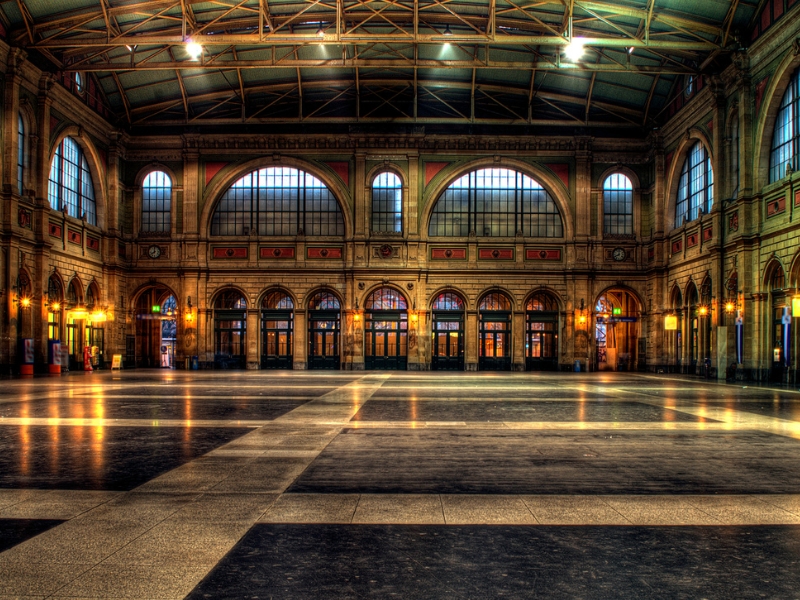
Most visitors arrive in Zurich at the main station, and four of the city's most rewarding places lie within a short walk of its doors: the Swiss National Museum, Bahnhofplatz with its statue of Alfred Escher, the small Pestalozzi park on Bahnhofstrasse and the Lindenhof hill above the Limmat. Together they tell the story of Zurich from a Roman fort to the railway age, and they are also the first four stops of our scavenger hunt.
Swiss National Museum (Landesmuseum)
The Swiss National Museum stands right behind the station, on the point of land where the Sihl river flows into the Limmat, next to the Platzspitz park. Its main building, by the Zurich architect Gustav Gull, opened in 1898. With its turrets, towers and courtyard it looks like a French Renaissance château, and that was the idea: in the historicist style of the time, the building itself was meant to feel like a piece of Swiss history.
Between 2013 and 2016 the museum was extended by the Basel architects Christ & Gantenbein. The new wing is a long block of concrete pierced by round windows, and it joins the old castle without copying it. Inside, the collections run from prehistoric finds to the present day: carved altars and Gothic sculpture, furnished rooms from old Swiss houses, coins and weapons.
- The Armoury Hall with Ferdinand Hodler's fresco The Retreat from Marignano on the west wall, painted around 1900. Its rough, monumental style caused a nationwide row known as the Fresco Dispute.
- The armoury tower and the diorama of the Battle of Murten, fought in 1476 by the Swiss Confederates against Charles the Bold of Burgundy.
- The contrast between Gull's towers and the concrete extension, best seen from the courtyard and from the Platzspitz side.
Bahnhofplatz and Zurich main station
Bahnhofplatz is the square in front of the south entrance of Zürich Hauptbahnhof, the largest station in Switzerland. Zurich's first station opened here in 1847 as the terminus of the line to Baden, known as the Spanisch-Brötli-Bahn after a pastry from Baden that was popular in Zurich. The present building replaced it in 1871. Its architect, Jakob Friedrich Wanner, built it in sandstone in neo-Renaissance style, with a main entrance shaped like a triumphal arch that looks straight down Bahnhofstrasse.
In front of the arch stands the monument to Alfred Escher (1819–1882), unveiled in 1889 and made by the sculptor Richard Kissling. Escher was a banker, politician and railway pioneer who pushed for the Gotthard line through the Alps, and the station building once housed the headquarters of the Swiss Northeastern Railway that he led. The square itself was rebuilt in 1970, when the ShopVille shopping arcade was dug out underneath it.
- The bronze Escher on a granite fountain, with allegorical figures around the base and a child holding a wreath.
- The station clock set into the portal above the main entrance.
- The main hall behind the arch, once the train shed of 1871 and now a large open space used for events and exhibitions.
Pestalozzianlage
A few minutes down Bahnhofstrasse, the shopping street opens out onto a small lawn with trees: the Pestalozzianlage, often just called the Pestalozziwiese. It is named after Johann Heinrich Pestalozzi (1746–1827), the Zurich-born educator who argued that all children, rich or poor, boys or girls, should be taught, and that learning should involve the head, the heart and the hands. His ideas shaped schools far beyond Switzerland.
The place has a darker past: until around 1860 this meadow was Zurich's place of execution. In 1873 a school, the Linth-Escher-Schulhaus, was built beside it. When the school was pulled down in 1961 and the Globus department store went up in 1968, the green space took its present shape. The bronze statue of Pestalozzi by the sculptor Hugo Siegwart was set up in 1899.
- Siegwart's statue of Pestalozzi from 1899, looking out over the lawn.
- The contrast between the quiet patch of grass and the busy shops and trams of Bahnhofstrasse around it.
Lindenhof
From Bahnhofstrasse, narrow lanes climb to the Lindenhof, a hill on the left bank of the Limmat that is the oldest part of Zurich. Archaeologists have found traces of a Celtic settlement from the 1st century BC here. The Romans called their small town Turicum, a name known from a 2nd-century tombstone of a boy found on the hill in 1747. In the 4th century, under Emperor Valentinian I, they built a fort with ten towers on the summit to guard against the Alamanni.
Later a royal palace (Pfalz) stood on the hill: first a Carolingian one, then an Ottonian palace where the future Emperor Henry IV was engaged to Bertha of Turin at Christmas 1055. By the early 13th century the palace was in ruins and its stones went into the city walls. Linden trees were planted in the 18th century, and the square got its present look around 1900. The building on its edge has been the home of the Masonic lodge Modestia cum Libertate since 1851.
The Hedwig fountain on the square recalls a legend. In 1292, the story goes, Zurich was besieged by the army of the Habsburg Duke Albert while its men were away fighting near Winterthur. The women, said to be led by Hedwig ab Burghalden, put on armour and marched onto the Lindenhof, and the enemy, thinking the city well defended, withdrew. The fountain, with the helmeted figure by Gustav Siber, was built in 1912 in their honour.
- The terrace wall, with a wide view across the Limmat to the old town on the right bank, the Grossmünster towers and the university buildings on the slope behind.
- The Hedwig fountain and its armed woman, a reminder of the 1292 legend.
- The chess players under the linden trees, a favourite pastime on the hill.
How to see them in one walk
Start at the Swiss National Museum, beside the north side of the station, then walk through or around the station to Bahnhofplatz and the Escher statue. Follow Bahnhofstrasse south to the Pestalozzianlage, then turn left into the lanes of the old town and climb to the Lindenhof. From the terrace the church of St. Peter, with its huge clock face, is just a few steps away, so the walk leads straight on into the rest of the old town.
See Zurich with World City Trail
Our Zurich scavenger hunt turns the old town into a game you play on your phone. The route links 10 stops and begins with all four places in this guide: the Swiss National Museum, Bahnhofplatz, the Pestalozzianlage and the Lindenhof. From there it continues to St. Peter, the Town Hall, the lake shore, the Opera House, the Grossmünster and the old town lanes. At each stop you solve a puzzle and learn a story, at your own pace.
There is also a self-guided walking tour and an outdoor escape game in Zurich, for people who prefer a different format.
Play the Zurich scavenger hunt →
Take the self-guided walking tour of Zurich →
Play the outdoor escape game in Zurich →
Facts checked in October 2026.