
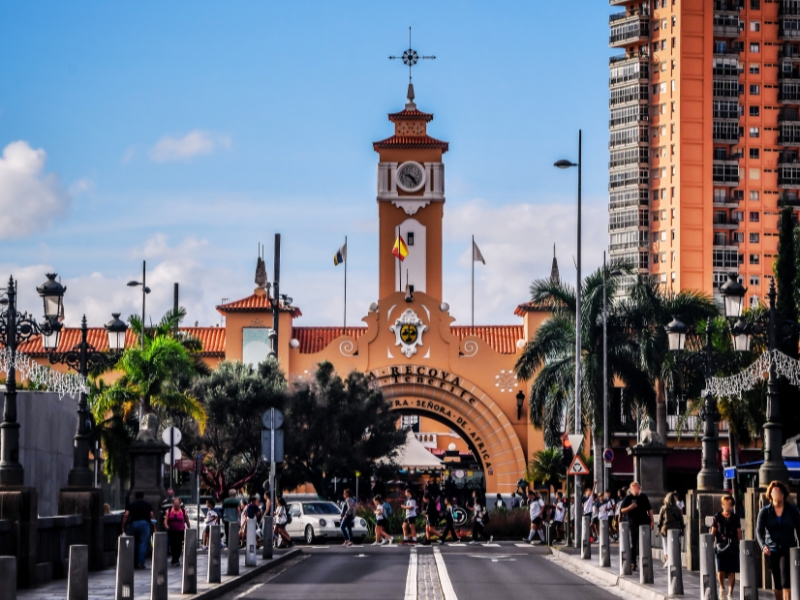
Santa Cruz, the capital of Tenerife, is a port city of squares, and this guide covers eight places in its centre: García Sanabria Park, Plaza Weyler and its marble fountain, the Teatro Guimerá, the African Market, Plaza de España by the sea with the Monument to the Fallen, and the two old Franciscan spaces, Plaza de San Francisco and Plaza del Príncipe. They are all close together, between the park in the upper town and the harbour, and you can see them in one unhurried walk.
García Sanabria Park
The park was built in 1926 and named after the mayor who approved it, Santiago García Sanabria; when it was finished it was the largest urban park in the Canary Islands. It is full of palms, ceibas and fig trees, and in 2016 it was declared a protected cultural site. In the centre stands the monument to García Sanabria, a fountain with an expressionist obelisk carved by Francisco Borges Salas in 1938 to a design by José Enrique Marrero Regalado, with a nude female figure honouring fertility and the women of Tenerife.
- The flower clock at the entrance on Calle del Pilar, made in Switzerland and donated in 1958, always planted with fresh flowers.
- The modern sculptures left from the street sculpture exhibition of 1973–1974, among them works by Pablo Serrano, Jesús Soto, Eduardo Paolozzi and Óscar Domínguez's cat.
Plaza Weyler
This square was laid out in 1893 as a forecourt to the neoclassical Captaincy General palace, the headquarters of the army in the Canaries, which still faces it. It is named after General Valeriano Weyler, Captain General of the Canary Islands and later, far more controversially, of Cuba, where his policy of forced reconcentration cost an estimated 100,000 Cuban lives. Calle del Castillo, the main shopping street, starts here.
- The white Carrara marble fountain by Achille Canessa of Genoa, installed in 1899: two children with a garland on top and four children below holding dolphins that spout water into shells.
Teatro Guimerá
Designed in 1849 by Manuel de Oraá and opened in January 1851, this is the oldest theatre in the Canary Islands. It began as the municipal theatre and in 1923, after the death of the dramatist Ángel Guimerá, who was born in Santa Cruz and wrote in Catalan, it took his name. A deep restoration in 1989 enlarged the stage and the foyer. In front of the building sits a bronze statue of Guimerá, and nearby stands Per Adriano, a sculpture by Igor Mitoraj from 1993.
African Market (Mercado de Nuestra Señora de África)
Locals call it La Recova. The market opened on 4 January 1944, built to a design by José Enrique Marrero Regalado, the same architect as the park's fountain. Its style is neocolonial and its plan is like a fortress, with an entrance arch and a Mudéjar-style tower, and inside the stalls are arranged around three large courtyards, the central one laid out like a Spanish town square. The name comes from the Virgin of Africa, patron saint of Ceuta, and a small statue of her stands at the entrance.
- Walk through the arch into the central courtyard, then go round the side courtyards where fruit, fish and flowers are sold.
Plaza de España
The city's largest square sits on the waterfront, on the site of the Castillo de San Cristóbal, the first major fortress on Tenerife, begun in 1575. The square itself dates from 1929, and its redesign by the Swiss architects Herzog & de Meuron gave it a large central pool of seawater. During the works, remains of the old castle were found; they can be seen in an underground gallery below the square. The Palacio Insular, seat of the island council, stands on the square.
- The remains of the castle walls in the underground gallery, and the pool that reflects the Palacio Insular.
Monument to the Fallen
The tall cross-shaped tower on Plaza de España is the Monumento a los Caídos, proposed after the Spanish Civil War by Captain General Francisco García-Escámez. The sculptors were Enrique Cejas Zaldívar and Alonso Reyes, whose sketches were signed in 1944. It honours the dead of one side of that war, which is why it is controversial today. The crypt at its base is now empty, and there is a lookout at the top.
Plaza de San Francisco
This square grew up in front of the church of San Francisco de Asís, part of a Franciscan convent founded in the late 17th century around an older hermitage. The convent closed in the early 19th century, but the church survives and is considered one of the best examples of Baroque in the Canary Islands, with three naves, a carved ceiling dated 1721 and an organ from 1778–1781. The El Toscal neighbourhood around it grew up together with the convent.
- The façade with its wavy cornice and two twisted Solomonic columns, each carved from a single block of stone.
Plaza del Príncipe
Just behind San Francisco, Plaza del Príncipe de Asturias occupies the old orchard of the Franciscan convent. Today it is a shady city garden with big old trees, benches and paths, a quiet place to sit between the shopping streets and the harbour.
How to see them in one walk
Start at García Sanabria Park in the upper town and walk downhill past Plaza 25 de Julio to Plaza Weyler. Continue down Calle del Castillo towards the sea, turn off to Plaza del Príncipe and Plaza de San Francisco, then reach Plaza de España and the Monument to the Fallen. From there walk to the Teatro Guimerá and cross the Barranco de Santos to the African Market.
See Tenerife with World City Trail
Our Tenerife scavenger hunt turns the centre of Santa Cruz into a game you play on your phone. The route links 10 stops, from García Sanabria Park to Plaza del Príncipe, and the park, Plaza Weyler, the Teatro Guimerá, the African Market, Plaza de España, Plaza de San Francisco and Plaza del Príncipe are all stops, along with Plaza 25 de Julio, the church of La Concepción and Plaza de la Candelaria. At each stop you solve a puzzle and learn a story, at your own pace.
There is also a self-guided walking tour and an outdoor escape game in Tenerife, for people who prefer a different format.
Play the Tenerife scavenger hunt →
Take the self-guided walking tour of Tenerife →
Play the outdoor escape game in Tenerife →
Facts checked in October 2026.