
Catania has been destroyed and rebuilt more than once, by Etna's lava and by earthquakes, and the six places in this guide show both sides of that story: Ursino Castle, which lava pushed away from the sea, the Cathedral of Saint Agatha, the buried Roman amphitheatre and Piazza Stesicoro above it, Piazza Università and Via dei Crociferi, the Baroque street built after the earthquake of 1693. All of them lie along or just off Via Etnea, the long straight street that runs from the sea towards the volcano.
Ursino Castle (Castello Ursino)
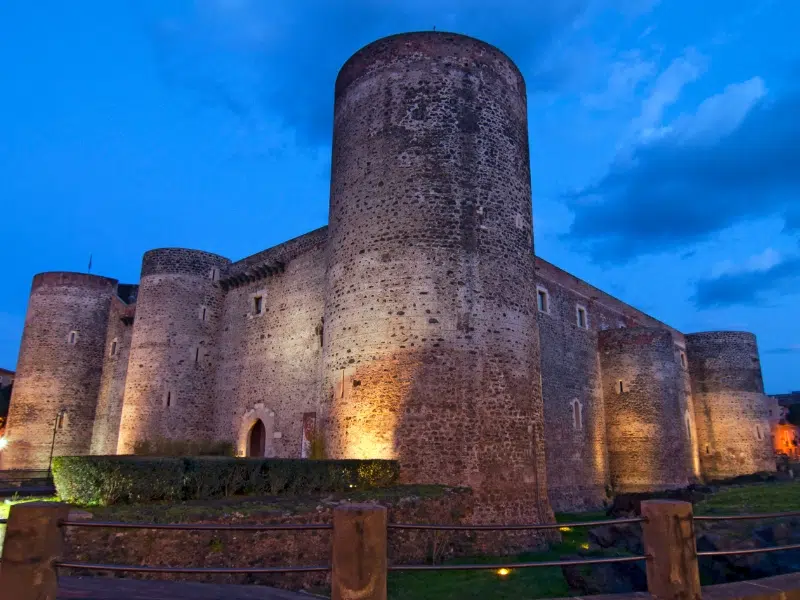
Emperor Frederick II, who was also King of Sicily, had the castle built between 1239 and 1250 as one of his royal fortresses. It was a square block with a large round tower at each corner and an open courtyard, standing on a cliff above the sea. Today it is far from the water: in the 17th century lava from an eruption of Etna filled its moat, and eruptions and earthquakes left it about a kilometre inland. It was also one of the few buildings in Catania to survive the earthquake of 1693.
The castle has a political past too. In 1295 the Sicilian Parliament met here and declared James II of Aragon deposed in favour of Frederick III, and for a time it was the parliament's seat. The city bought the castle in 1932, restored it and opened the Museo Civico inside in 1934, with art and finds from the classical period onwards.
- The black lava stone around the base, where the old moat once was, and a pentagram set in black lava on the east wall.
Cathedral of Saint Agatha
Roger I of Sicily built the first cathedral in 1078–1093, after the Normans took the city from the emirate, on the ruins of the Roman Achillean Baths; it was originally a fortified church. An earthquake in 1169 destroyed almost all of it except the apse, and the earthquake of 1693 brought more ruin, so most of what you see is Baroque. Giovanni Battista Vaccarini designed the façade in 1711, using granite columns that may come from the city's Roman theatre.
The cathedral is dedicated to Saint Agatha, the young martyr who is Catania's patron saint, and it is also the burial place of the composer Vincenzo Bellini, who was born in Catania; his tomb is in the south aisle. In front of it, in Piazza del Duomo, stands the city's symbol, the lava-stone elephant known as u Liotru, carrying an Egyptian obelisk; Vaccarini assembled the fountain in 1736.
- The main wooden door, with 32 carved panels showing the life and martyrdom of Saint Agatha.
- The three Norman apses at the back, built of big blocks of lava stone, some of them taken from Roman buildings.
Roman Amphitheatre
Most of Catania's Roman amphitheatre lies under the streets. It was probably built in the 2nd century AD and later enlarged, and it was the largest amphitheatre in Sicily: its outer walls measured about 125 by 105 metres, and around 15,000 people could sit on its lava-stone tiers, faced with marble. In the 5th century the Ostrogothic king Theodoric allowed the people to take its stones for building, walls of 1550 cut through its upper levels, and after the earthquake of 1693 it was buried for good. Only about a tenth can be seen today, in a pit on the west side of Piazza Stesicoro, some ten metres below street level.
- Look over the railing at the dark lava-stone arches of the outer corridor, and imagine the rest of the oval running under the buildings around you.
Piazza Stesicoro
This large square on Via Etnea is where old and modern Catania meet. The amphitheatre section on its west side was uncovered in 1903 and opened to visitors in 1907. On the opposite side stands the monument to Vincenzo Bellini by the sculptor Giulio Monteverde, and the square was reshaped in the 1950s, when part of the San Berillo quarter was demolished to open Corso Sicilia towards the station. On the west side you also find the church of San Biagio and the Palazzo della Borsa, opened in 1933.
- The Bellini monument, with the composer seated high on the base and figures from his operas below him.
Piazza Università
On Via Etnea, a little above Piazza del Duomo, this square is named after the University of Catania, founded in 1434 by King Alfonso V as the Siciliae Studium Generale and the oldest university in Sicily. Its central palace, designed by the Battaglia family after the earthquake, holds university offices and the main library. The square is best known for its four bronze street lamps, each decorated with reliefs of a Catanian legend: Colapesce, the boy who dived to the bottom of the sea; Amphinomus and Anapias, the pious brothers who carried their parents away from Etna's lava; Gammazita, a young woman of the old town; and the young knight Uzeta.
- Walk round the four lamps and try to match each relief with its legend before you read the plaques.
Via dei Crociferi
Via dei Crociferi is an 18th-century street rebuilt after the 1693 earthquake, and it shows Catanese Baroque at its most unified. You enter from Piazza San Francesco d'Assisi through the arch of San Benedetto, which joins the two parts of the Benedictine convent. In about 400 metres you pass four churches: San Benedetto behind its iron railings at the top of a staircase, San Francesco Borgia with its double stairs, San Giuliano, attributed to Vaccarini and admired for its curved façade, and San Camillo. At the far end is Villa Cerami, now home to the university's law faculty. Catania is part of the Late Baroque Towns of the Val di Noto, a UNESCO World Heritage Site since 2002.
- The convex façade of San Giuliano, facing the former Jesuit college with its arcaded cloister.
How to see them in one walk
Start at Piazza Stesicoro with the amphitheatre and the Bellini monument, then walk down Via Etnea to Piazza Università. Turn off towards Piazza San Francesco d'Assisi and walk up Via dei Crociferi under the arch of San Benedetto, then come back down to Piazza del Duomo for the cathedral and the elephant fountain. Finish at Ursino Castle, a short walk south-west of the cathedral.
See Catania with World City Trail
Our Catania scavenger hunt turns the old town into a game you play on your phone. The route links 10 stops, from the Roman Amphitheatre to the Greek-Roman theatre, and the amphitheatre, Piazza Stesicoro, Piazza Università, the Cathedral of Saint Agatha and Ursino Castle are all stops, along with Via Etnea, the Teatro Massimo Bellini, the elephant fountain and Porta Uzeda. At each stop you solve a puzzle and learn a story, at your own pace.
There is also a self-guided walking tour and an outdoor escape game in Catania, for people who prefer a different format.
Play the Catania scavenger hunt →
Take the self-guided walking tour of Catania →
Play the outdoor escape game in Catania →
Facts checked in October 2026.