
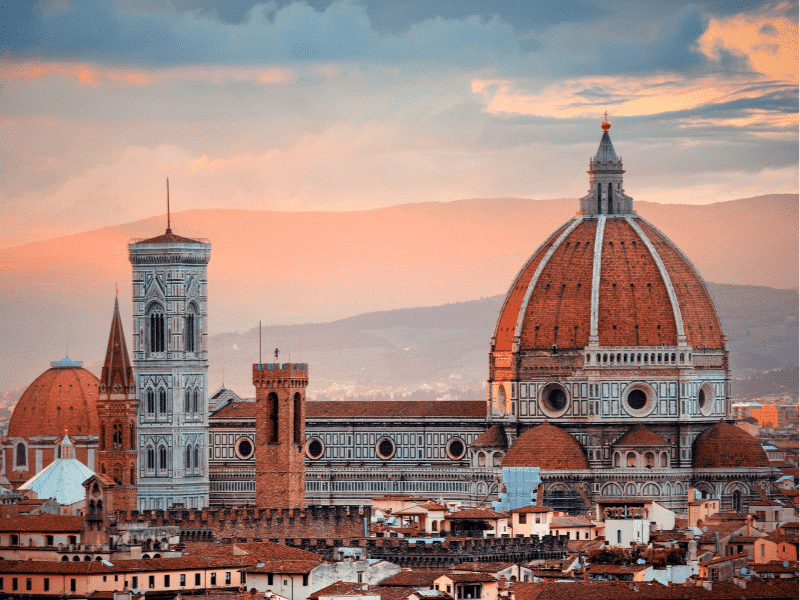
Florence is where the Renaissance took shape, and its compact centre shows it on every corner: a dome engineers studied for centuries, bankers' palaces, and churches full of paintings that changed how Europe saw the world. Here are the facts and stories behind the city.
10 fun facts about Florence
- A record-breaking dome: Brunelleschi's dome on the cathedral was built between 1420 and 1436 and is still the largest masonry dome in the world. The climb to the top is 463 steps, with no lift.
- The bridge the Germans spared: when German troops retreated in August 1944, they blew up every bridge in Florence except the Ponte Vecchio. The present bridge dates from 1345.
- Jewellers instead of butchers: the shops on the Ponte Vecchio once belonged to butchers and tanners. In the late 16th century the Medici dukes threw them out, and since then only goldsmiths and jewellers have traded there.
- A private corridor over the rooftops: in 1565 Giorgio Vasari built a raised passage for Duke Cosimo I that runs from the Palazzo Vecchio through the Uffizi and over the Ponte Vecchio to the Palazzo Pitti. The Vasari Corridor reopened to visitors in December 2024 after eight years of closure.
- A museum named after offices: the Uffizi was built from 1560 to Vasari's design as offices, uffizi in Italian, for the magistrates of Florence. The Medici art collections later filled its upper floor.
- Two Davids: Michelangelo's David, 5.17 metres tall, was unveiled in the Piazza della Signoria in 1504. The original moved to the Galleria dell'Accademia in 1873, and the copy you see in the square has stood there since 1910.
- A painting that taught Europe perspective: Masaccio's Holy Trinity in Santa Maria Novella, painted in the 1420s, is one of the earliest paintings to use mathematically correct perspective.
- Wine through a hole in the wall: Florence has more than 150 tiny wine windows. In 1559 Cosimo I allowed families to sell wine from their homes, and during the plague of the 1630s sellers used the hatches to avoid contact. In 2020 a few reopened.
- Capital of Italy for six years: after the unification of Italy, Florence was the capital from 1865 to 1871, until the government moved to Rome.
- Football with no rules to speak of: every June teams from the four historic quarters play calcio storico, a brutal mix of football, rugby and wrestling, in Piazza Santa Croce. The final is played on 24 June, the feast of the city's patron, St John the Baptist.
The story of Brunelleschi's dome
Florence began its cathedral in 1296 and planned a dome wider than any since antiquity, without knowing how to build it. For decades the church stood with a gaping hole over the altar. In 1418 the city held a competition. According to the artist and writer Giorgio Vasari, Filippo Brunelleschi refused to show his model and challenged his rivals to stand an egg upright on a marble table. When they failed, he cracked the bottom of the egg and stood it up. Whatever really happened, he won. He built two shells, one inside the other, laid the bricks in a herringbone pattern so they held themselves in place, and designed new lifting machines. The dome was finished in 1436, and the lantern on top was begun in 1446, the year Brunelleschi died.
The Oltrarno, explained
Oltrarno means beyond the Arno, the district on the south bank of the river. It is home to the Palazzo Pitti, the Medici's later residence, and the Boboli Gardens behind it, and to Brunelleschi's church of Santo Spirito. Its side streets are still full of workshops where craftspeople restore furniture, bind books and work leather.
What to eat in Florence
- Bistecca alla fiorentina: a thick T-bone steak grilled over coals and served rare, usually priced by weight and meant for sharing.
- Lampredotto: the fourth stomach of the cow, slow-cooked and served in a bread roll with green sauce, sold from street carts.
- Ribollita: a thick soup of bread, beans, black cabbage and vegetables, a classic of the Tuscan countryside.
- Schiacciata: Florentine flatbread, salty and oily, split and filled with cured meats and cheese for a quick lunch.
- Chianti Classico: the red wine from the hills between Florence and Siena, recognised by the black rooster on the bottle neck.
Good to know before you go
- Book the Uffizi, the Accademia and the dome climb ahead, especially from spring to autumn. The dome can only be climbed with a timed reservation.
- Most state museums in Florence, including the Uffizi and the Accademia, close on Mondays.
- For the classic view of the city, walk up to Piazzale Michelangelo on the south bank, ideally around sunset.
- Pisa, Siena and the Chianti hills all make easy day trips by train or bus.
Explore Florence with World City Trail
Our Florence scavenger hunt turns these sights into a game you play on your phone. The route links 10 stops and takes around three hours, with about 60 minutes of walking, including Santa Maria Novella, the Duomo and the Uffizi.
At each stop you solve a puzzle and hear a short story, at your own pace. You can start whenever you like.
Play the Florence scavenger hunt →
Facts checked in October 2026.