
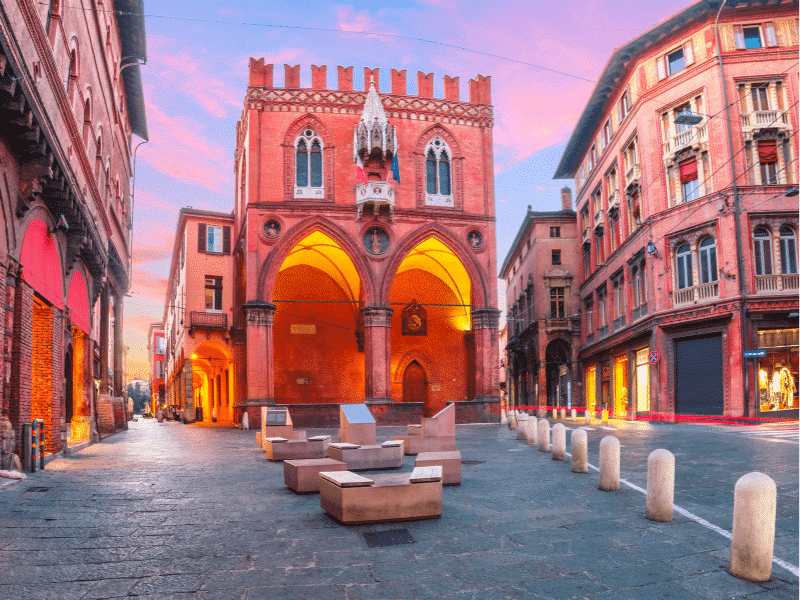
Bologna has three nicknames, and it has earned all of them: la dotta, the learned, for a university founded in 1088; la grassa, the fat, for its cooking; and la rossa, the red, for its terracotta roofs and, for much of the 20th century, its politics. Here are the facts and stories that make it special.
10 fun facts about Bologna
- A university from 1088: the University of Bologna takes 1088 as its founding date and is widely regarded as the oldest university in continuous operation in the world.
- Kilometres of arcades: Bologna's porticoes add up to about 62 kilometres, inside and outside the old walls. In 2021, twelve sections of them were added to UNESCO's World Heritage List.
- The longest portico of all: a covered walkway of about 3.8 kilometres, said to have 666 arches, climbs from the edge of the old town to the Sanctuary of the Madonna di San Luca on a hill above the city.
- Two leaning towers: the Asinelli Tower is about 97 metres tall, with 498 steps to the top, and dates from the early 12th century. Its shorter neighbour, the Garisenda, leans so much that Dante used it in the Inferno to picture a giant bending down.
- A medieval skyline: in the Middle Ages, Bologna's powerful families built dozens of tower houses as fortresses and status symbols. Fewer than twenty still stand today.
- The official width of pasta: in 1972 a golden tagliatella was deposited at Bologna's Chamber of Commerce to record the correct width of the city's favourite pasta, about 8 millimetres once cooked.
- A church that was meant to be bigger: the Basilica of San Petronio, begun in 1390, is one of the largest churches in Europe, yet its façade was never finished. Only the lower part is faced with marble.
- A sundial on the floor: in 1655 the astronomer Giovanni Domenico Cassini laid out a meridian line about 67 metres long across the floor of San Petronio. At solar noon a beam of sunlight from a small hole in the roof falls on it.
- A whispering corner: under the vaults of Palazzo del Podestà, next to Piazza Maggiore, you can whisper into one corner and be heard clearly by a friend standing in the corner diagonally opposite.
- A bronze giant: the Neptune in Piazza del Nettuno was made by the Flemish-born sculptor Giambologna in the 1560s.
The Two Towers and the students' curse
The Asinelli and Garisenda towers are named after the families traditionally credited with building them in the early 12th century, when rich families competed to build higher than their rivals. The Garisenda began to lean early because the ground beneath it gave way, and in the 14th century it was cut down to about 48 metres. The towers also come with a warning for students: legend says that anyone who climbs the Asinelli Tower before graduating will never finish their degree, so many wait until after their final exam.
Piazza Maggiore and the Archiginnasio, explained
Piazza Maggiore has been Bologna's main square since the 13th century, framed by San Petronio, the town hall in Palazzo d'Accursio and Palazzo del Podestà. A short walk away, the Archiginnasio was built in the 1560s to bring the university's schools under one roof. Inside Palazzo d'Accursio, the Biblioteca Salaborsa is a public library with a glass floor through which you can see excavated remains of Roman and medieval Bologna.
What to eat in Bologna
- Tagliatelle al ragù: the dish the rest of the world calls spaghetti bolognese. In Bologna the slow-cooked meat sauce goes on fresh egg tagliatelle, never on spaghetti.
- Tortellini in brodo: small stuffed pasta served in a clear meat broth, the traditional Christmas dish.
- Mortadella: the large, pale pink pork sausage dotted with cubes of fat. Mortadella Bologna is protected by the EU, and you will find it sliced paper-thin in every deli.
- Lasagne verdi: green spinach pasta layered with ragù and béchamel, the Bolognese way of making lasagne.
- Crescentine: puffy pieces of fried dough served with mortadella, salami and soft cheese, best with a glass of local Pignoletto wine.
Good to know before you go
- Both of the Two Towers are closed to visitors while the Garisenda is being made safe, and the area around them is a building site. Check the current situation before planning a climb.
- Walking to San Luca under the portico is a classic Bolognese outing. Allow about an hour each way and bring water, as the second half is a steady climb.
- Look for the little window in a wall on Via Piella: open the shutter and you see the Canale delle Moline running between the houses, a reminder of the canals that once crossed the city.
- Modena, Ferrara and Ravenna are all easy day trips by train.
Explore Bologna with World City Trail
Our Bologna scavenger hunt turns these sights into a game you play on your phone. The route links 10 stops and takes around two hours, with about 33 minutes of walking, and passes the Two Towers and the Biblioteca Salaborsa.
At each stop you solve a puzzle and hear a short story, at your own pace. You can start whenever you like.
Play the Bologna scavenger hunt →
Facts checked in October 2026.