
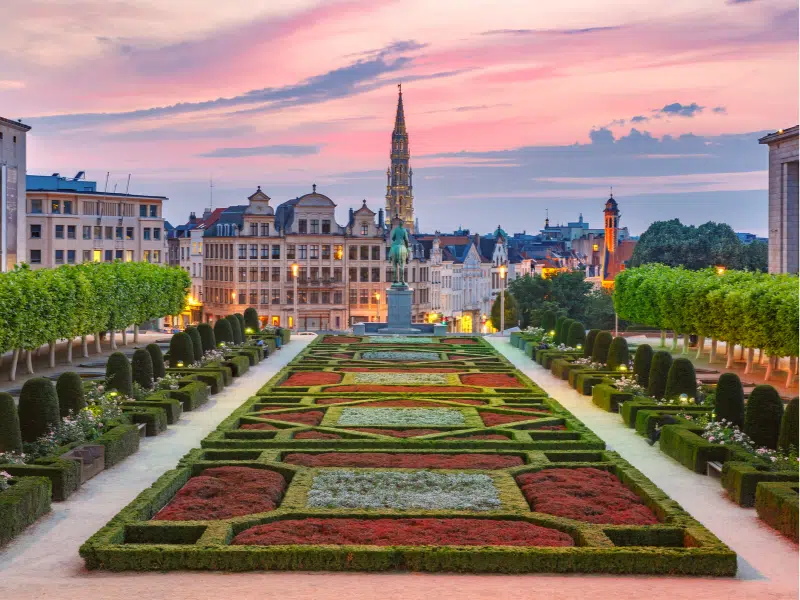
Brussels is the capital of Belgium and home to the main institutions of the European Union, yet its heart is a medieval market square and a fountain of a small boy. The city is officially bilingual, French and Dutch, and takes its comics, chocolate and beer seriously. Here are the facts and stories behind it.
10 fun facts about Brussels
- A square on the World Heritage list: the Grand Place, lined with guildhouses and the Gothic Town Hall, has been a UNESCO World Heritage Site since 1998.
- Rebuilt after a bombardment: on 13 August 1695, French troops under Marshal Villeroy bombarded Brussels and gutted the square, leaving only the stone shell of the Town Hall. The guilds rebuilt their houses within a few years, which is why most façades date from the late 1690s.
- An off-centre tower: the Town Hall's 96-metre tower, finished in 1455, is not in the middle of the façade. Legend says the architect jumped to his death when he noticed; in reality the building simply went up in stages.
- Saint Michael on top: a gilded statue of the city's patron saint, Michael, slaying a dragon, crowns the tower. The 15th-century original was replaced by a copy and is kept in the Brussels City Museum.
- A very small celebrity: Manneken Pis is just 55.5 cm tall. The bronze was commissioned in 1619 from Jérôme Duquesnoy the Elder; the figure on the corner today is a copy from 1965, and the original is in the Brussels City Museum on the Grand Place.
- A wardrobe of about a thousand outfits: Manneken Pis is dressed up for festivals, national days and visits. His 1,000th costume was presented in 2018, and many are on show in the GardeRobe MannekenPis museum.
- A carpet of flowers: every two years in mid-August the Grand Place is covered with a giant carpet of hundreds of thousands of begonias and other flowers, a tradition that began in 1971.
- Where the praline was born: in 1912 Jean Neuhaus created the filled chocolate praline at his family's shop in the Galeries Royales Saint-Hubert, a glass-roofed arcade that opened in 1847.
- An atom 165 billion times larger: the Atomium, built for the 1958 World's Fair, models an iron crystal magnified 165 billion times and stands 102 metres tall.
- A capital of comics: Hergé, the creator of Tintin, was born in Brussels in 1907, and dozens of comic-strip murals now decorate walls across the city.
The legends of Manneken Pis
Nobody knows for certain why Brussels put up a statue of a boy relieving himself, and over the centuries the city has collected several legends to explain it. In one, a boy named Julianske saved Brussels by urinating on the burning fuse of explosives that attackers had placed by the walls. In another, the infant Duke Godfrey III of Leuven was hung in a basket from a tree during a battle in 1142 to encourage his troops, and from there relieved himself on the enemy. A third tells of a merchant who lost his little son and, on finding him in this very spot, paid for the fountain in gratitude.
The Cathedral of St Michael and St Gudula
On the slope between the upper and lower town stands the cathedral of the city's two patron saints, Michael and Gudula. Its Gothic nave and twin-towered façade went up over about three centuries, from the 13th to the early 16th, and some of its stained glass dates from the 16th century. It is the setting for Belgium's great royal occasions: King Baudouin married Fabiola here in 1960, and Prince Philippe, now King, married Mathilde here in 1999.
What to eat in Brussels
- Moules-frites: a pot of mussels steamed with celery, onion and white wine, served with fries, best in the season from late summer.
- Frites: thick fries cooked twice in beef fat or oil, bought in a paper cone from a friterie and topped with one of a dozen sauces.
- Brussels waffle: light, crisp and rectangular, dusted with icing sugar; the denser, caramelised round one is the Liège waffle.
- Lambic and gueuze: sour beers fermented with wild yeasts from the air, a tradition of Brussels and the nearby Pajottenland. The Cantillon brewery has made them in Anderlecht since 1900.
Good to know before you go
- Come back to the Grand Place after dark, when the façades are lit up. It is quietest early in the morning.
- Manneken Pis is smaller than most people expect and is usually surrounded by a crowd. Check the city's costume calendar if you want to see him dressed up.
- Bruges, Ghent and Antwerp are all within about an hour by direct train, and the Atomium is a short metro ride north of the centre.
Explore Brussels with World City Trail
Our Brussels scavenger hunt turns these sights into a game you play on your phone. The route links 10 stops and takes around three hours, with about an hour of walking, and its stops include the Grand Place, Manneken Pis and the Cathedral of St Michael and St Gudula.
At each stop you solve a puzzle and hear a short story, at your own pace. You can start whenever you like.
Play the Brussels scavenger hunt →
Facts checked in October 2026.