
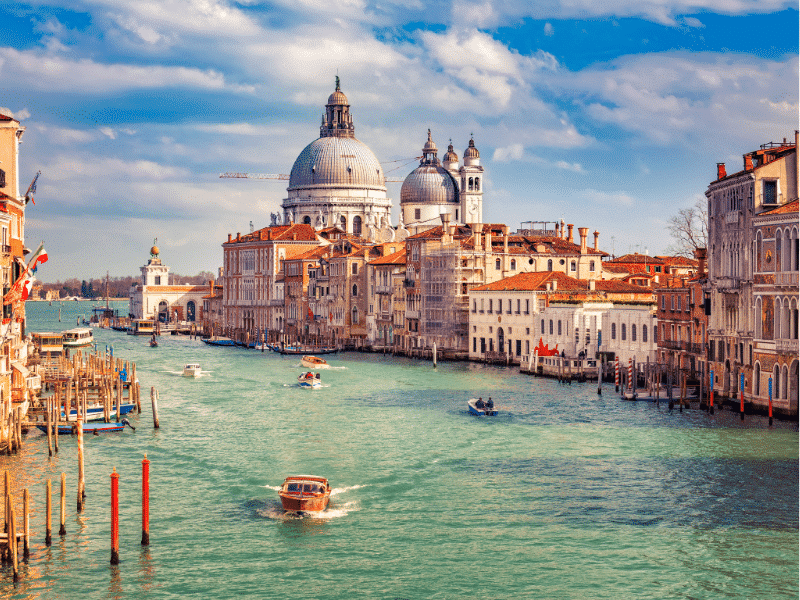
Venecia no debería existir. Se construyó sobre bancos de lodo en medio de una laguna, no tiene coches ni carreteras, y durante más de mil años fue uno de los estados independientes más ricos de Europa. Estos son los datos y las historias que hacen especial a la ciudad.
10 curiosidades sobre Venecia
- Una ciudad sobre pilotes de madera: Venecia se extiende por más de 100 pequeñas islas unidas por unos 400 puentes. Muchos de sus edificios descansan sobre pilotes de madera clavados en el fango de la laguna.
- Solo cuatro puentes sobre el Gran Canal: el de Rialto, el de la Academia, el de los Descalzos y el de la Constitución, un diseño de vidrio y acero de Santiago Calatrava inaugurado en 2008.
- El puente que estaba solo: el puente de Rialto de piedra se terminó en 1591 según un proyecto de Antonio da Ponte, sustituyendo a otros de madera. Hasta 1854 fue la única forma de cruzar el Gran Canal a pie.
- A bell tower rebuilt 'as it was, where it was': St Mark's Campanile collapsed on 14 July 1902 without killing anyone. The city rebuilt it exactly as before, and it was inaugurated again on 25 April 1912, the feast of St Mark.
- Horses that travelled to Paris: the four bronze horses of St Mark's were taken from Constantinople after the city was sacked in 1204. Napoleon carried them off to Paris in 1797, and they returned in 1815. The originals are now inside the basilica, with copies on the façade.
- The word 'ghetto' comes from here: in 1516 Venice ordered its Jewish community to live in the area of a former foundry, the getto. The name spread across the world.
- El vidrio se mudó a una isla: en 1291 la ciudad envió a sus vidrieros a Murano, sobre todo para alejar el riesgo de incendio del abarrotado centro.
- Titian's masterpiece and his grave: Titian painted the huge Assumption of the Virgin for the high altar of the Frari between 1516 and 1518, and he is buried in the same church.
- Un barco torcido a propósito: la góndola no es simétrica. Un lado es más largo que el otro para que avance recta aunque el gondolero reme por un solo lado.
- Una república de más de mil años: según la tradición, Venecia eligió a su primer dux en 697. La Serenísima no terminó hasta 1797, cuando se rindió ante Napoleón.
Cómo llegó San Marcos a Venecia
In 828 two Venetian merchants, Buono da Malamocco and Rustico da Torcello, took the body of St Mark the Evangelist from his tomb in Alexandria. Legend says they hid it in a basket under layers of pork, knowing that the Muslim customs officers would not want to touch it. Back home, the relics made Venice a city of pilgrimage, and St Mark's winged lion became the symbol of the Republic. The story is still told on the basilica: the mosaic over the far left doorway, the only original one on the façade, shows the saint's body being carried into the church.
El acqua alta, en pocas palabras
Several times a year, mostly in autumn and winter, a combination of high tide and wind pushes the sea into the city. This is acqua alta, and St Mark's Square, one of the lowest points in Venice, is usually the first place to flood. Since 2020 a system of mobile barriers called MOSE can close the lagoon's inlets when very high tides are forecast, which has kept the worst floods out.
Qué comer en Venecia
- Cicchetti: pequeños bocados sobre pan o en palillos, que se comen de pie en la barra de un bacaro (bar de vinos) con un vasito de vino.
- Sarde in saor: sardinas fritas marinadas con cebolla agridulce, pasas y piñones, una receta que los marineros llevaban en sus viajes.
- Baccalà mantecato: bacalao seco batido con aceite de oliva hasta formar una crema, servido sobre pan o polenta a la plancha.
- Bigoli in salsa: pasta gruesa integral con una salsa de cebolla pochada lentamente y anchoas.
- Fegato alla veneziana: calf's liver cooked with plenty of onions, one of the city's classic main courses.
Antes de ir
- On peak days in spring and summer, day-trippers have to register and pay an access fee before arriving, while overnight visitors register through their hotel. Check the city's official website for the current dates.
- St Mark's Basilica asks visitors to cover shoulders and knees. Booking a time slot ahead saves most of the queue.
- Busca un traghetto: en algunos puntos sin puente, góndolas-transbordador siguen cruzando el Gran Canal con pasajeros, una forma breve y barata de ir de pie en góndola como los venecianos.
- The busiest stretch is the route between the Rialto and St Mark's. Come early in the morning or in the evening, or wander off into Cannaregio and Castello, to see the quieter side of the city.
Descubre Venecia con World City Trail
Our Venice scavenger hunt turns these sights into a game you play on your phone. The route links 10 stops and takes around two hours, with about 41 minutes of walking, from the Frari Basilica over the Rialto Bridge to St Mark's Square.
En cada parada resuelves un acertijo y escuchas una historia breve, a tu ritmo. Puedes empezar cuando quieras.
Juega a la búsqueda del tesoro de Venecia →
Datos comprobados en octubre de 2026.