
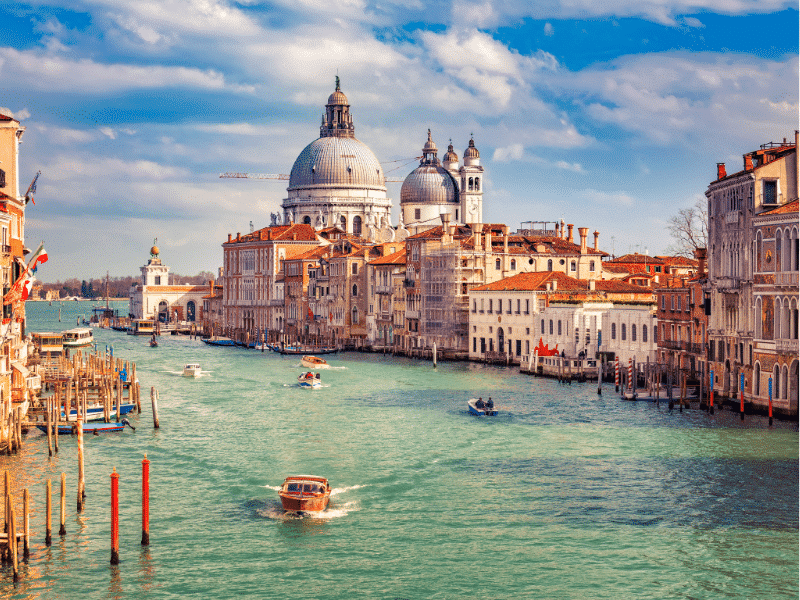
Venezia non dovrebbe esistere. È stata costruita su banchi di fango in mezzo a una laguna, non ha auto né strade, e per oltre mille anni è stata uno degli stati indipendenti più ricchi d’Europa. Ecco i fatti e le storie che rendono speciale la città.
10 curiosità su Venezia
- Una città su pali di legno: Venezia si estende su più di 100 piccole isole collegate da circa 400 ponti. Molti edifici poggiano su pali di legno piantati in profondità nel fango della laguna.
- Solo quattro ponti sul Canal Grande: Rialto, Accademia, Scalzi e il Ponte della Costituzione, un progetto in vetro e acciaio di Santiago Calatrava inaugurato nel 2008.
- Il ponte che era solo: il Ponte di Rialto in pietra fu completato nel 1591 su progetto di Antonio da Ponte, al posto di precedenti ponti in legno. Fino al 1854 fu l’unico modo per attraversare a piedi il Canal Grande.
- A bell tower rebuilt 'as it was, where it was': St Mark's Campanile collapsed on 14 July 1902 without killing anyone. The city rebuilt it exactly as before, and it was inaugurated again on 25 April 1912, the feast of St Mark.
- Horses that travelled to Paris: the four bronze horses of St Mark's were taken from Constantinople after the city was sacked in 1204. Napoleon carried them off to Paris in 1797, and they returned in 1815. The originals are now inside the basilica, with copies on the façade.
- The word 'ghetto' comes from here: in 1516 Venice ordered its Jewish community to live in the area of a former foundry, the getto. The name spread across the world.
- Il vetro traslocò su un’isola: nel 1291 la città mandò i suoi vetrai a Murano, soprattutto per allontanare il rischio di incendi dal centro affollato.
- Titian's masterpiece and his grave: Titian painted the huge Assumption of the Virgin for the high altar of the Frari between 1516 and 1518, and he is buried in the same church.
- Una barca storta apposta: la gondola non è simmetrica. Un lato è più lungo dell’altro, così procede dritta anche se il gondoliere rema da un solo lato.
- Una repubblica per oltre mille anni: secondo la tradizione Venezia elesse il primo doge nel 697. La Serenissima finì solo nel 1797, quando si arrese a Napoleone.
Come San Marco arrivò a Venezia
In 828 two Venetian merchants, Buono da Malamocco and Rustico da Torcello, took the body of St Mark the Evangelist from his tomb in Alexandria. Legend says they hid it in a basket under layers of pork, knowing that the Muslim customs officers would not want to touch it. Back home, the relics made Venice a city of pilgrimage, and St Mark's winged lion became the symbol of the Republic. The story is still told on the basilica: the mosaic over the far left doorway, the only original one on the façade, shows the saint's body being carried into the church.
L’acqua alta in breve
Several times a year, mostly in autumn and winter, a combination of high tide and wind pushes the sea into the city. This is acqua alta, and St Mark's Square, one of the lowest points in Venice, is usually the first place to flood. Since 2020 a system of mobile barriers called MOSE can close the lagoon's inlets when very high tides are forecast, which has kept the worst floods out.
Cosa mangiare a Venezia
- Cicchetti: piccoli assaggi su pane o stuzzicadenti, mangiati in piedi al banco di un bacaro con un’ombra di vino.
- Sarde in saor: sarde fritte marinate con cipolle in agrodolce, uvetta e pinoli, una ricetta che un tempo i marinai portavano in mare.
- Baccalà mantecato: stoccafisso montato con olio d’oliva fino a diventare una crema, servito su pane o polenta grigliata.
- Bigoli in salsa: grossa pasta integrale con un sugo di cipolle cotte a lungo e acciughe.
- Fegato alla veneziana: calf's liver cooked with plenty of onions, one of the city's classic main courses.
Da sapere prima di partire
- On peak days in spring and summer, day-trippers have to register and pay an access fee before arriving, while overnight visitors register through their hotel. Check the city's official website for the current dates.
- St Mark's Basilica asks visitors to cover shoulders and knees. Booking a time slot ahead saves most of the queue.
- Cerca un traghetto: in alcuni punti senza ponte, gondole-traghetto portano ancora i passeggeri da una riva all’altra del Canal Grande, un modo breve ed economico per stare in piedi in gondola come i veneziani.
- The busiest stretch is the route between the Rialto and St Mark's. Come early in the morning or in the evening, or wander off into Cannaregio and Castello, to see the quieter side of the city.
Scopri Venezia con World City Trail
Our Venice scavenger hunt turns these sights into a game you play on your phone. The route links 10 stops and takes around two hours, with about 41 minutes of walking, from the Frari Basilica over the Rialto Bridge to St Mark's Square.
A ogni tappa risolvi un enigma e ascolti una breve storia, al tuo ritmo. Puoi iniziare quando vuoi.
Gioca alla caccia al tesoro di Venezia →
Fatti verificati a ottobre 2026.