
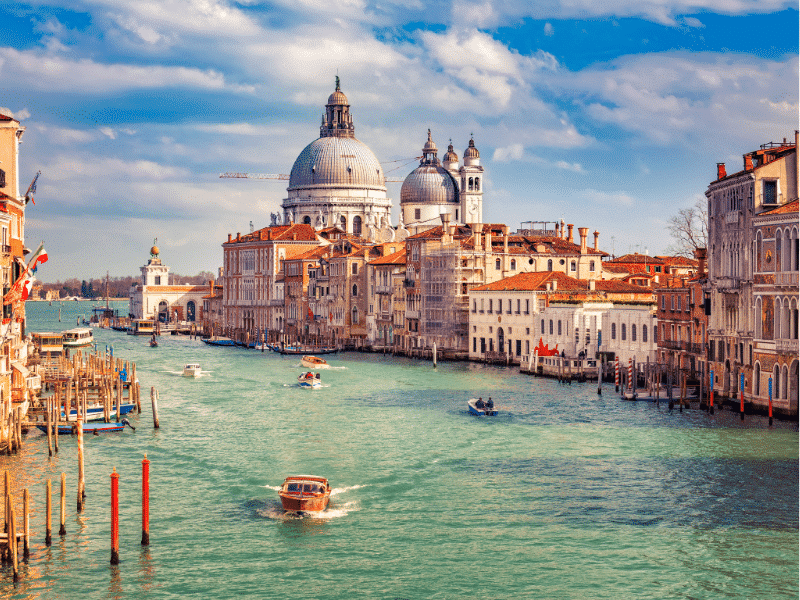
Venice should not exist. It was built on mudbanks in a lagoon, it has no cars and no roads, and for over a thousand years it was one of the richest independent states in Europe. Here are the facts and stories that make the city special.
10 fun facts about Venice
- A city on wooden piles: Venice spreads over more than 100 small islands linked by around 400 bridges. Many of its buildings stand on wooden piles driven deep into the mud of the lagoon.
- Only four bridges over the Grand Canal: the Rialto, the Accademia, the Scalzi and the Constitution Bridge, a glass and steel design by Santiago Calatrava that opened in 2008.
- The bridge that stood alone: the stone Rialto Bridge was completed in 1591 to a design by Antonio da Ponte, replacing earlier wooden bridges. Until 1854 it was the only way to cross the Grand Canal on foot.
- A bell tower rebuilt 'as it was, where it was': St Mark's Campanile collapsed on 14 July 1902 without killing anyone. The city rebuilt it exactly as before, and it was inaugurated again on 25 April 1912, the feast of St Mark.
- Horses that travelled to Paris: the four bronze horses of St Mark's were taken from Constantinople after the city was sacked in 1204. Napoleon carried them off to Paris in 1797, and they returned in 1815. The originals are now inside the basilica, with copies on the façade.
- The word 'ghetto' comes from here: in 1516 Venice ordered its Jewish community to live in the area of a former foundry, the getto. The name spread across the world.
- Glass moved to an island: in 1291 the city sent its glassmakers to Murano, largely to keep the risk of fire away from the crowded centre.
- Titian's masterpiece and his grave: Titian painted the huge Assumption of the Virgin for the high altar of the Frari between 1516 and 1518, and he is buried in the same church.
- A boat built crooked on purpose: a gondola is not symmetrical. One side is longer than the other, so the boat runs straight even though the gondolier rows on one side only.
- A republic for over a thousand years: by tradition Venice elected its first doge in 697. The Most Serene Republic only came to an end in 1797, when it surrendered to Napoleon.
How St Mark came to Venice
In 828 two Venetian merchants, Buono da Malamocco and Rustico da Torcello, took the body of St Mark the Evangelist from his tomb in Alexandria. Legend says they hid it in a basket under layers of pork, knowing that the Muslim customs officers would not want to touch it. Back home, the relics made Venice a city of pilgrimage, and St Mark's winged lion became the symbol of the Republic. The story is still told on the basilica: the mosaic over the far left doorway, the only original one on the façade, shows the saint's body being carried into the church.
Acqua alta, explained
Several times a year, mostly in autumn and winter, a combination of high tide and wind pushes the sea into the city. This is acqua alta, and St Mark's Square, one of the lowest points in Venice, is usually the first place to flood. Since 2020 a system of mobile barriers called MOSE can close the lagoon's inlets when very high tides are forecast, which has kept the worst floods out.
What to eat in Venice
- Cicchetti: small snacks on bread or cocktail sticks, eaten standing at the counter of a bacaro (wine bar) with a small glass of wine.
- Sarde in saor: fried sardines marinated with sweet-and-sour onions, raisins and pine nuts, a recipe sailors once took to sea.
- Baccalà mantecato: dried cod whipped with olive oil into a creamy spread, usually served on bread or grilled polenta.
- Bigoli in salsa: thick wholewheat pasta with a sauce of slow-cooked onions and anchovies.
- Fegato alla veneziana: calf's liver cooked with plenty of onions, one of the city's classic main courses.
Good to know before you go
- On peak days in spring and summer, day-trippers have to register and pay an access fee before arriving, while overnight visitors register through their hotel. Check the city's official website for the current dates.
- St Mark's Basilica asks visitors to cover shoulders and knees. Booking a time slot ahead saves most of the queue.
- Look for a traghetto: at a few points without a bridge, gondola ferries still carry passengers across the Grand Canal, a short and inexpensive way to stand in a gondola like the Venetians do.
- The busiest stretch is the route between the Rialto and St Mark's. Come early in the morning or in the evening, or wander off into Cannaregio and Castello, to see the quieter side of the city.
Explore Venice with World City Trail
Our Venice scavenger hunt turns these sights into a game you play on your phone. The route links 10 stops and takes around two hours, with about 41 minutes of walking, from the Frari Basilica over the Rialto Bridge to St Mark's Square.
At each stop you solve a puzzle and hear a short story, at your own pace. You can start whenever you like.
Play the Venice scavenger hunt →
Facts checked in October 2026.