
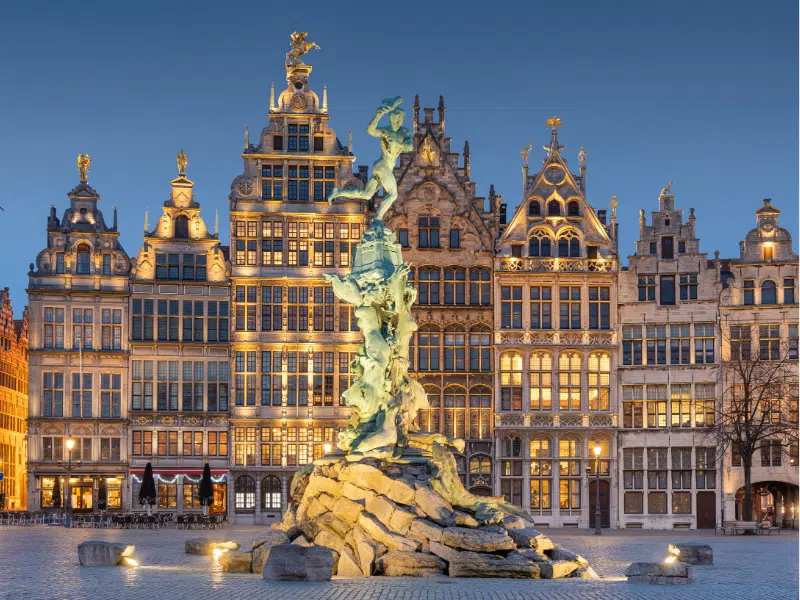
Antwerp grew rich on the river Scheldt. In the 16th century it was one of the busiest trading cities in Europe, and its port is still the second largest on the continent. It is also the city of Rubens, of diamonds and of a fashion academy that put Belgium on the catwalk. Here are the facts and stories that make it special.
10 fun facts about Antwerp
- The tallest church tower in the Low Countries: the spire of the Cathedral of Our Lady rises 123 metres, the highest in the Benelux. Building the cathedral took from 1352 to 1521.
- Four Rubens masterpieces in one church: the cathedral holds four altarpieces by Peter Paul Rubens, including The Elevation of the Cross and The Descent from the Cross.
- A Renaissance city hall: Antwerp City Hall on the Grote Markt was built between 1561 and 1565 by Cornelis Floris. It was set on fire during the Spanish Fury of 1576, when mutinous Spanish troops sacked the city, and later restored.
- A railway cathedral: Antwerpen-Centraal station, completed in 1905, is so grand that locals call it the spoorwegkathedraal, the railway cathedral.
- The world's oldest printing presses: the Plantin-Moretus Museum, the home and workshop of a 16th-century printing family, has the two oldest surviving printing presses in the world. It became a UNESCO World Heritage Site in 2005.
- A diamond city: Antwerp has been a centre of the diamond trade since the 15th century, and the Diamond Quarter sits right next to Centraal station.
- Europe's second port: after Rotterdam, the Port of Antwerp is the largest port in Europe.
- One of the oldest zoos in the world: Antwerp Zoo opened in 1843, right beside the station.
- Where the Olympic flag first flew: at the 1920 Antwerp Olympics, the Olympic flag with its five rings was raised for the first time, and athletes swore the Olympic oath for the first time.
- A tunnel with wooden escalators: the Sint-Annatunnel, a pedestrian tunnel under the Scheldt opened in 1933, still has some of its original wooden escalators.
The legend of Brabo and the giant
Antwerp's favourite story explains its name. Legend says a giant called Druon Antigoon lived by the Scheldt and forced every passing boatman to pay a toll. Anyone who refused lost a hand. A brave Roman soldier, Silvius Brabo, finally fought the giant, cut off his hand and threw it into the river. Hand werpen, 'throwing the hand', supposedly became Antwerpen. Linguists prefer a duller origin, probably from aan de werpen, a mound of land by the water, but the city has embraced the legend: two hands appear on its coat of arms, and on the Grote Markt the Brabo Fountain by Jef Lambeaux, unveiled in 1887, shows Brabo about to hurl the giant's hand.
Antwerpen-Centraal, explained
Antwerp's main station was built between 1895 and 1905 to designs by the architect Louis Delacenserie, at a time when King Leopold II wanted buildings to match Belgium's new wealth. The traveller first enters a stone hall topped by a dome, full of marble and gilding, before reaching the iron-and-glass train shed behind. For a century it was a terminus where every train had to reverse out. In 2007 a tunnel opened beneath the city, and trains now stop on several levels, from the historic platforms down to tracks deep underground. It regularly appears on lists of the world's most beautiful stations.
What to eat in Antwerp
- Frieten: Belgian fries, fried twice and served in a paper cone from a frituur, with mayonnaise or stoofvlees sauce.
- Stoofvlees: beef slowly stewed in brown beer with onions and mustard-spread bread, usually served with fries.
- Antwerpse handjes: biscuits and chocolates shaped like a hand, a sweet nod to the Brabo legend.
- Bolleke: an amber De Koninck beer from the local brewery, served in its round glass. Order 'een bolleke' at any café.
- Elixir d'Anvers: a sweet, herbal yellow liqueur made in Antwerp since 1863, traditionally sipped after dinner.
Good to know before you go
- Visitors need a ticket for the Cathedral of Our Lady outside services.
- Walk through the Sint-Annatunnel to the left bank for the best view of the old town skyline across the Scheldt.
- The MAS museum by the harbour has a walkway that spirals up the building to a rooftop view, which you can usually visit without a museum ticket.
- Ghent, Bruges and Brussels are all easy day trips by train from Centraal. If you drive, note that central Antwerp is a low emission zone.
Explore Antwerp with World City Trail
Our Antwerp scavenger hunt turns these sights into a game you play on your phone. The route links 10 stops and takes around three hours, with about 44 minutes of walking: Antwerpen-Centraal station, the Cathedral of Our Lady, City Hall and more of the old centre's main sights.
At each stop you solve a puzzle and hear a short story, at your own pace. You can start whenever you like.
Play the Antwerp scavenger hunt →
Facts checked in October 2026.