
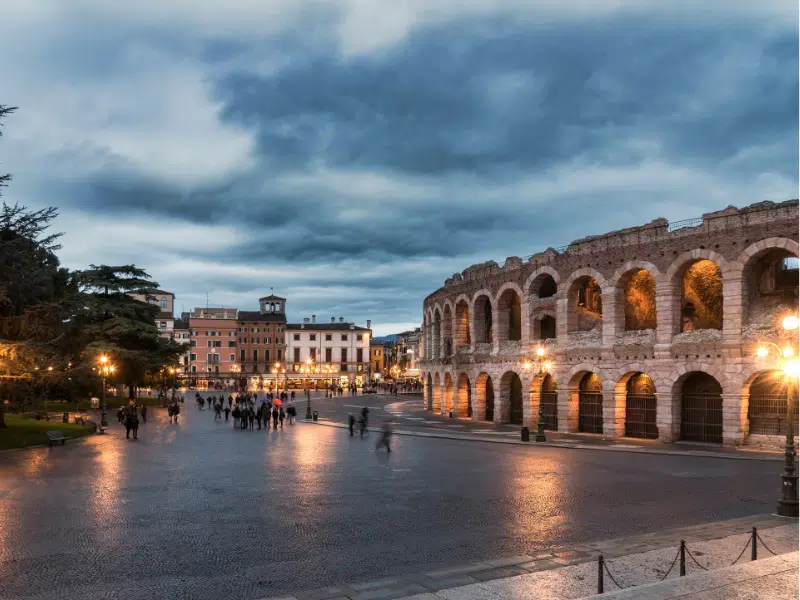
Verona has been lived in without a break since Roman times, and it shows: a first-century amphitheatre still hosts opera, a Roman gate stands in the middle of a shopping street, and the market square sits on top of the old forum. Shakespeare set two of his plays here without, as far as anyone knows, ever visiting. Here are the facts and stories that make the city special.
10 fun facts about Verona
- A Roman arena that still sells out: the Arena di Verona was built in the first century AD and is one of the best-preserved Roman amphitheatres anywhere. Since 1913, when Verdi's Aida was staged to mark the centenary of the composer's birth, it has hosted an opera festival almost every summer.
- An Olympic finale in a Roman ring: on 22 February 2026 the Arena hosted the closing ceremony of the Milano Cortina Winter Olympics, nearly two thousand years after it was built.
- The wing that survived: an earthquake in 1117 brought down most of the Arena's outer ring. Only four arches of it still stand, a fragment the Veronese call the Ala, the wing.
- A balcony from the 1930s: the famous balcony at Juliet's House was added in the 20th century, when the director of the city's museums, Antonio Avena, reshaped the medieval house to fit the story. The building really did belong to the Cappello family, and their carved stone hat still sits on the courtyard archway.
- Letters to Juliet: people from all over the world write to Juliet, and volunteers of the Juliet Club in Verona read the letters and answer them.
- A gate named after tax collectors: Porta Borsari was the main Roman entrance to the city, and an inscription on its façade records that the walls were rebuilt in AD 265 under the emperor Gallienus. Its name comes from the bursarii, the officials who later collected duties there.
- A whale rib above the street: under the Arco della Costa, between Piazza delle Erbe and Piazza dei Signori, hangs a large whale bone. Legend says it will fall on the first person to walk beneath it who has never told a lie.
- A tower 84 metres tall: the Torre dei Lamberti was begun in 1172, struck by lightning in 1403 and finished in the 15th century. You can climb it, or take the lift most of the way, for a view over the rooftops.
- Dante's host: Cangrande della Scala, lord of Verona, took Dante in during his exile, and Dante dedicated the Paradiso to him. Cangrande and his family lie in the Scaliger Tombs, Gothic monuments that stand right by the street next to the church of Santa Maria Antica.
- The home of pandoro: the tall, star-shaped Christmas cake now eaten all over Italy was patented by the Verona baker Domenico Melegatti in 1894.
Romeo and Juliet: how the story came to Verona
The tale of two young lovers from feuding families is older than Shakespeare. Luigi da Porto, a writer from Vicenza, set it in Verona in a novella published around 1530 and called the families Montecchi and Cappelletti, names Dante had already used for rival factions in the Divine Comedy. Matteo Bandello retold it, Arthur Brooke turned it into an English poem in 1562, and Shakespeare wrote his play in the 1590s. There is no evidence that Romeo and Juliet were real people. Verona embraced them anyway: in the 1930s the city created both Juliet's House and Juliet's Tomb, a red marble sarcophagus in the former monastery of San Francesco al Corso, and both still draw visitors from all over the world.
What to eat in Verona
- Risotto all'Amarone: rice cooked with the region's big, dry red wine, often finished with Monte Veronese cheese.
- Bollito con la pearà: boiled meats served with pearà, a thick, peppery sauce of breadcrumbs, bone marrow and broth that is found almost only in Verona.
- Pastissada de caval: a slow-cooked horse-meat stew, usually served with polenta. It is one of the city's oldest traditional dishes, so you will see it on many menus.
- Gnocchi: Verona's carnival is led by the Papà del Gnoco, a bearded figure who carries a giant fork with a gnocco on its tip, and potato gnocchi are a local favourite all year round.
Good to know before you go
- The courtyard of Juliet's House is small and gets very crowded. Go early in the morning, and check before you visit, as access has been limited at busy times.
- For the best view of the city, cross the Ponte Pietra and climb to Castel San Pietro, ideally at sunset. The Roman bridge was blown up in 1945 and rebuilt in the 1950s, partly with stones recovered from the Adige.
- Lake Garda is close enough for an easy day trip by train or bus. The whole historic centre of Verona has been a UNESCO World Heritage Site since 2000.
Explore Verona with World City Trail
Our Verona scavenger hunt turns these sights into a game you play on your phone. The route links 10 stops and takes around three hours, with about 45 minutes of walking, past sights such as the Arena di Verona, Casa di Giulietta and Porta Borsari.
At each stop you solve a puzzle and hear a short story, at your own pace. You can start whenever you like and play in English, German, French, Italian, Spanish or Dutch.
Play the Verona scavenger hunt →
Facts checked in October 2026.