
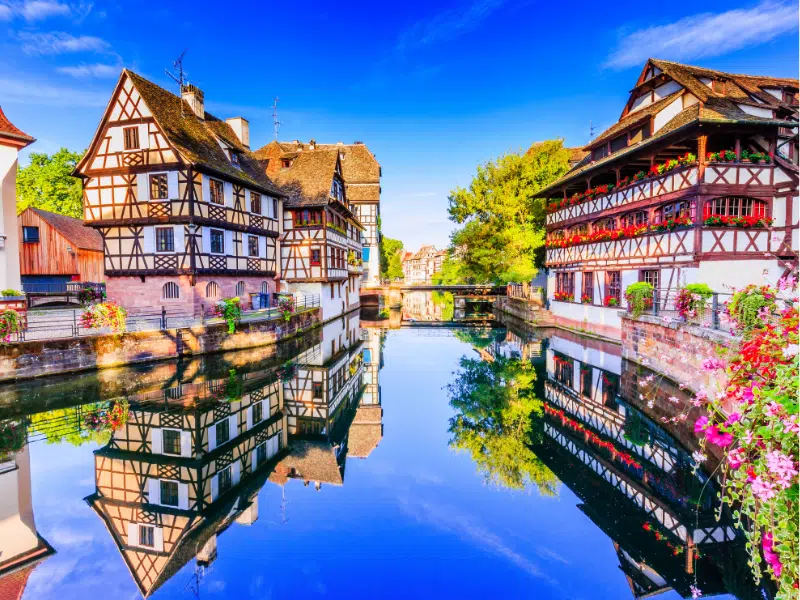
Strasbourg sits right on the border between France and Germany, and it changed nationality four times between 1870 and 1945. You can see both sides in its half-timbered houses, its food and its grand German-era boulevards. Today it is also one of the capitals of Europe. Here are the facts and stories that make it special.
10 fun facts about Strasbourg
- Once the tallest building in the world: the cathedral's spire reaches 142 metres. From 1647 until 1874, when a church in Hamburg overtook it, Strasbourg Cathedral was the tallest building on Earth.
- A cathedral with one spire: the west front was designed for two spires, but only the north tower was ever built. When a second spire was proposed after Alsace became German in 1871, the people of Strasbourg saw it as a symbol of the occupation and the idea was dropped.
- A clock with a daily parade: the astronomical clock inside the cathedral was rebuilt by Jean-Baptiste Schwilgué and inaugurated on 31 December 1842. Every day at 12:30, figures of Christ and the apostles process past, and a life-size mechanical cockerel crows three times.
- France's anthem was written here: Rouget de Lisle composed the 'War Song for the Army of the Rhine' on the night of 25 to 26 April 1792 at the home of Strasbourg's mayor, Dietrich. It became known as La Marseillaise after volunteers from Marseille sang it in Paris that summer.
- Gutenberg worked here first: Johannes Gutenberg lived in Strasbourg in the 1430s and 1440s, before he printed his famous Bible in Mainz. His statue by David d'Angers stands on Place Gutenberg.
- A Christmas market since 1570: the Christkindelsmärik has been held around the cathedral since 1570, which makes it one of the oldest Christmas markets in Europe.
- Covered bridges with no covers: the Ponts Couverts opened around 1250 with wooden roofs, which were removed in 1784. Four medieval towers still stand along the bridges.
- A palace for a cardinal: the Palais Rohan was built from 1732 to 1742 for Cardinal Armand Gaston de Rohan, prince-bishop of Strasbourg. Marie Antoinette spent her first night on French soil here in May 1770, and Napoleon stayed several times.
- A capital of Europe: Strasbourg is the official seat of the European Parliament, and it is home to the Council of Europe, founded in 1949, and the European Court of Human Rights.
- An island on the World Heritage List: the Grande Île, the old town ringed by two arms of the River Ill, was listed by UNESCO in 1988. In 2017 the listing was extended to the Neustadt, the district built under German rule after 1871.
How Petite France got its name
Petite France, the district of half-timbered houses and canals at the western tip of the Grande Île, owes its name to something far less charming than its looks. In 1503 a citizen named Gaspard Hofmeister founded a hospice here for incurable patients, many of them soldiers who had caught syphilis while fighting for King Charles VIII of France in Italy. Because syphilis was known locally as the French disease, the hospice was nicknamed 'Zum Französel'. By 1795 the building was being called 'La Petite France', and the name later spread to the whole district. For centuries this was the quarter of tanners, millers and fishermen. The Maison des Tanneurs, the tanners' guild house from 1572, still stands by the water, and the open lofts under the steep roofs are where hides were once hung to dry.
What to eat in Strasbourg
- Tarte flambée (flammekueche): a thin, crisp base topped with fromage blanc, onions and bacon, baked in a very hot oven and shared at the table.
- Choucroute garnie: sauerkraut cooked in Alsace wine and piled high with sausages, smoked pork and potatoes.
- Baeckeoffe: pork, beef and lamb marinated in white wine with potatoes, then baked slowly in a sealed earthenware dish.
- Kougelhopf: a tall, ring-shaped yeast cake with raisins and almonds, eaten at breakfast or with coffee.
- Alsace wine: order a Riesling or a Gewurztraminer in a winstub, the traditional wood-panelled Alsatian tavern.
Good to know before you go
- You can climb to the cathedral's viewing platform, 66 metres up, for a view over the roofs of the old town and, on clear days, the Black Forest.
- To see the clock's 12:30 procession, arrive early: in busy seasons the space in front of it fills up, and a separate ticket is usually needed at that time.
- For the classic view of the Ponts Couverts and Petite France, go up onto the roof terrace of the Barrage Vauban, the covered dam that took over the city's river defence in 1690.
- During the Christmas market season the centre gets very crowded, especially at weekends. Weekday mornings are the calmest time to walk around.
Explore Strasbourg with World City Trail
Our Strasbourg scavenger hunt turns these sights into a game you play on your phone. The route links 10 stops and takes around three hours, with about 47 minutes of walking: the Ponts Couverts, Strasbourg Cathedral and the Palais Rohan.
At each stop you solve a puzzle and hear a short story, at your own pace. You can start whenever you like.
Play the Strasbourg scavenger hunt →
Facts checked in October 2026.