
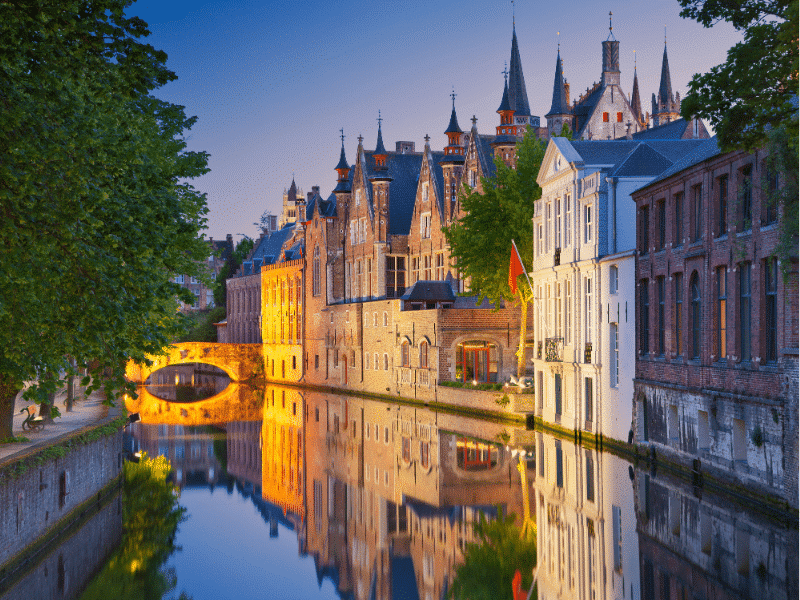
In the Middle Ages, Bruges was one of the great trading cities of northern Europe, until its channel to the sea silted up and the merchants left. That decline is why it looks the way it does: with little money to rebuild, the city kept its canals, brick gables and Gothic towers. Here are the facts and stories that make the city special.
10 fun facts about Bruges
- A belfry that leans: the Belfry on the Markt is 83 metres tall and leans about 87 centimetres to the east. Before a fire destroyed its wooden spire in 1741, it was about 102 metres high.
- 366 steps to the bells: the climb to the top of the Belfry takes you past the carillon of 47 bells that still plays over the Markt.
- A brick giant: the tower of the Church of Our Lady is 115.6 metres high, the tallest structure in Bruges and one of the tallest brick church towers in the world.
- A Michelangelo far from Italy: the marble Madonna and Child in the Church of Our Lady, bought in 1504 by a family of cloth merchants, was the first of Michelangelo's sculptures to leave Italy in his lifetime. It was carried off in 1794 and again in 1944, and came back both times.
- A beer pipeline under the streets: since 2016, De Halve Maan has pumped beer through a pipeline of about 3.3 kilometres from its brewery in the centre to its bottling plant, keeping trucks out of the old streets.
- Where the word 'bourse' comes from: medieval merchants met outside the inn of the Van der Beurse family in Bruges, and the name gave several languages their word for a stock exchange.
- Swans by order, says the legend: in 1488 the people of Bruges executed Pieter Lanchals, an official of Maximilian of Austria. As punishment, legend says, Maximilian ordered the city to keep swans on its canals forever, because Lanchals sounds like 'long neck'.
- A 14th-century town hall: the City Hall on the Burg was built between 1376 and 1421 and is one of the oldest in the Low Countries. Its Gothic Hall has a double-vaulted wooden ceiling.
- Van Eyck's city: the painter Jan van Eyck lived and worked in Bruges and died here in 1441. His statue stands on the Jan van Eyckplein, and the Groeninge Museum holds two of his paintings.
- A relic carried through the streets: the Basilica of the Holy Blood keeps a relic said to hold drops of Christ's blood. Every Ascension Day it is carried through the city in a procession that UNESCO listed as intangible heritage in 2009.
The Bruges Matins
In 1302 Flanders was under the control of the French king Philip the Fair, and Bruges was in revolt over taxes. Before dawn on 18 May, Flemish militiamen led by the weaver Pieter de Coninck and the butcher Jan Breydel attacked the sleeping French garrison. To tell friend from foe, they made suspects say 'schild en vriend', shield and friend, words French speakers struggled to pronounce. Around 2,000 people are thought to have died. On 11 July 1302, Flemish militias defeated the French knights at the Battle of the Golden Spurs near Kortrijk, a date that is now the official holiday of the Flemish Community.
The Burg, explained
The Burg is where Bruges began: in the 9th century the counts of Flanders built a fortress here. Around the square stand the Gothic City Hall, the Renaissance façade of the old civil registry and the Basilica of the Holy Blood, a Romanesque lower chapel from the 12th century with a Gothic chapel above. In 2000 the whole historic centre became a UNESCO World Heritage Site.
What to eat in Bruges
- Stoverij: Flemish beef stew slowly braised in dark beer, usually served with fries.
- Brugse Zot: the blond beer of De Halve Maan. The name means 'Bruges fool', after a story that Maximilian of Austria called the city a madhouse.
- Fries: buy them from a stand near the Markt and try them with mayonnaise.
- Waffles: the light Brussels waffle comes with toppings, while the denser, sweeter Liège waffle is a snack to eat on the go.
- Chocolate: Bruges has dozens of chocolate shops, and pralines are the classic gift to take home.
Good to know before you go
- Only a limited number of people are allowed inside the Belfry at once, so go early or late in the day to avoid the longest queue.
- For the classic view of the Belfry above the canal, stand on the Rozenhoedkaai, near the Burg.
- Canal boat trips leave from several landing stages in the centre, but they may not sail in freezing weather.
- Ghent is about half an hour away by train, and the village of Damme is a short bike ride along a canal.
Explore Bruges with World City Trail
Our Bruges scavenger hunt turns these sights into a game you play on your phone. The route links 10 stops and takes around two hours, with about 24 minutes of walking, and leads you past the Jan van Eyckplein, the Belfry and the Burg square, among other sights.
At each stop you solve a puzzle and hear a short story, at your own pace. You can start whenever you like.
Play the Bruges scavenger hunt →
Facts checked in October 2026.