
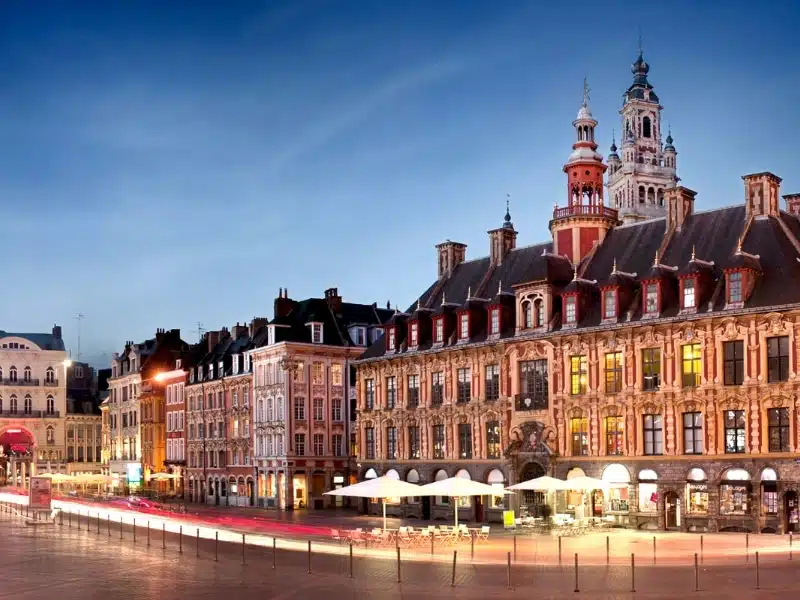
Lille was a Flemish city for most of its history until Louis XIV made it French in 1667, and you can still read both halves of that story in its stepped gables, brick belfries and grand French squares. Today it is a big student city with a serious appetite. Here are the facts and stories behind it.
10 fun facts about Lille
- French since 1667: Louis XIV took Lille in August 1667 after a short siege, and the treaty of 1668 confirmed it as French. In Dutch the city is still called Rijsel.
- The queen of citadels: right after the conquest, Vauban built a star-shaped citadel on the edge of the city in about three years. It is still used by the army, and the park around it is open to all.
- De Gaulle's birthplace: Charles de Gaulle was born in Lille on 22 November 1890, in his grandparents' house on rue Princesse, now a museum. The Grand Place is officially named after him.
- A stock exchange of 24 houses: the Vieille Bourse was built in 1652 and 1653 by Julien Destrée as 24 identical houses around an arcaded courtyard. Today booksellers and chess players gather under the arcades.
- A goddess for a siege: the column in the middle of the Grand Place remembers the Austrian siege of 1792, when the city held out under heavy bombardment. The bronze Goddess on top, by Théophile Bra, was finished in 1845.
- A 104-metre belfry: the belfry of the City Hall was built between 1924 and 1932 by Émile Dubuisson. Since 2005 it has been part of the UNESCO World Heritage listing of the Belfries of Belgium and France.
- Europe's giant flea market: on the first weekend of September the Braderie takes over the streets with stalls, a tradition that goes back to the Middle Ages. Restaurants compete over the tallest heap of empty mussel shells outside their doors.
- A world first underground: in 1983 Lille opened the first metro line using the VAL system, with small driverless trains.
- A hospital from 1237: the Hospice Comtesse in Vieux-Lille was founded in 1237 by Countess Jeanne of Flanders. It cared for the sick for centuries and is now a museum.
- A cathedral finished in 1999: Notre-Dame-de-la-Treille was begun in 1854 but only completed in 1999, with a modern facade of thin marble panels that glows from inside when the lights are on.
The legend of Lydéric and Phinaert
Lille's founding legend begins around the year 620. Salvaert, a prince of Dijon, was travelling through Flanders with his pregnant wife Ermengaert when the giant Phinaert, lord of the land, ambushed and killed him. Ermengaert escaped into the forest, gave birth to a son and, before she died, left the baby with a hermit, who raised him on the milk of a doe and called him Lydéric. When Lydéric grew up and learned the truth, he went to the court of King Dagobert and killed Phinaert in a duel. The legend says he received the giant's lands and founded Lille in 640.
Vieux-Lille, explained
North of the Grand Place, Vieux-Lille is the old town of narrow cobbled streets and 17th and 18th-century houses in brick and carved stone, the local Flemish Baroque style. Rue de la Monnaie is its best-known street, leading past the Hospice Comtesse towards the cathedral. Once run-down, the district has been carefully restored and is now full of boutiques, cafés and estaminets, the cosy traditional restaurants of the north.
What to eat in Lille
- Welsh: a slice of bread and ham drowned in cheddar melted with beer, baked and often topped with an egg, served with fries.
- Carbonade flamande: beef slowly braised in brown beer with onions and a slice of gingerbread spread with mustard.
- Potjevleesch: a cold terrine of several white meats set in jelly, eaten with fries.
- Maroilles: a strong-smelling washed-rind cheese from the region, baked into a tart called flamiche.
- Waffles from Méert: the confectioner on rue Esquermoise traces its history to 1761 and is known for thin waffles filled with vanilla cream.
Good to know before you go
- Lille has two main stations a few minutes apart: Lille-Flandres for regional trains and Lille-Europe for high-speed trains and the Eurostar.
- During the Braderie, hotels sell out months ahead and the centre is closed to traffic. Book early or pick another weekend if you prefer quiet streets.
- The Palais des Beaux-Arts is one of the largest art museums in France. La Piscine in Roubaix, an art museum in a former Art Deco swimming pool, is a short metro or tram ride away.
- The Wazemmes market is liveliest on Sunday mornings, with food, flowers and bric-a-brac.
Explore Lille with World City Trail
Our Lille scavenger hunt turns these sights into a game you play on your phone. The route links 10 stops and takes around two hours, with about 38 minutes of walking, and its stops include the Grand Place (Place du Général-de-Gaulle), the Vieille Bourse and the Belfry.
At each stop you solve a puzzle and hear a short story, at your own pace. You can start whenever you like.
Play the Lille scavenger hunt →
Facts checked in October 2026.