
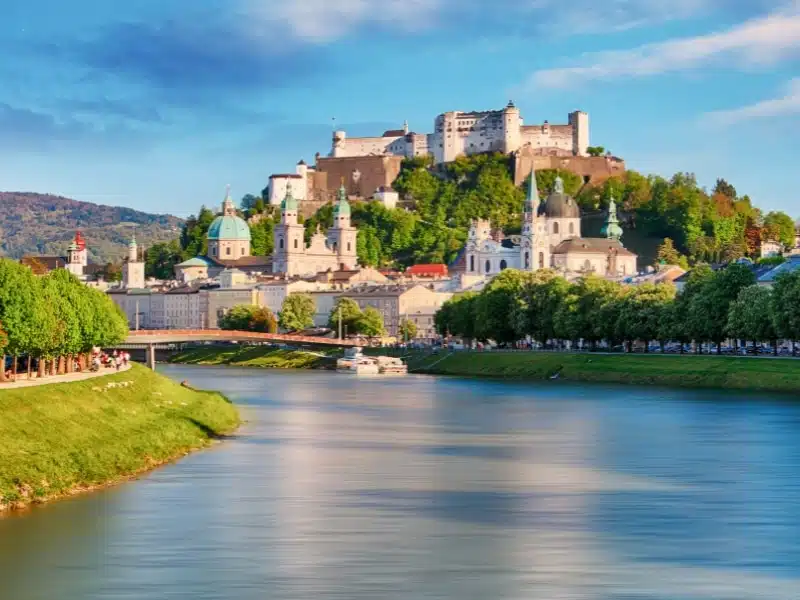
For about a thousand years Salzburg was run by prince-archbishops who grew rich on salt and spent the money on churches, palaces and music. The result is a compact Baroque old town below a medieval fortress, split by the river Salzach, with Mozart's name in half the shop windows. Here are the facts and stories behind the city.
10 fun facts about Salzburg
- A city named after salt: Salzburg means 'salt castle'. Salt from the Dürrnberg mine near Hallein, shipped down the Salzach, paid for much of the city you see today.
- A fortress more than 900 years old: Hohensalzburg Fortress was begun in 1077 under Archbishop Gebhard. It is one of the largest fully preserved medieval castles in Europe.
- Mozart's yellow house: Wolfgang Amadeus Mozart was born on 27 January 1756 on the third floor of Getreidegasse 9. The family lived there until 1773, then moved across the river to a larger flat on Makartplatz, now the Mozart Residence.
- Austrian only since 1816: for centuries Salzburg was an independent church state inside the Holy Roman Empire, not part of Austria. It was secularised in 1803, changed hands several times in the Napoleonic years and finally became Austrian in 1816.
- A palace built for love: in 1606 Prince-Archbishop Wolf Dietrich von Raitenau built a palace for Salome Alt, the woman he lived with and the mother of his many children. After his fall, his successor renamed it Mirabell.
- Do-Re-Mi in the garden: The Sound of Music, released in 1965, was filmed in and around Salzburg. The Pegasus Fountain and the steps of the Mirabell Gardens appear in the Do-Re-Mi scene.
- A cathedral with a famous baptism: the present Salzburg Cathedral, one of the first early Baroque churches north of the Alps, was consecrated in 1628. Mozart was baptised in it the day after he was born.
- Silent Night has Salzburg roots: Joseph Mohr, who wrote the words of Silent Night, was born in Salzburg in 1792. The carol was first sung on 24 December 1818 in Oberndorf, a village north of the city.
- A festival that opens with Everyman: the Salzburg Festival was founded in 1920 by Max Reinhardt, Hugo von Hofmannsthal and Richard Strauss. Hofmannsthal's play Jedermann (Everyman) has been performed in front of the cathedral almost every summer since.
- A funicular from 1892: the FestungsBahn has carried visitors up to the fortress since 1892. It ran on water ballast until it was converted to electric power in 1960.
The legend of the bull washers
In the 16th century, the legend says, rebellious peasants besieged Salzburg. The walls held, so the attackers tried to starve the city out, and in the end only one bull was left. The commander had it led along the walls every day in full view of the enemy, painted white one day and black the next. Convinced the city still had plenty of cattle, the peasants gave up and went home, and the townspeople washed the paint off their bull. That is why a born-and-bred Salzburger is still called a Stierwascher, a bull washer.
Getreidegasse, explained
Getreidegasse was the medieval main street of Salzburg's merchants, and its tall, narrow houses still stand shoulder to shoulder. Look up for the wrought-iron signs hanging over almost every door: they come from a time when many customers could not read. Look sideways for the Durchhäuser, passages through the buildings that lead to quiet courtyards and on to Universitätsplatz, where a farmers' market is held on the square behind Mozart's Birthplace.
What to eat in Salzburg
- Salzburger Nockerl: a sweet soufflé baked in three golden peaks, said to stand for the hills around the city. It is large, so order one to share.
- Mozartkugel: the confectioner Paul Fürst created this pistachio, marzipan and nougat praline in 1890. His family's café still makes them by hand in silver and blue foil.
- Beer: Stiegl has been brewed in Salzburg since 1492. At Augustiner Bräu in Mülln, a brewery founded by Augustinian monks in 1621, beer is poured from wooden barrels into stone mugs.
- Bosna: Salzburg's own street snack, a spiced bratwurst in a toasted roll with onions and curry powder, sold at the tiny Balkan Grill in a passage off Getreidegasse.
Good to know before you go
- Hellbrunn Palace was built in the early 17th century for Archbishop Markus Sittikus. Its trick fountains are open roughly from spring to autumn, and you will probably get wet.
- During the Salzburg Festival, from late July to the end of August, hotels and restaurants fill up early. Book well ahead if you travel then.
- For the classic view over the domes and the fortress, take the lift up the Mönchsberg from the old town, or climb the steps of the Kapuzinerberg on the other bank.
Explore Salzburg with World City Trail
Our Salzburg scavenger hunt turns these sights into a game you play on your phone. The route links 10 stops and takes around two hours, with about 31 minutes of walking, and its stops include Mirabell Palace and Gardens, Mozart's Birthplace and Salzburg Cathedral.
At each stop you solve a puzzle and hear a short story, at your own pace. You can start whenever you like.
Play the Salzburg scavenger hunt →
Facts checked in October 2026.