
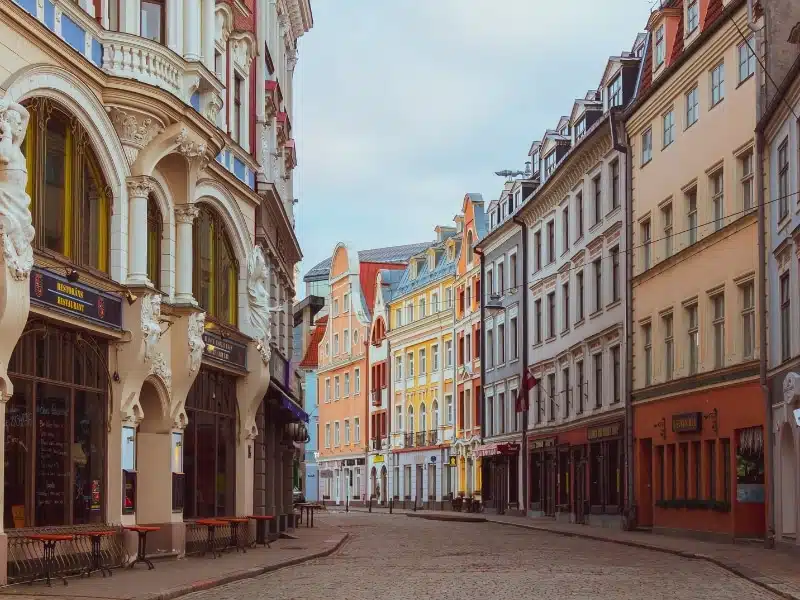
Riga, the capital of Latvia, was founded in 1201 and grew rich as a Hanseatic port on the Daugava. It has two faces: a medieval Old Town of guild halls, merchants' houses and church spires, and a newer centre lined with some of the most elaborate Art Nouveau facades in Europe. Here are the facts and stories that make the city special.
10 fun facts about Riga
- Founded by a bishop: Bishop Albert of Buxhoeveden founded Riga in 1201 as a base for the crusades in the eastern Baltic.
- A claim to the first Christmas tree: Riga says the first decorated Christmas tree was put up here in 1510 by the Brotherhood of Blackheads, a guild of unmarried merchants. A plaque on Town Hall Square marks the spot, although Tallinn makes a similar claim.
- A guild hall rebuilt from scratch: the House of the Blackheads on Town Hall Square goes back to 1334. It was bombed to ruins in 1941, and the Soviet authorities had the remains cleared in 1948. The building you see today is a reconstruction that opened in 1999.
- Three brothers in a row: the Three Brothers on Mazā Pils iela are three adjoining houses, the oldest from the 15th century. Side by side they show how Riga's homes changed over the centuries, and today they house the Latvian Museum of Architecture.
- Cats with their tails turned: two black cats with arched backs sit on the turrets of the Cat House, built in 1909 on Līvu Square. Legend says the owner, refused entry to the Great Guild, turned the cats' tails towards the guild hall across the street.
- A market in Zeppelin hangars: Riga Central Market opened in 1930 in five pavilions whose steel frames came from German First World War Zeppelin hangars at Vaiņode in western Latvia.
- Roosters on the spires: the main church spires of the Old Town are topped with weathercocks. The spire of St Peter's Church burned in 1941, was rebuilt in steel after the war and now has a lift up to a viewing platform.
- A monument that outlasted the Soviet era: the Freedom Monument was unveiled on 18 November 1935, Latvia's Independence Day. Paid for by public donations, it is 42 metres tall and topped by a copper figure of Liberty, nicknamed Milda, holding up three gold stars.
- A clock that took a chocolate name: the Laima Clock at the edge of the Old Town was completed in 1924 and has carried the name of the Laima confectionery company since 1936.
- A song festival since 1873: Latvia's first Song Festival was held in Riga in 1873. The Baltic song and dance celebrations are on UNESCO's intangible heritage list, and the festival still brings tens of thousands of singers and dancers to the city.
The legend of 'Is Riga finished?'
Riga's best-known legend comes from the river. Once every hundred years, it says, a spirit rises from the Daugava at night and asks the first person it meets: 'Is Riga finished yet?' If the answer is ever yes, the whole city will sink into the water. So the answer must always be no, and Riga must never stop building.
Art Nouveau and the museum quarter
Around 1900 Riga was booming, and roughly a third of the buildings in today's centre went up in the Art Nouveau style. The most theatrical facades, with carved faces and masks, are on Alberta iela, several of them by Mikhail Eisenstein, father of the film director Sergei Eisenstein. Nearby stands the Latvian National Museum of Art, built in 1903–1905 as the first purpose-built museum in the Baltics.
What to eat in Riga
- Grey peas with bacon: pelēkie zirņi ar speķi, a hearty dish of peas fried with bacon and onion, often served with a glass of kefir.
- Rye bread: dark, dense and slightly sweet rupjmaize comes with almost every meal and even turns up in desserts, layered with cream and berries.
- Pīrāgi: small baked buns filled with chopped bacon and onion, sold in bakeries and at the Central Market.
- Sklandrausis: a small open tart of rye dough filled with mashed potato and sweet carrot, spiced with cinnamon.
- Riga Black Balsam: a dark herbal liqueur whose recipe goes back to 1752 and the Riga pharmacist Abraham Kunze.
Good to know before you go
- The Central Market is busiest and best stocked in the morning.
- Jūrmala's long sandy beach is a short train ride from Riga, an easy half-day trip in summer.
- For a view over the Old Town's roofs and the Daugava, take the lift up the tower of St Peter's Church.
- Midsummer, Jāņi, on 23 and 24 June, is Latvia's biggest holiday. Many people leave the city, and some shops and restaurants close.
Explore Riga with World City Trail
Our Riga scavenger hunt turns these sights into a game you play on your phone. The route links 10 stops and takes around three hours, with about 40 minutes of walking, including the Latvian National Museum of Art, the Freedom Monument and the Laima Clock.
At each stop you solve a puzzle and hear a short story, at your own pace. You can start whenever you like.
Play the Riga scavenger hunt →
Facts checked in October 2026.