
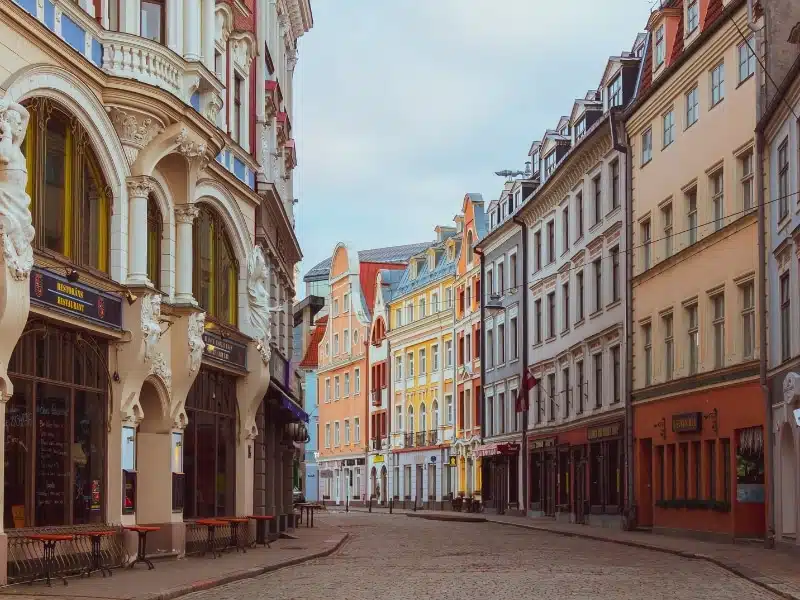
Riga, the capital of Latvia, was founded in 1201 and grew rich as a Hanseatic port on the Daugava. It has two faces: a medieval Old Town of guild halls, merchants' houses and church spires, and a newer centre lined with some of the most elaborate Art Nouveau facades in Europe. Here are the facts and stories that make the city special.
10 curiosidades sobre Riga
- Fundada por um bispo: o bispo Alberto de Buxhoeveden fundou Riga em 1201 como base para as cruzadas no leste do Báltico.
- A primeira árvore de Natal? Riga afirma que a primeira árvore de Natal decorada foi montada aqui em 1510 pela Irmandade dos Cabeças Negras, uma guilda de mercadores solteiros. Uma placa na Praça da Câmara assinala o local, embora Tallinn reivindique o mesmo.
- Uma casa de guilda reconstruída de raiz: a Casa dos Cabeças Negras, na Praça da Câmara, remonta a 1334. Ficou em ruínas com os bombardeamentos de 1941, e as autoridades soviéticas mandaram retirar os restos em 1948. O edifício que vês hoje é uma reconstrução inaugurada em 1999.
- Three brothers in a row: the Three Brothers on Mazā Pils iela are three adjoining houses, the oldest from the 15th century. Side by side they show how Riga's homes changed over the centuries, and today they house the Latvian Museum of Architecture.
- Cats with their tails turned: two black cats with arched backs sit on the turrets of the Cat House, built in 1909 on Līvu Square. Legend says the owner, refused entry to the Great Guild, turned the cats' tails towards the guild hall across the street.
- Um mercado em hangares de zepelins: o Mercado Central de Riga abriu em 1930 em cinco pavilhões cujas estruturas de aço vieram de hangares alemães de zepelins da Primeira Guerra Mundial em Vaiņode, no oeste da Letónia.
- Roosters on the spires: the main church spires of the Old Town are topped with weathercocks. The spire of St Peter's Church burned in 1941, was rebuilt in steel after the war and now has a lift up to a viewing platform.
- A monument that outlasted the Soviet era: the Freedom Monument was unveiled on 18 November 1935, Latvia's Independence Day. Paid for by public donations, it is 42 metres tall and topped by a copper figure of Liberty, nicknamed Milda, holding up three gold stars.
- Um relógio com nome de chocolate: o Relógio Laima, à beira da cidade velha, foi concluído em 1924 e tem desde 1936 o nome da fábrica de doces Laima.
- A song festival since 1873: Latvia's first Song Festival was held in Riga in 1873. The Baltic song and dance celebrations are on UNESCO's intangible heritage list, and the festival still brings tens of thousands of singers and dancers to the city.
The legend of 'Is Riga finished?'
Riga's best-known legend comes from the river. Once every hundred years, it says, a spirit rises from the Daugava at night and asks the first person it meets: 'Is Riga finished yet?' If the answer is ever yes, the whole city will sink into the water. So the answer must always be no, and Riga must never stop building.
A Arte Nova e o bairro dos museus
Around 1900 Riga was booming, and roughly a third of the buildings in today's centre went up in the Art Nouveau style. The most theatrical facades, with carved faces and masks, are on Alberta iela, several of them by Mikhail Eisenstein, father of the film director Sergei Eisenstein. Nearby stands the Latvian National Museum of Art, built in 1903–1905 as the first purpose-built museum in the Baltics.
O que comer em Riga
- Ervilhas cinzentas com toucinho: pelēkie zirņi ar speķi, um prato forte de ervilhas salteadas com toucinho e cebola, muitas vezes servido com um copo de kefir.
- Pão de centeio: o rupjmaize, escuro, denso e ligeiramente doce, acompanha quase todas as refeições e aparece até em sobremesas, em camadas com natas e frutos vermelhos.
- Pīrāgi: pãezinhos assados recheados de toucinho picado e cebola, vendidos em padarias e no Mercado Central.
- Sklandrausis: uma pequena tarte aberta de massa de centeio, recheada de puré de batata e cenoura doce, com canela.
- Bálsamo Negro de Riga: um licor escuro de ervas cuja receita remonta a 1752 e ao farmacêutico de Riga Abraham Kunze.
Antes de ires
- O Mercado Central tem mais movimento e mais escolha de manhã.
- Jūrmala's long sandy beach is a short train ride from Riga, an easy half-day trip in summer.
- For a view over the Old Town's roofs and the Daugava, take the lift up the tower of St Peter's Church.
- Midsummer, Jāņi, on 23 and 24 June, is Latvia's biggest holiday. Many people leave the city, and some shops and restaurants close.
Descobre Riga com a World City Trail
A nossa caça ao tesouro em Riga transforma estes locais num jogo no teu telemóvel. O percurso liga 10 paragens e demora cerca de três horas, com uns 40 minutos a pé, incluindo o Museu Nacional de Arte da Letónia, o Monumento à Liberdade e o Relógio Laima.
Em cada paragem resolves um enigma e ouves uma pequena história, ao teu ritmo. Podes começar quando quiseres.
Jogar a caça ao tesouro de Riga →
Factos verificados em outubro de 2026.