
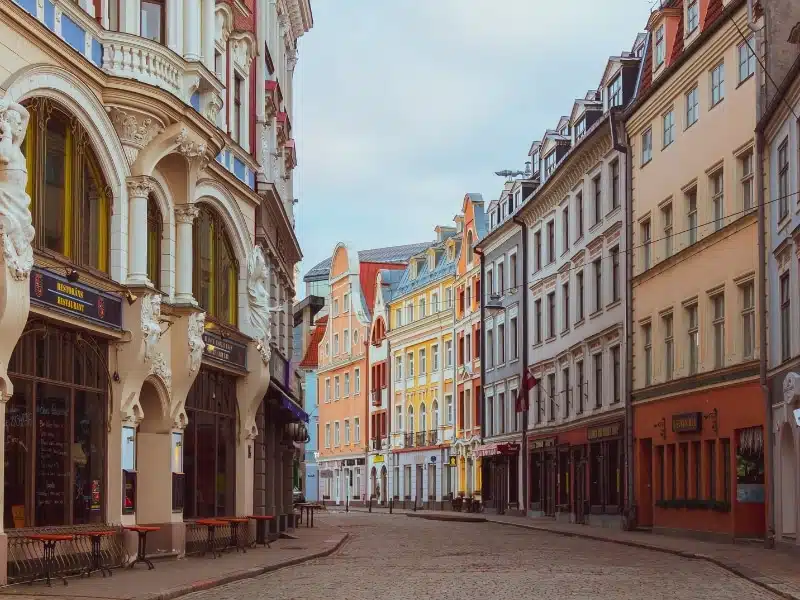
Riga, the capital of Latvia, was founded in 1201 and grew rich as a Hanseatic port on the Daugava. It has two faces: a medieval Old Town of guild halls, merchants' houses and church spires, and a newer centre lined with some of the most elaborate Art Nouveau facades in Europe. Here are the facts and stories that make the city special.
10 leuke weetjes over Riga
- Gesticht door een bisschop: bisschop Albert van Buxhoeveden stichtte Riga in 1201 als uitvalsbasis voor de kruistochten in het oostelijke Balticum.
- De eerste kerstboom? Riga zegt dat hier in 1510 de eerste versierde kerstboom werd neergezet door de Broederschap van de Zwarthoofden, een gilde van ongetrouwde kooplieden. Een plaquette op het Raadhuisplein markeert de plek, al maakt Tallinn dezelfde claim.
- Een gildehuis van de grond af herbouwd: het Zwarthoofdenhuis aan het Raadhuisplein gaat terug tot 1334. In 1941 werd het platgebombardeerd, en in 1948 lieten de Sovjetautoriteiten de resten opruimen. Het gebouw dat je nu ziet is een reconstructie die in 1999 openging.
- Three brothers in a row: the Three Brothers on Mazā Pils iela are three adjoining houses, the oldest from the 15th century. Side by side they show how Riga's homes changed over the centuries, and today they house the Latvian Museum of Architecture.
- Cats with their tails turned: two black cats with arched backs sit on the turrets of the Cat House, built in 1909 on Līvu Square. Legend says the owner, refused entry to the Great Guild, turned the cats' tails towards the guild hall across the street.
- Een markt in zeppelinhangars: de Centrale Markt van Riga opende in 1930 in vijf paviljoens waarvan de stalen skeletten afkomstig zijn van Duitse zeppelinhangars uit de Eerste Wereldoorlog in Vaiņode, in het westen van Letland.
- Roosters on the spires: the main church spires of the Old Town are topped with weathercocks. The spire of St Peter's Church burned in 1941, was rebuilt in steel after the war and now has a lift up to a viewing platform.
- A monument that outlasted the Soviet era: the Freedom Monument was unveiled on 18 November 1935, Latvia's Independence Day. Paid for by public donations, it is 42 metres tall and topped by a copper figure of Liberty, nicknamed Milda, holding up three gold stars.
- Een klok met een chocoladenaam: de Laima-klok aan de rand van de oude stad werd in 1924 voltooid en draagt sinds 1936 de naam van zoetwarenfabrikant Laima.
- A song festival since 1873: Latvia's first Song Festival was held in Riga in 1873. The Baltic song and dance celebrations are on UNESCO's intangible heritage list, and the festival still brings tens of thousands of singers and dancers to the city.
The legend of 'Is Riga finished?'
Riga's best-known legend comes from the river. Once every hundred years, it says, a spirit rises from the Daugava at night and asks the first person it meets: 'Is Riga finished yet?' If the answer is ever yes, the whole city will sink into the water. So the answer must always be no, and Riga must never stop building.
Art nouveau en de museumwijk
Around 1900 Riga was booming, and roughly a third of the buildings in today's centre went up in the Art Nouveau style. The most theatrical facades, with carved faces and masks, are on Alberta iela, several of them by Mikhail Eisenstein, father of the film director Sergei Eisenstein. Nearby stands the Latvian National Museum of Art, built in 1903–1905 as the first purpose-built museum in the Baltics.
Wat je moet eten in Riga
- Grauwe erwten met spek: pelēkie zirņi ar speķi, een stevig gerecht van erwten gebakken met spek en ui, vaak met een glas kefir erbij.
- Roggebrood: het donkere, compacte en licht zoete rupjmaize komt bij bijna elke maaltijd op tafel en duikt zelfs op in desserts, in laagjes met room en bessen.
- Pīrāgi: kleine gebakken broodjes gevuld met gehakt spek en ui, te koop bij bakkers en op de Centrale Markt.
- Sklandrausis: een klein open taartje van roggedeeg, gevuld met aardappelpuree en zoete wortel en op smaak gebracht met kaneel.
- Rigas Zwarte Balsem: een donkere kruidenlikeur waarvan het recept teruggaat tot 1752 en de Rigase apotheker Abraham Kunze.
Goed om te weten voor je gaat
- De Centrale Markt is ‘s ochtends het drukst en het best gevuld.
- Jūrmala's long sandy beach is a short train ride from Riga, an easy half-day trip in summer.
- For a view over the Old Town's roofs and the Daugava, take the lift up the tower of St Peter's Church.
- Midsummer, Jāņi, on 23 and 24 June, is Latvia's biggest holiday. Many people leave the city, and some shops and restaurants close.
Ontdek Riga met World City Trail
Onze schattenjacht in Riga maakt van deze plekken een spel op je telefoon. De route verbindt 10 stops en duurt zo’n drie uur, met ongeveer 40 minuten lopen, onder meer langs het Lets Nationaal Kunstmuseum, het Vrijheidsmonument en de Laima-klok.
Bij elke stop los je een puzzel op en hoor je een kort verhaal, in je eigen tempo. Je kunt beginnen wanneer je wilt.
Speel de schattenjacht in Riga →
Feiten gecontroleerd in oktober 2026.