
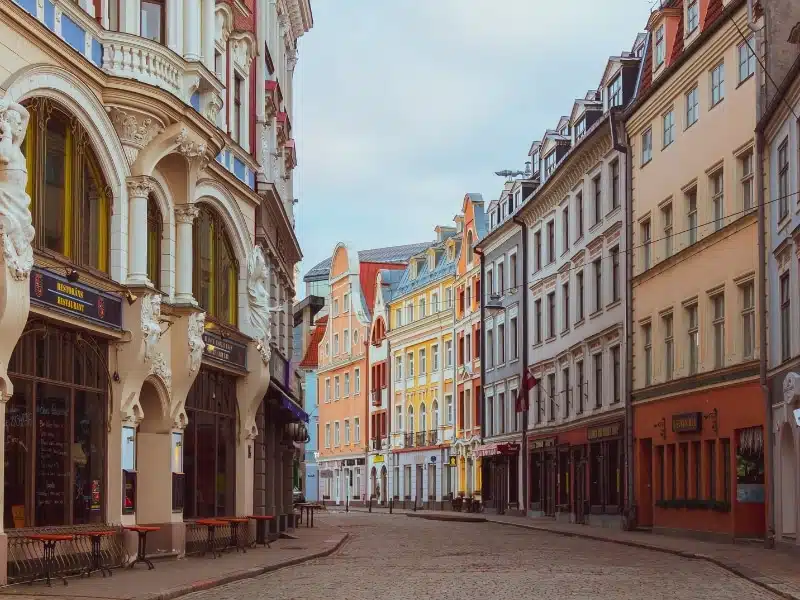
Riga, the capital of Latvia, was founded in 1201 and grew rich as a Hanseatic port on the Daugava. It has two faces: a medieval Old Town of guild halls, merchants' houses and church spires, and a newer centre lined with some of the most elaborate Art Nouveau facades in Europe. Here are the facts and stories that make the city special.
10 curiosidades sobre Riga
- Fundada por un obispo: el obispo Alberto de Buxhoeveden fundó Riga en 1201 como base para las cruzadas en el este del Báltico.
- ¿El primer árbol de Navidad? Riga sostiene que aquí se montó el primer árbol de Navidad decorado en 1510, obra de la Hermandad de las Cabezas Negras, un gremio de comerciantes solteros. Una placa en la plaza del Ayuntamiento marca el lugar, aunque Tallin reivindica lo mismo.
- Una casa gremial reconstruida desde cero: la Casa de las Cabezas Negras, en la plaza del Ayuntamiento, se remonta a 1334. Quedó en ruinas por los bombardeos de 1941, y las autoridades soviéticas mandaron retirar los restos en 1948. El edificio que ves hoy es una reconstrucción inaugurada en 1999.
- Three brothers in a row: the Three Brothers on Mazā Pils iela are three adjoining houses, the oldest from the 15th century. Side by side they show how Riga's homes changed over the centuries, and today they house the Latvian Museum of Architecture.
- Cats with their tails turned: two black cats with arched backs sit on the turrets of the Cat House, built in 1909 on Līvu Square. Legend says the owner, refused entry to the Great Guild, turned the cats' tails towards the guild hall across the street.
- Un mercado en hangares de zepelines: el Mercado Central de Riga abrió en 1930 en cinco pabellones cuyas estructuras de acero proceden de hangares alemanes de zepelines de la Primera Guerra Mundial en Vaiņode, en el oeste de Letonia.
- Roosters on the spires: the main church spires of the Old Town are topped with weathercocks. The spire of St Peter's Church burned in 1941, was rebuilt in steel after the war and now has a lift up to a viewing platform.
- A monument that outlasted the Soviet era: the Freedom Monument was unveiled on 18 November 1935, Latvia's Independence Day. Paid for by public donations, it is 42 metres tall and topped by a copper figure of Liberty, nicknamed Milda, holding up three gold stars.
- Un reloj con nombre de chocolate: el reloj Laima, en el borde del casco antiguo, se terminó en 1924 y lleva desde 1936 el nombre de la empresa de dulces Laima.
- A song festival since 1873: Latvia's first Song Festival was held in Riga in 1873. The Baltic song and dance celebrations are on UNESCO's intangible heritage list, and the festival still brings tens of thousands of singers and dancers to the city.
The legend of 'Is Riga finished?'
Riga's best-known legend comes from the river. Once every hundred years, it says, a spirit rises from the Daugava at night and asks the first person it meets: 'Is Riga finished yet?' If the answer is ever yes, the whole city will sink into the water. So the answer must always be no, and Riga must never stop building.
El modernismo y el barrio de los museos
Around 1900 Riga was booming, and roughly a third of the buildings in today's centre went up in the Art Nouveau style. The most theatrical facades, with carved faces and masks, are on Alberta iela, several of them by Mikhail Eisenstein, father of the film director Sergei Eisenstein. Nearby stands the Latvian National Museum of Art, built in 1903–1905 as the first purpose-built museum in the Baltics.
Qué comer en Riga
- Guisantes grises con tocino: pelēkie zirņi ar speķi, un plato contundente de guisantes salteados con tocino y cebolla, a menudo acompañado de un vaso de kéfir.
- Pan de centeno: el rupjmaize, oscuro, denso y algo dulce, acompaña casi todas las comidas y aparece incluso en postres, en capas con nata y frutos rojos.
- Pīrāgi: bollitos horneados rellenos de tocino picado y cebolla, que se venden en panaderías y en el Mercado Central.
- Sklandrausis: una pequeña tarta abierta de masa de centeno, rellena de puré de patata y zanahoria dulce, con canela.
- Bálsamo Negro de Riga: un licor oscuro de hierbas cuya receta se remonta a 1752 y al farmacéutico de Riga Abraham Kunze.
Antes de ir
- El Mercado Central tiene más ambiente y mejor género por la mañana.
- Jūrmala's long sandy beach is a short train ride from Riga, an easy half-day trip in summer.
- For a view over the Old Town's roofs and the Daugava, take the lift up the tower of St Peter's Church.
- Midsummer, Jāņi, on 23 and 24 June, is Latvia's biggest holiday. Many people leave the city, and some shops and restaurants close.
Descubre Riga con World City Trail
Nuestra búsqueda del tesoro en Riga convierte estos lugares en un juego en tu móvil. La ruta une 10 paradas y dura unas tres horas, con unos 40 minutos a pie, e incluye el Museo Nacional de Arte de Letonia, el Monumento a la Libertad y el reloj Laima.
En cada parada resuelves un acertijo y escuchas una historia breve, a tu ritmo. Puedes empezar cuando quieras.
Juega a la búsqueda del tesoro de Riga →
Datos comprobados en octubre de 2026.