
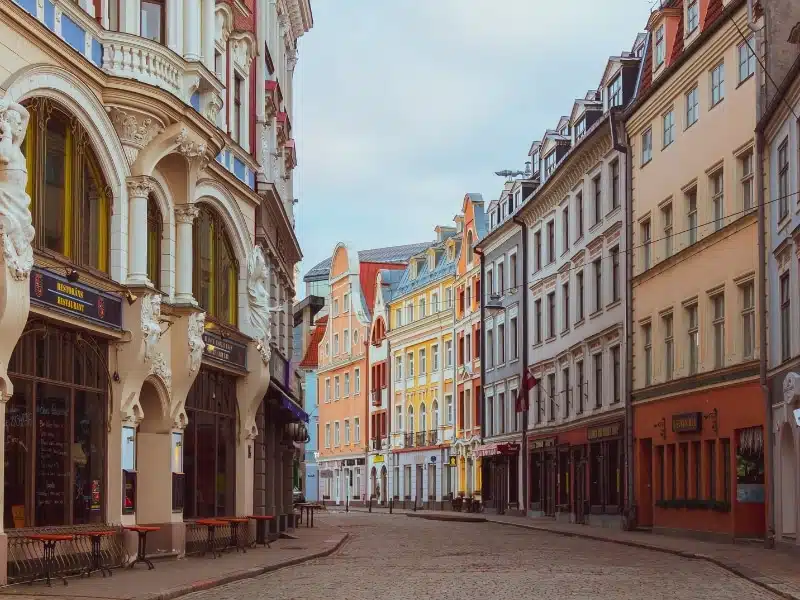
Riga, the capital of Latvia, was founded in 1201 and grew rich as a Hanseatic port on the Daugava. It has two faces: a medieval Old Town of guild halls, merchants' houses and church spires, and a newer centre lined with some of the most elaborate Art Nouveau facades in Europe. Here are the facts and stories that make the city special.
10 curiosità su Riga
- Fondata da un vescovo: il vescovo Alberto di Buxhoeveden fondò Riga nel 1201 come base per le crociate nel Baltico orientale.
- Il primo albero di Natale? Riga sostiene che il primo albero di Natale decorato fu allestito qui nel 1510 dalla Confraternita delle Teste Nere, una gilda di mercanti non sposati. Una targa in Piazza del Municipio indica il punto, anche se Tallinn rivendica lo stesso primato.
- Una sede di gilda ricostruita da zero: la Casa delle Teste Nere, in Piazza del Municipio, risale al 1334. Fu ridotta in macerie dai bombardamenti nel 1941 e le autorità sovietiche ne fecero rimuovere i resti nel 1948. L’edificio che vedi oggi è una ricostruzione inaugurata nel 1999.
- Three brothers in a row: the Three Brothers on Mazā Pils iela are three adjoining houses, the oldest from the 15th century. Side by side they show how Riga's homes changed over the centuries, and today they house the Latvian Museum of Architecture.
- Cats with their tails turned: two black cats with arched backs sit on the turrets of the Cat House, built in 1909 on Līvu Square. Legend says the owner, refused entry to the Great Guild, turned the cats' tails towards the guild hall across the street.
- Un mercato negli hangar degli zeppelin: il Mercato centrale di Riga aprì nel 1930 in cinque padiglioni con strutture in acciaio provenienti da hangar tedeschi per zeppelin della Prima guerra mondiale a Vaiņode, nella Lettonia occidentale.
- Roosters on the spires: the main church spires of the Old Town are topped with weathercocks. The spire of St Peter's Church burned in 1941, was rebuilt in steel after the war and now has a lift up to a viewing platform.
- A monument that outlasted the Soviet era: the Freedom Monument was unveiled on 18 November 1935, Latvia's Independence Day. Paid for by public donations, it is 42 metres tall and topped by a copper figure of Liberty, nicknamed Milda, holding up three gold stars.
- Un orologio con un nome di cioccolato: l’orologio Laima, al margine del centro storico, fu completato nel 1924 e dal 1936 porta il nome dell’azienda dolciaria Laima.
- A song festival since 1873: Latvia's first Song Festival was held in Riga in 1873. The Baltic song and dance celebrations are on UNESCO's intangible heritage list, and the festival still brings tens of thousands of singers and dancers to the city.
The legend of 'Is Riga finished?'
Riga's best-known legend comes from the river. Once every hundred years, it says, a spirit rises from the Daugava at night and asks the first person it meets: 'Is Riga finished yet?' If the answer is ever yes, the whole city will sink into the water. So the answer must always be no, and Riga must never stop building.
L’Art Nouveau e il quartiere dei musei
Around 1900 Riga was booming, and roughly a third of the buildings in today's centre went up in the Art Nouveau style. The most theatrical facades, with carved faces and masks, are on Alberta iela, several of them by Mikhail Eisenstein, father of the film director Sergei Eisenstein. Nearby stands the Latvian National Museum of Art, built in 1903–1905 as the first purpose-built museum in the Baltics.
Cosa mangiare a Riga
- Piselli grigi con pancetta: pelēkie zirņi ar speķi, un piatto sostanzioso di piselli saltati con pancetta e cipolla, spesso servito con un bicchiere di kefir.
- Pane di segale: il rupjmaize, scuro, compatto e leggermente dolce, accompagna quasi ogni pasto e compare perfino nei dolci, a strati con panna e frutti di bosco.
- Pīrāgi: piccoli panini al forno ripieni di pancetta tritata e cipolla, venduti nei forni e al Mercato centrale.
- Sklandrausis: una piccola crostata aperta di pasta di segale, ripiena di purè di patate e carote dolci, profumata alla cannella.
- Balsamo nero di Riga: un liquore scuro alle erbe la cui ricetta risale al 1752 e al farmacista di Riga Abraham Kunze.
Da sapere prima di partire
- Il Mercato centrale è più animato e più fornito la mattina.
- Jūrmala's long sandy beach is a short train ride from Riga, an easy half-day trip in summer.
- For a view over the Old Town's roofs and the Daugava, take the lift up the tower of St Peter's Church.
- Midsummer, Jāņi, on 23 and 24 June, is Latvia's biggest holiday. Many people leave the city, and some shops and restaurants close.
Scopri Riga con World City Trail
La nostra caccia al tesoro a Riga trasforma questi luoghi in un gioco sul tuo telefono. Il percorso collega 10 tappe e dura circa tre ore, con una quarantina di minuti a piedi, tra cui il Museo nazionale d’arte lettone, il Monumento alla Libertà e l’orologio Laima.
A ogni tappa risolvi un enigma e ascolti una breve storia, al tuo ritmo. Puoi iniziare quando vuoi.
Gioca alla caccia al tesoro di Riga →
Fatti verificati a ottobre 2026.